The Digital Revolution, Education, and the Changing Workplace
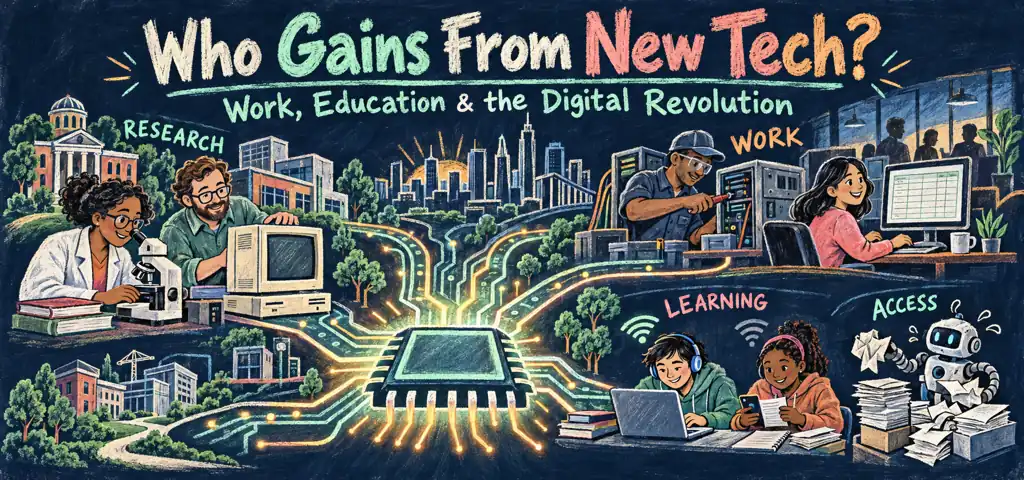
Chapter 16 of the CLEP History of the United States II study guide on Effortless Math covers The Digital Revolution, Education, and the Changing Workplace: the key terms, the core ideas, and worked examples showing how this topic is tested on the exam.
CLEP History of the United States II, Chapter 16
Federal research helped build a private digital economy
Defense research supported semiconductors, computing, and ARPANET; the National Science Foundation expanded networking, and universities trained engineers and programmers. Private firms commercialized personal computers, software, and online services. The story is not government invention versus private invention. Public funding absorbed early risk, academic networks developed knowledge, and firms designed mass markets.
Personal computing moved capacity to homes and offices
Microprocessors reduced cost and size. Apple, IBM-compatible machines, Microsoft software, and other firms made computing a workplace and household tool. Spreadsheets, databases, word processing, and computer-aided design changed tasks rather than simply eliminating them. Productivity gains often required reorganizing work, training employees, and connecting systems.
The internet changed distribution and coordination
Commercial access expanded in the 1990s, the World Wide Web simplified publishing and navigation, and search engines organized information. Email and networks reduced communication costs; e-commerce altered retail and logistics. Early optimism about decentralized access coexisted with new concentration in platforms, infrastructure, data, and advertising. A network can widen entry while rewarding firms that control scale.
Automation changed occupations unevenly
Routine clerical and production tasks were easier to automate or move abroad than many interpersonal, analytic, repair, and care tasks. Technology could complement skilled workers while substituting for others. The result was polarization: growth in high-skill professional and lower-paid service work alongside pressure on many middle-skill jobs. Counting total employment alone can hide occupational displacement.
The jobless recoveries altered expectations
After the 1990-1991 recession, output recovered before payroll employment strengthened; later recoveries showed similar lag. Restructuring, productivity, cautious hiring, and global competition contributed. A jobless recovery does not mean no jobs ever return. It means standard economic growth resumed without the rapid employment rebound workers expected from earlier cycles.
The 2001 recession began with an investment collapse
Telecommunications firms borrowed heavily after 1996 to build fiber-optic networks ahead of demand, while technology share prices peaked in March 2000. When the bubble broke, businesses sharply reduced spending on computers, communications equipment, software, and networks. Households kept spending and residential construction remained comparatively strong. The recession from March to November 2001 was mild in total output but severe for technology investment and employment. It differed from the housing and banking collapse that began later in the decade.
Education policy linked national risk to standards
The 1983 report A Nation at Risk warned of weak academic performance and intensified standards reform. States raised graduation requirements and testing. The federal government had created a cabinet-level Department of Education in 1979, but most school governance remained state and local. National concern did not equal national operation of schools.
No Child Left Behind expanded federal accountability
The 2001 law required annual testing, subgroup reporting, and progress targets as conditions of federal aid. Supporters valued attention to achievement gaps; critics attacked unrealistic targets, test narrowing, sanctions, and uneven capacity. It differed from the 1965 education law's original focus on aid to disadvantaged students by attaching a more elaborate accountability system.
College became more important and more expensive
A wage premium for degrees grew while tuition and borrowing rose. Community colleges, for-profit schools, online education, employer training, and certification offered varied routes. Credential demand could reflect real skill, employer screening, or both. Access without completion or affordable repayment did not guarantee mobility.
Farm households illustrate diversified work
Mechanization and consolidation reduced farm labor, while many farm families depended primarily on off-farm wages and benefits. Rural economies joined agriculture to manufacturing, health care, education, prisons, tourism, and energy. A farm's survival could depend more on a spouse's job and health insurance than on commodity income.
The digital divide changed form as access expanded
Early gaps concerned whether a household had a computer or internet connection. As basic access spread, connection speed, device quality, affordability, technical support, disability access, and the ability to use information became decisive. Schools assigning online work exposed differences between a phone connection and reliable broadband with a full computer. Access statistics therefore require a denominator and a standard: connection alone does not measure equal capacity to learn, apply, create, or work.
Platforms reorganized labor as well as communication
Online marketplaces and app-based firms matched customers with drivers, sellers, designers, and delivery workers. Supporters valued flexible entry and lower transaction costs; workers raised questions about classification, benefits, scheduling, surveillance, and who bore equipment risk. The same software could increase an individual's access to customers while giving the platform power over rankings and terms. Calling this either pure entrepreneurship or ordinary employment skips the contested allocation of control and risk.
Data created a new exchange behind nominally free services
Search, social media, and advertising platforms offered communication and information without a direct price to many users, while collecting behavioral data to target advertisements and rank content. Network effects rewarded services that already had many participants. Privacy disputes concerned consent, security, government access, and whether users understood the bargain. A zero-dollar price does not mean an exchange has no economic value or social cost.
distinguish substitution from complementarity
A new system automates data entry but increases demand for technicians and analysts.
audit an accountability metric
A school raises tested scores while reducing science projects and arts time.
Watch the history in motion
This short lesson adds voices, images, and chronology to the ideas you just studied.
Video: HISTORY OF THE INTERNET, Life Noggin.
Try four CLEP-style questions
- Why is the digital revolution not a purely private-sector story?
- Federal research and university networks helped develop technologies later commercialized by firms.
- Congress financed household-computer design but left software development to state universities.
- Private software firms entered the market only after federal agencies opened the World Wide Web.
- Military networks remained the principal providers after commercial internet access expanded.
- Universities chiefly trained workers after private networks had developed the core technologies.
- What does occupational polarization describe?
- A regional division that concentrates digital jobs in cities and manual jobs in rural areas
- Similar wage and employment growth across occupations after automation
- Growth at high- and low-skill ends alongside pressure on many middle-skill routine jobs
- Declining professional employment accompanied by renewed growth in routine factory work
- Automation of interpersonal services alongside expansion of middle-skill clerical work
- How did No Child Left Behind change federal education policy?
- It redirected Title I aid from low-income students toward state university systems.
- It made federal ownership of school facilities a condition of receiving education funds.
- It established national curricula while leaving testing schedules to local districts.
- It tied testing, subgroup reporting, and progress requirements to federal aid.
- It replaced annual assessments with locally defined reports that did not separate subgroup results.
- Why can farm households survive when farm income is weak?
- Mechanization increases the need for relatives to work full time on smaller farms.
- Commodity-program eligibility restricts farm families from earning wages outside agriculture.
- Off-farm earnings and benefits can support the household and agricultural operation.
- Price-support programs generally keep commodity revenue above household expenses.
- Rural labor markets offer agricultural processing but few health, education, or service jobs.
Check your answers and reasoning
Independent preparation. CLEP is a registered trademark of the College Board, which does not endorse this lesson.

Related to This Article
More math articles
- Number Properties Puzzle -Critical Thinking 4
- GED Testing Accommodations and Support for Students with Disabilities
- Double the Steps, Double the Fun: How to Solve Two-Step Inequalities
- The Best Algebra 1 Book for Missouri Students
- Traffic Control, One-Way Workflow, and Ergonomics
- Expansion of suffrage
- 4th Grade IAR Math FREE Sample Practice Questions
- Theories of Aging
- How to Use Integers to Complete Equations
- The Best ALEKS Math Worksheets: FREE & Printable


















What people say about "The Digital Revolution and the Changing Workplace"?
No one replied yet.