Citizenship, Immigration, Family, and Rights in the Early Twenty-First Century
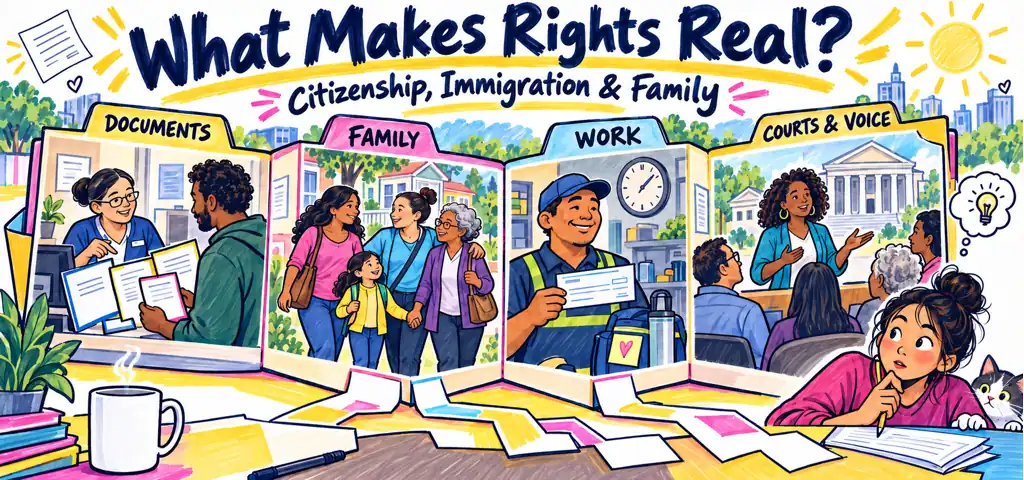
Chapter 16 of the CLEP History of the United States II study guide on Effortless Math covers Citizenship, Immigration, Family, and Rights in the Early Twenty-First Century: the key terms, the core ideas, and worked examples showing how this topic is tested on the exam.
CLEP History of the United States II, Chapter 16
Immigration law accumulated categories across eras
Chinese exclusion targeted Chinese laborers while exempting specified classes; national-origins quotas later favored northern and western Europe; the 1952 law retained quotas while ending racial bars to naturalization; the 1965 law prioritized family and skills while capping hemispheres and later countries. The 1990 act added diversity visas and Temporary Protected Status. Each law changed a different gate.
Post-1965 immigration changed origins and institutions
Migration from Latin America, Asia, Africa, and the Caribbean expanded religious, linguistic, and national diversity. Family sponsorship, employment, refugee policy, unauthorized entry, and earlier communities all mattered. New churches, mosques, temples, businesses, schools, and political organizations transformed metropolitan and rural regions. The process did not repeat the 1880-1924 wave exactly because law, origins, economy, and settlement differed.
Legal status contains several distinct questions
Citizenship, lawful permanent residence, temporary protection, refugee status, visas, and unauthorized presence carry different rights. DACA, announced in 2012, deferred removal and allowed work authorization for some people brought to the country as children; it did not grant citizenship or permanent residence. Confusing nonenforcement, status, and citizenship turns many immigration questions into errors.
Family life changed faster than one ideal
Two-earner households, delayed marriage, cohabitation, divorce, single parenthood, same-sex couples, and multigenerational homes grew in visibility. Paid work did not eliminate unpaid care. The Family and Medical Leave Act provided unpaid leave to eligible workers; lack of universal paid leave and childcare preserved unequal burdens. Family policy distributes time, income, recognition, and risk.
Pregnancy and pay discrimination produced statutory responses
The Pregnancy Discrimination Act treated pregnancy discrimination as sex discrimination in employment. The Lilly Ledbetter Fair Pay Act of 2009 reset the filing period with each discriminatory paycheck, reversing a narrow limitations ruling. Neither statute guaranteed equal wages automatically; workers still needed evidence, enforcement, and a covered legal claim.
Rights expanded through speech, marriage, and violence law
In Texas v. Johnson, the Court protected flag burning as expression. The Violence Against Women Act funded services and criminal-justice measures; the Court later invalidated its federal civil remedy as beyond the commerce and Fourteenth Amendment powers used. Obergefell required marriage equality, altering legal recognition of families across states.
Campaign finance changed after Citizens United
The Court held that corporations and unions could not be barred from independent political expenditures. It did not authorize direct corporate contributions to candidates or eliminate disclosure automatically. Super PACs could raise unlimited funds for independent spending but could not legally coordinate expenditures with candidates. The distinction between contribution, expenditure, and coordination is decisive.
Voting-rights enforcement lost its coverage formula
Shelby County invalidated the formula identifying jurisdictions subject to preclearance, reasoning that it relied on outdated conditions. Section 2 litigation against discriminatory practices remained, but it operates after enactment and places burdens on challengers. A preventive review system and a reactive lawsuit are not equivalent.
Mass incarceration shaped citizenship and family
Drug enforcement, sentencing, policing, parole, and local economic conditions helped drive imprisonment, with disproportionate effects on Black men and communities after the 1980s. Incarceration affected employment, voting eligibility, housing, and family stability. Crime trends alone do not explain policy intensity; statutes and enforcement decisions mediate the relationship.
Demography and rights remain institutional questions
Foreign-born population shares approached earlier historic levels by 2010, but composition and law differed. Aging, immigration, lower fertility, and regional movement altered schools, work, health systems, and representation. Rights become practical through documents, employers, courts, agencies, ballots, and family law. A demographic trend does not specify the policy response by itself.
Immigration enforcement joined federal power to local institutions
Federal agencies controlled admission and removal, but programs enlisted local police and jails in identifying noncitizens. Supporters argued that cooperation improved enforcement; critics warned that it discouraged crime reporting, magnified profiling, and made local priorities depend on immigration status. Some jurisdictions limited cooperation, prompting federalism disputes. The central distinction is between federal authority over immigration law and the separate question of how much local personnel must or may assist.
California's Proposition 187 tested the boundary of state restriction
California voters approved Proposition 187 in 1994 to deny many public services, including nonemergency health care and public education, to people classified as undocumented and to require verification and reporting. Federal courts blocked its core provisions because immigration regulation is principally federal and because other federal and constitutional rules constrained the state. The initiative did not create a federal deportation system or alter lawful permanent residence, but it became a major symbol of restriction politics.
Marriage equality changed a bundle of legal rules
Marriage status affects taxation, inheritance, hospital access, immigration sponsorship, parental recognition, benefits, and dissolution. Before Obergefell, state variation meant a couple's status could change across borders even after federal recognition expanded. The decision required state licensing and recognition for same-sex couples; it did not settle every dispute involving religious institutions, antidiscrimination rules, or parental law. A precise answer identifies the legal bundle actually at issue.
The COVID-19 pandemic tested divided authority and administrative capacity
The pandemic that reached the United States in 2020 joined a public-health emergency to a sharp recession. Federal agencies managed border rules, vaccine support, monetary policy, and large relief laws, while states and localities exercised much of the authority over schools, businesses, and public-health orders. The CARES Act supplied direct payments, expanded unemployment benefits, loans and grants, health funding, and other emergency support. Outcomes still varied with occupation, housing, health access, age, race, and local capacity. The episode is best analyzed as overlapping federalism, not as the work of one level of government.
The 2020 election tested transfer, certification, and constitutional procedure
Joe Biden defeated Donald Trump in the 2020 presidential election and took office in January 2021. Trump and allies challenged the result, but recounts, state certifications, and court proceedings did not reverse it. On January 6, a mob breached the Capitol while Congress was counting electoral votes. Congress reconvened and certified the result. The House impeached Trump for incitement of insurrection, and the Senate acquitted him after he left office. A careful account separates political claims from the evidence and procedures by which states, courts, Congress, and the vice president performed their distinct roles.
Dobbs changed the constitutional baseline for abortion policy
In 2022, Dobbs v. Jackson Women's Health Organization overruled Roe and Casey and held that the federal Constitution did not itself protect a right to abortion. Regulatory authority shifted back to elected institutions, producing sharply different state rules and renewed disputes over federal legislation, medication, interstate travel, and state constitutions. The decision did not resolve the political conflict; it changed the institution and legal source through which much of that conflict proceeded.
The Biden administration revived an older argument over public direction of markets
Pandemic relief, the 2021 infrastructure law, the CHIPS and Science Act, and the Inflation Reduction Act used spending, loans, procurement, and tax credits to shape recovery, transportation, semiconductor production, energy investment, and supply chains. Supporters described resilience, research, jobs, and climate goals; critics questioned cost, targeting, protection, and administrative choice. These measures did not replace private ownership. They renewed a recurring historical question: when government subsidizes investment, who bears the risk, who receives the gain, and what evidence would show that the policy changed capacity rather than merely rewarding activity that would have occurred anyway?
The 2024 election continued rather than ended the era's political conflict
Donald Trump defeated Kamala Harris in 2024 and returned to office in January 2025 as the forty-seventh president, after having served as the forty-fifth. The result made a nonconsecutive presidential return part of the era's chronology, but an election result alone does not establish a single public mandate on immigration, tariffs, executive power, alliances, or administration. Those claims require separate evidence from votes, statutes, orders, court decisions, implementation, and later outcomes.
classify immigration authority
A person receives renewable work authorization and deferred removal but no green card.
compare preventive and reactive voting enforcement
A jurisdiction once needed approval before a voting rule took effect; now challengers sue afterward.
The Mariel boatlift created a distinct 1980 migration episode
After Cubans crowded into Peru's embassy in Havana, Fidel Castro opened the port of Mariel to departures. About 125,000 people reached Florida by boat between April and October 1980. The Carter administration classified many arrivals with Haitians as Cuban-Haitian entrants. Mariel was not the earlier Freedom Flights and not the 1994 rafter crisis; the port, year, and sea crossing identify it.
Watch the history in motion
This short lesson adds voices, images, and chronology to the ideas you just studied.
Video: The Immigration History of the United States, TDC.
Try four CLEP-style questions
- What did the 1965 immigration law change most directly?
- It replaced national-origins priorities with family- and skill-based categories under numerical limits.
- It extended Chinese labor exclusion while adding exemptions for professional workers.
- It removed country ceilings while retaining separate unlimited hemispheric quotas.
- It converted temporary humanitarian protection into a route to citizenship.
- It reduced family sponsorship in favor of a lottery-centered admissions system.
- What did DACA provide to eligible recipients?
- Refugee status triggered by childhood arrival and proof of educational enrollment
- A direct naturalization process after renewal of work authorization
- Lawful permanent residence granted through participating state agencies
- A diversity visa category outside the regular country ceilings
- Deferred removal and work authorization without citizenship or permanent residence
- What did the Lilly Ledbetter Act change?
- Each discriminatory paycheck could restart the filing period for a pay claim.
- Employers had to use one salary schedule for workers in different occupations.
- Sex-discrimination pay claims shifted from federal courts to administrative arbitration.
- The act replaced Title VII's pay provisions with the Equal Pay Act's job-comparison standard.
- The filing period generally ran only from an employer's initial discriminatory pay decision.
- What was the practical effect of Shelby County?
- The nationwide discrimination ban became unenforceable when the preclearance formula fell.
- Preclearance expanded from covered jurisdictions to states with recent turnout changes.
- The old coverage formula fell, so preclearance stopped unless Congress supplied a new formula.
- Section 2 lawsuits required advance Justice Department approval after the decision.
- Congress retained remedial power but could use it only after a court found intentional discrimination.
Check your answers and reasoning
Independent preparation. CLEP is a registered trademark of the College Board, which does not endorse this lesson.

Related to This Article
More math articles
- Why Prejudice and Conflict Develop
- Ratio, Proportion and Percentages Puzzle -Critical Thinking 9
- 5 Best Praxis Core Math Study Guides
- 5 Hidden Math Concepts Behind Today’s Most Popular Financial Platforms
- The Ultimate ACT Math Formula Cheat Sheet
- The Math Adventure: The Quest for Probability and Predictions
- How to Use Number Lines to Identify Equivalent Fractions?
- How to Find the Axis of Symmetry of Quadratic Functions?
- The Best Grade 2 Math Worksheets for Vermont Students
- Equation of a Line Calculator (Free, with Graph)




















What people say about "Citizenship, Immigration and Rights Since 2000"?
No one replied yet.