Why Prejudice and Conflict Develop
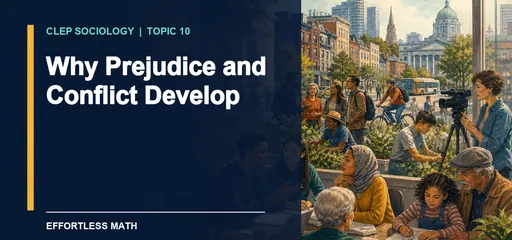
Chapter 10 of the CLEP Sociology study guide on Effortless Math covers Why Prejudice and Conflict Develop: the key terms, the core ideas, and worked examples showing how this topic is tested on the exam.

CLEP Sociology – Chapter 10
Why Prejudice and Conflict Develop
CLEP Introductory Sociology · Chapter 10
The scapegoat hypothesis proposes that people redirect frustration toward a less powerful group that is blamed for problems it did not cause. Conflict approaches examine competition over jobs, housing, political influence, or other resources and ask how dominant groups protect advantages. Symbolic interactionists study how labels and meanings are learned and reinforced in everyday interaction and media.
Social learning matters: families, peers, organizations, and media can teach group boundaries. Yet people interpret and resist messages, so socialization does not make prejudice inevitable.
Realistic group conflict theory predicts hostility when groups perceive that they are competing over scarce resources. The threat may be material, such as jobs or land, or political, such as influence over public decisions. Leaders can intensify conflict by defining another group as responsible for insecurity. The scapegoat mechanism is more specific because frustration is displaced onto a vulnerable target that did not cause the original problem.
Symbolic interaction directs attention to labels, jokes, routine categories, and repeated encounters. Conflict analysis asks who gains from the boundary and who controls institutions. A functionalist account may examine how an out-group boundary increases solidarity among insiders while also producing social costs. The theories can address the same event at different levels.
Contact theory, associated with Gordon Allport, holds that intergroup contact is especially likely to reduce prejudice when participants have equal status in the situation, pursue common goals, cooperate, and receive support from authorities or norms. Mere proximity is not enough. Contact marked by competition and unequal status can reproduce hostility.
Contact effects depend on what participants learn and whether the setting transfers beyond one encounter. Equal-status teammates may revise beliefs about the specific partners yet retain a stereotype about the wider group. Repeated contact across several members, visible counterexamples to the stereotype, and continued institutional support make broader change more plausible. Researchers should measure attitudes before contact, afterward, and in a new setting.
Boundary conditions explain failed contact. Unequal authority can make deference look like confirmation of a stereotype. Competition for one reward can turn familiarity into threat. A short encounter chosen by unusually tolerant volunteers may not generalize to people who avoided the program. Evidence from randomized group assignment, comparable tasks, and follow-up outside the program gives a stronger test than mere co-presence.
Prior conflict can also shape the result. Participants who expect betrayal may need repeated cooperation and credible enforcement before one successful task changes belief. Contact may improve views of a teammate while leaving attitudes toward the larger category unchanged, so both person-specific and group-level outcomes should be measured.
A research design can separate the mechanisms. To test scapegoating, measure frustration before hostility and examine whether blame shifts toward a target unrelated to the original loss. To test conflict theory, trace competition over a valued resource and evidence that actors protect advantage through group boundaries. To test learned meaning, follow labels and interpretations through interaction over time. A cross-sectional prejudice score cannot decide among the three because it records an outcome after the proposed pathways may already have operated.
Negative evidence narrows the explanation. If hostility rises without any preceding loss or frustration, the scapegoat account loses support for that change. If resources become more abundant but leaders continue the same boundary campaign, immediate scarcity is less persuasive, though an established conflict organization may persist. If children express a label they have not heard from family, peers, school, or media, a documented learning path is missing. If a cooperative equal-status program with strong institutional support produces no attitude change, contact theory may need a boundary condition such as prior threat or failure to generalize beyond one teammate.
Researchers should prestate these predictions before seeing the outcome. Measure frustration, perceived competition, label exposure, and contact conditions at the start, then follow attitude and behavior over time. A theory becomes more credible when its proposed cause changes before the outcome and when cases lacking that cause do not change in the same way. One failed prediction does not erase a theory from every setting. It limits the mechanism’s fit to the case and directs attention to the alternative whose expected evidence actually appears.
Quick review: Scapegoating redirects frustration toward a vulnerable target. Conflict theory follows competition and the protection of advantage. Symbolic interaction follows learned labels and meanings. Contact is most likely to reduce prejudice under equal status, cooperation, shared goals, and institutional support.
Watch the chapter connection
Race and Ethnicity gives you a second explanation of the chapter ideas surrounding this lesson. As you watch, pause when the lesson concept appears and explain how the example fits.
Use this lesson for CLEP practice
Write one original example, one close nonexample, and one observation that would help you choose between them. This turns vocabulary recognition into the kind of applied reasoning the exam expects.

Related to This Article
More math articles
- South Dakota SBAC Grade 8 Math Free Worksheets: Printable Standards-Aligned Practice PDFs, Free
- FREE 5th Grade OST Math Practice Test
- Oklahoma OSTP Grade 5 Math: 48 Free Single-Page Printables, One Skill Each, Answer Keys Included
- The Ultimate SAT Math Course (+FREE Worksheets & Tests)
- Improper integrals: Everything A Beginner Needs to Know
- 10 Most Common SIFT Math Questions
- Top 10 6th Grade ACT Aspire Math Practice Questions
- District of Columbia DC CAPE Grade 6 Math Free Worksheets: 72 Free Printable Math Practice PDFs
- Addition of 3-Digit Numbers
- The Ultimate MAP Algebra 1 Course (+FREE Worksheets)


















What people say about "Why Prejudice and Conflict Develop | CLEP Sociology"?
No one replied yet.