How to Calculate Percentages: Formulas + Real-Life Examples
TL;DR: A percent is just a fraction with 100 on the bottom. That is the whole secret. 25 percent equals 0.25 equals one-fourth, all describing the same slice of the whole. From there, four main problems cover almost every percent question you will see: find a percent of a number, find what percent one number is of another, find the whole when you know the percent and the part, and find percent change. Master those four and percents stop being slippery.
Key takeaways:
- Convert the percent to a decimal first: divide by \(100\) or move the decimal two places left.
- Find a percent of a number: multiply. \(20\%\) of \(80 = 0.20 \times 80 = 16\).
- Find what percent: divide, then multiply by \(100\). \(\tfrac{12}{50} = 0.24 = 24\%\).
- Percent change: \(\dfrac{\text{new} – \text{old}}{\text{old}} \times 100\%\).
- Tip shortcut: \(10\%\) = move decimal one place left; \(15\%\) tip = \(10\%\) + half of that.
Percentages show up everywhere, restaurant tips, store sales, test grades, loan interest, news headlines. The good news? Once you understand the one big idea behind a percent, every type of problem looks the same. Here’s how to calculate percentages with confidence.
This guide walks you through the four main percent problems you’ll meet, finding a percent of a number, finding what percent one number is of another, finding the whole when given a part, and percent change. We’ll finish with mental-math shortcuts you can use at restaurants and in stores without reaching for your phone.
The one idea behind every percent
A percent is just a fraction with 100 on the bottom. So 25% means 25 out of 100, which is the same as \(\tfrac{25}{100}\) or $0.25$.
If you can move between “percent → decimal → fraction” comfortably, you can solve any percent problem.
| Percent | Decimal | Fraction |
|---|---|---|
| 1% | 0.01 | 1/100 |
| 10% | 0.10 | 1/10 |
| 25% | 0.25 | 1/4 |
| 50% | 0.50 | 1/2 |
| 75% | 0.75 | 3/4 |
| 100% | 1.00 | 1 |
These six are worth memorizing for life. They open up most mental percent math.
Type 1, Find a percent of a number
“What is 20% of 80?”
Convert the percent to a decimal and multiply:
\(0.20 \times 80 = 16\).
That’s it. 20% of 80 is 16.
Another worked example. What is 35% of 240? \(0.35 \times 240 = 84\).
Type 2, Find what percent one number is of another
“What percent of 50 is 12?”
Divide, then multiply by 100:
\(\dfrac{12}{50} = 0.24 = 24\%\).
Another example. Last month you spent \$520 on groceries; this month you spent \$390. What percent of last month’s bill is this month’s? \(\tfrac{390}{520} = 0.75 = 75\%\). You spent 75% as much.
Type 3, Find the whole when given a percent
“15 is 30% of what number?”
Divide the part by the decimal form of the percent:
\(\dfrac{15}{0.30} = 50\).
Another example. A student got 18 questions right, which was 60% of the test. How many questions total? \(\tfrac{18}{0.60} = 30\) questions.
Type 4, Percent increase and decrease
Formula: \(\text{percent change} = \dfrac{\text{new} – \text{old}}{\text{old}} \times 100\%\).
Example: a shirt goes from \$40 to \$50. \(\dfrac{50-40}{40} \times 100\% = 25\%\) increase.
If the result is negative, it’s a decrease.
Reverse-direction example. A car loses 20% of its value in year one. Year one starts at \$30,000. What is it worth at the end? $0.80 \times 30{,}000 = \\(24{,}000\). (Notice: you’re paying 80% of the original.)
Real-life shortcuts
- 10% of anything: move the decimal point one place left. 10% of 73 = 7.3.
- 1% of anything: move it two places left. 1% of 460 = 4.6.
- 5% of anything: half of 10%. 5% of 73 = 3.65.
- Tip 15%: take 10% + half of that. For \$60, that’s \$6 + \$3 = \$9.
- Tip 20%: double the 10%. For \$60, that’s \$12.
- 20% off: 20% off is the same as paying 80% of the price.
- Sales tax (e.g., 8%): find 10% (move decimal), subtract 1% twice, or add 8% of the price directly.
Compound interest in one line
If something grows or shrinks by a percent repeatedly, multiply.
Example: a \$1000 investment grows 6% per year. After 3 years: $1000 \times 1.06^3 \approx \$1191.02$.
The “1.06” factor is just “100% + 6%” rewritten as a decimal.
Common mistakes
- Forgetting to convert percent to decimal before multiplying (16% is 0.16, not 16).
- Mixing up “percent of” and “percent off.”
- Using the new value as the base when calculating percent change, always use the original.
- Forgetting that a 50% increase followed by a 50% decrease does not return to the original.
- Confusing percentage points with percent. A jump from 8% to 10% is a 2 percentage point increase, but a 25% relative increase.
Quick practice
- A jacket originally costs \$80. It’s marked 35% off. What’s the sale price? *Answer:* Discount = \$28. Sale price = \$52.
- 42 is what percent of 70? Answer: 60%.
- 18 is 24% of what number? Answer: 75.
- A house grew in value from \$240,000 to \$282,000. What is the percent increase? Answer: 17.5%.
- If you tip 20% on a \$56 dinner bill, what’s the total? *Answer:* \$67.20.
- A laptop is on sale for 25% off and then another 10% off at checkout. If the original price is \$800, what is the final price? *Answer:* $800 \times 0.75 \times 0.90 = \$540$.
- A student scored 85% on a 60-question test. How many questions did she get right? Answer: 51.
- After a 30% raise, an hourly wage is now \$26 per hour. What was the original wage? *Answer:* \$20.
Reverse percents: working backward from a final amount
Reverse percents catch a lot of students off guard because the “base” is the original value, not the final value you’re looking at.
Example. A coat costs \$84 after a 30% discount. What was the original price?
The sale price represents 70% of the original. So: $\dfrac{84}{0.70} = \$120$ original price.
Another example. A house’s value rose 15% to \$345{,}000. What was the original?
The new value is 115% of the original. So: $\dfrac{345000}{1.15} = \$300{,}000$ original.
When the problem says “after a 25% discount,” divide by 0.75. When it says “after a 25% increase,” divide by 1.25.
Percents on standardized tests
The SAT, ACT, GED, and TEAS all feature percent problems. The most common traps:
- Compound discounts. “30% off, then 20% off” is not the same as 50% off. It’s \(0.80 \times 0.70 = 56\%\) of the original (a 44% total discount).
- Percent points vs. Percent change. A jump from 4% to 6% interest is a 2-percentage-point rise, but a 50% relative increase.
- Sales tax on a discount. Always discount first, then add tax. That’s how stores actually do it.
Practicing 10 to 15 percent word problems before test day is one of the single highest-yield study activities you can do.
Mental-math toolbox
- Switch the percent and the number. 18% of 50 is the same as 50% of 18 = 9. (Commutative property!) This trick works every time and saves real time.
- Use “of” = multiply. Whenever you see “percent of,” multiply.
- Round, then adjust. 19% of 80 ≈ 20% of 80 = 16. Then subtract 1% of 80 (which is 0.8) → 15.2.
These tricks let you do percent math at the register, at the restaurant, and on the SAT without a calculator.
FAQ
How do I convert a percent to a decimal?
Drop the % sign and divide by 100 (or move the decimal two places left). 47% = 0.47.
What’s the formula for percent change?
\(\dfrac{\text{new}-\text{old}}{\text{old}} \times 100\%\).
How do I calculate a tip without a calculator?
Find 10% (move the decimal left), then add half of that for 15%, or double it for 20%.
Why is percent change calculated using the original value?
Because the original value is the reference point. It’s what changed.
Are percents on the GED, ACT, and SAT?
Yes, frequently. Percent problems are among the highest-yield topics on every standardized test.
Why doesn’t a 20% increase plus a 20% decrease equal the original?
Because the base changes. A 20% increase grows the base; the 20% decrease then comes off a larger number, so you end up at 96% of the original.
What’s the difference between “X percent more” and “X percent of”?
“More” means added on top. “Of” means the result. “20% more than 80” = 96; “20% of 80” = 16.
How do I convert a fraction directly to a percent?
Divide the numerator by the denominator, then multiply by 100. \(\tfrac{3}{8} = 0.375 = 37.5\%\).
Why is the percent symbol “%”?
It comes from the Italian per cento (“per hundred”). The two zeros in the symbol are a nod to the “100” in that phrase. So “45%” literally means “45 per 100”, a fraction with a hidden denominator of 100.
What’s the difference between a percent and a percentile?
A percent is a part of a whole (“30% of students passed”). A percentile ranks you in a distribution (“you scored in the 80th percentile” means you outranked 80% of test-takers). They look alike but mean different things.
How can I quickly estimate a percent in my head?
Learn the 10% trick: divide by 10. Once you have 10%, you can scale up or down. 30% = 3 × 10%. 5% = half of 10%. 15% = 10% + 5%. With these three building blocks you can estimate any percent within a few seconds.
Brush up with our 6th-grade math worksheets or, if you’re prepping for the GED, our GED Math books cover percents in depth.
Recommended EffortlessMath Books
For a pre-algebra workbook that builds percent into a full year of work, Pre-Algebra for Beginners covers percent, ratio, and proportion with worked examples. For real-world word-problem practice, Mastering Grade 7 Math Word Problems includes tax, tip, discount, and percent-change problems with answer keys.
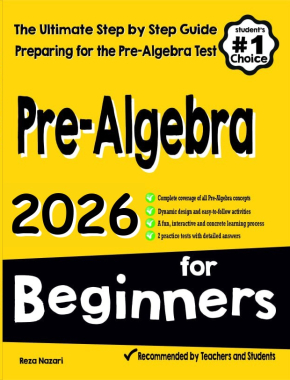
Pre-Algebra for Beginners 2026 The Ultimate Step by Step Guide to Preparing for the Pre-Algebra Test
Frequently Asked Questions
What is a percent in plain English?
A percent is just a fraction out of \(100\). \(25\%\) means \(25\) out of \(100\), which is \(\tfrac{25}{100} = 0.25 = \tfrac{1}{4}\). Percents, decimals, and fractions are three ways of writing the same number.
How do I find a percent of a number?
Convert and multiply. \(35\%\) of \(240 = 0.35 \times 240 = 84\). For a quick mental check: \(10\%\) of \(240\) is \(24\), so \(35\%\) should be three-and-a-half times that, or about \(84\). Matches.
How do I find what percent one number is of another?
Divide and multiply by \(100\). “What percent of \(50\) is \(12\)?”, \(\tfrac{12}{50} = 0.24 = 24\%\). Order matters: the part goes on top, the whole goes on the bottom.
How do I find the whole when I know the percent and the part?
Divide the part by the percent as a decimal. “\(15\) is \(30\%\) of what?”, \(\tfrac{15}{0.30} = 50\). “A student got \(18\) right, which was \(60\%\) of the test”, total questions \(= \tfrac{18}{0.60} = 30\).
How do I calculate a tip in my head?
\(10\%\): move the decimal one place left. On \(\$60\), that’s \(\$6\). \(20\%\): double the \(10\%\), \(\$12\). \(15\%\): \(10\%\) plus half of that, \(\$6 + \$3 = \$9\). \(18\%\): \(10\%\) + \(5\%\) + \(3\%\) is close enough.
How do I find a percent discount?
A \(20\%\) off means you pay \(80\%\) of the price. \(0.80 \times \$50 = \$40\). Or compute the discount first: \(0.20 \times \$50 = \$10\), then \(\$50 – \$10 = \$40\). Same answer, two paths.
What’s percent change?
\(\dfrac{\text{new}-\text{old}}{\text{old}} \times 100\%\). Positive means increase, negative means decrease. Always use the OLD value as the base, not the new value.
Does a \(50\%\) increase followed by a \(50\%\) decrease return to the original?
No. \(\$100 \rightarrow +50\% \rightarrow \$150 \rightarrow -50\% \rightarrow \$75\). You end up below the start because the second percent is taken from a bigger number. Percent changes don’t simply cancel.
What’s the difference between “percent” and “percentage points”?
If an interest rate jumps from \(8\%\) to \(10\%\), that’s a \(2\) percentage-point increase OR a \(25\%\) relative increase (\(\tfrac{10-8}{8} = 0.25\)). News stories often mix these up; reading the wording carefully matters.
How do I compute compound growth?
Multiply by \(1 + r\) each period, where \(r\) is the rate as a decimal. \(\$1000\) at \(6\%\) per year for \(3\) years: \(1000 \times 1.06^3 \approx \$1191.02\). For decay, use \(1 – r\), a car that loses \(20\%\) yearly: \(\$30{,}000 \times 0.80 = \$24{,}000\) after year one.
Related EffortlessMath Lessons
If a topic on this page feels rusty, these short lessons go deeper:
- How to find percentage of numbers (resource currently unavailable)
- How to solve percent change (resource currently unavailable)
- Percent word problems and percent equations
- How to convert fractions to decimals
- How to calculate discount, tax, and tip

Related to This Article
More math articles
- Best Cheap Laptops for College Students
- Overview of the ISEE Middle-Level Mathematics Test
- Paroli (Reverse Martingale): The Math of Riding Streaks
- Free Grade 4 English Worksheets for South Dakota Students
- Free Grade 3 English Worksheets for Louisiana Students
- 3rd Grade Common Core Math Practice Test Questions
- Free Grade 5 English Worksheets for Ohio Students
- Whips
- AI Homework Helpers vs. Real Math Practice: What Actually Works in 2026
- Free Grade 5 English Worksheets for Georgia Students




What people say about "How to Calculate Percentages"?
No one replied yet.