Why the Articles of Confederation Failed
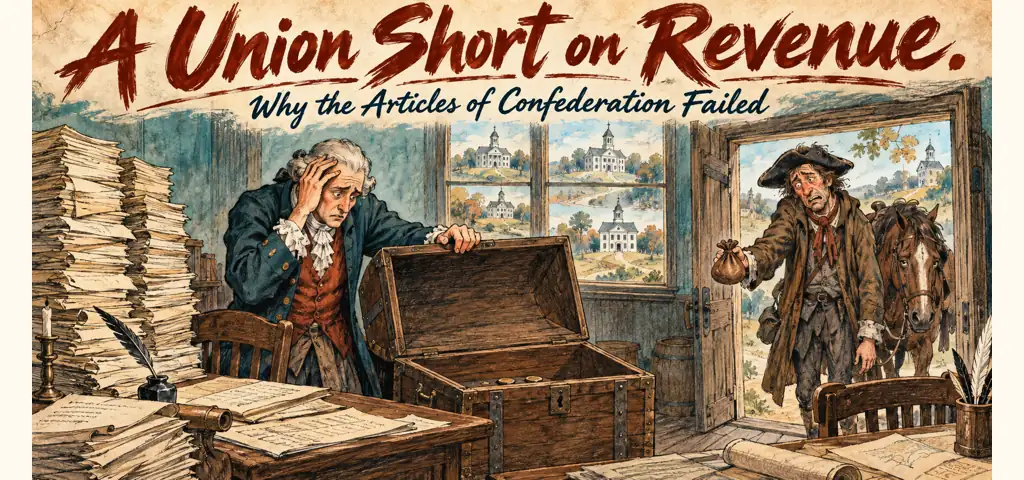
Revenue exposed the Confederation’s central implementation problem. Congress could determine national expenses and assign each state’s share under the formula in Article VIII, but state legislatures laid and collected the taxes. National officials could not impose a general federal tax directly on individuals. A requisition was therefore a lawful demand within the Confederation system, not merely a casual request, yet Congress lacked an effective way to collect the full amount when a state delayed or refused. Borrowing covered some immediate needs but created principal and interest that eventually required revenue. Incomplete payments weakened public credit, complicated military planning, and made national commitments less credible.
Administrative and judicial capacity was similarly uneven. Congress appointed officers and created boards or departments for finance, war, and foreign affairs, but the Articles established no separate national executive branch charged with continuous execution of federal law. Specialized courts and interstate-dispute panels existed, but there was no general federal judiciary with jurisdiction over national law and treaties. Congress could make a decision and still depend on state institutions to translate it into action. The problem was not the total absence of administrators or tribunals. It was the absence of a durable national system able to act uniformly when states interpreted obligations differently or declined to cooperate.
A closer look at why the articles of confederation failed
Diplomacy revealed the consequences. Congress could enter treaties, but treaty performance could require states to change laws, respect creditor rights, return property, or supply money. Congress could protest noncompliance without possessing the later Constitution’s supremacy rule, executive machinery, and general federal courts. Foreign governments could doubt whether a national promise would be honored throughout the union. Financial and diplomatic weakness thus reinforced one another: uncertain revenue reduced national use, while inconsistent state compliance made national bargaining less dependable.
Why the Articles of Confederation Failed: what the rule leaves unsettled
High voting thresholds made repair difficult. Nine states had to approve specified major decisions, and every state legislature had to confirm an amendment. Proposals to give Congress a limited impost or other dependable revenue source failed despite substantial support because unanimity was not achieved. Keep each weakness tied to its mechanism. Unpaid quotas point to dependence on state taxation. Uneven execution points to limited executive and judicial machinery. Stalled major action can point to the nine-state rule. Failed structural reform points to unanimity. The Articles did not make every national act impossible, but they made sustained action least reliable when state interests diverged and cooperation mattered most.
Check your understanding of why the articles of confederation failed
For Weaknesses of the national government, ask what the Confederation Congress could request and what it could actually compel states or individuals to do. Give one concrete example. A precise response says: Congress could not tax individuals directly, regulate interstate commerce, or reliably compel states to comply. Amendments required unanimity and major measures required nine states, making collective action and institutional reform unusually difficult. Under the Articles, states retained every power not expressly delegated to the Confederation.
Video lesson: Why the Articles of Confederation Failed
Heimler's History gives a focused explanation of this topic in The ARTICLES of CONFEDERATION, Explained [AP Government Foundational Documents].
If the player does not load, watch this lesson directly on YouTube.
Connect this lesson to the larger course
For a broader map connecting why the articles of confederation failed to founding ideals, the Constitution, and federalism, use the AP U.S. Government and Politics learning hub.

Related to This Article
More math articles
- How to Perform Scalar Multiplication
- Ohio OST Grade 6 Math Free Worksheets: Printable Practice Worksheets with Step-by-Step Keys
- CLEP U.S. History I 109: Sharecropping, Courts, Northern Retreat, and 1877
- Full-Length 6th Grade GMAS Math Practice Test-Answers and Explanations
- 5 Real-Life Ways Math Helps You Make Smarter Financial Decisions
- Long Division by One Digit for 4th Grade
- Bill introduction
- The Best Grade 8 ELA Practice Tests for Rhode Island Students
- How to Find the Slope of a Line: A Complete Step-by-Step Guide
- Illinois Grade 2 Math Worksheets — Free Printable PDFs





















What people say about "Why the Articles of Confederation Failed"?
No one replied yet.