Federal and State Powers in the United States
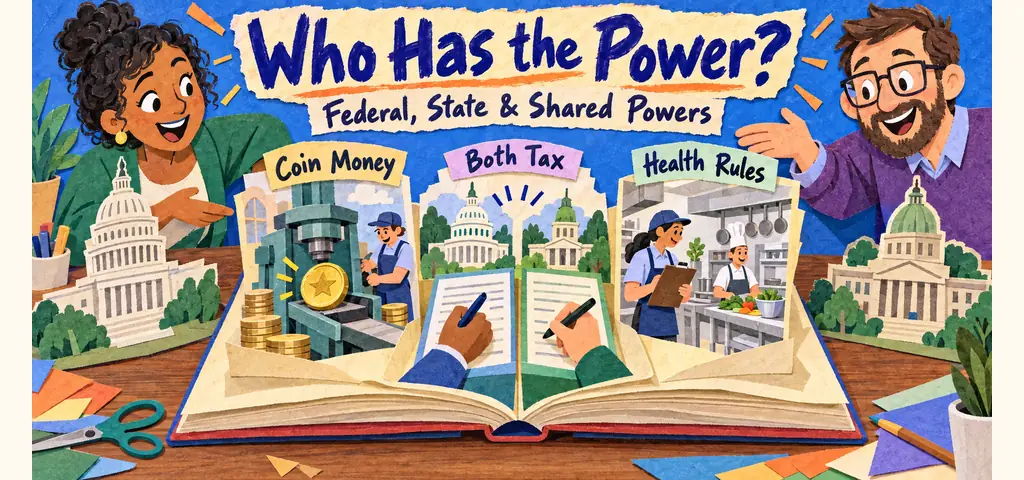
Expressed powers appear in constitutional text. Implied powers are appropriate means for executing granted authority. Inherent powers arise from national sovereignty. Reserved powers remain with states. Concurrent powers are exercised by both levels.
The categories answer different questions. “Expressed” identifies the textual source, “implied” describes a means of executing granted authority, and “reserved” identifies power left outside the federal grant. “Concurrent” describes overlap, not a separate constitutional source. Taxation can be concurrent even though each level taxes under its own authority.
Federal and State Powers in the United States: the working rule
Start with the actor and action. Congress must connect regulation to an enumerated power. A state ordinarily relies on its general police power. If both rules are valid, ask whether compliance with both is possible or federal law displaces the state rule. The Tenth Amendment does not reverse the Supremacy Clause.
Federal and State Powers in the United States: limits and hard cases
A useful answer names one category and explains why it fits. Congress coining money is expressed. Creating a national bank to carry fiscal powers into execution is implied. State health regulation is generally reserved. And both levels may levy taxes. Do not treat “federal” as proof of supremacy until federal authority is established.
A new case involving federal and state powers in the united states
Classify a federal tax, a state licensing rule, and a power both levels exercise. Then explain when supremacy or preemption would matter.
Check your reasoning
Expressed powers appear in constitutional text. Implied powers are useful means for executing granted authority. Inherent powers arise from national sovereignty. Reserved powers remain with states. Concurrent powers are exercised by both levels. Valid federal Constitution, statutes, and treaties are supreme over conflicting state law.
Video lesson: Federal and State Powers in the United States
CrashCourse gives a focused explanation of this topic in Federalism: Crash Course Government and Politics #4.
If the player does not load, watch this lesson directly on YouTube.
Connect this lesson to the larger course
For a broader map connecting federal and state powers in the united states to founding ideals, the Constitution, and federalism, use the AP U.S. Government and Politics learning hub.

Related to This Article
More math articles
- The Best Grade 2 Math Worksheets for New Hampshire Students
- How Do You Simplify √45?
- Using Number Lines to Represent Fractions
- Advanced Vocabulary Words: Ostracize to Potable
- Public-relations campaigns
- Free Grade 8 English Worksheets for North Carolina Students
- How long is the SAT Test?
- Chapter 41: Political Behavior and Data Analysis
- Top 10 HSPT Math Prep Books (Our 2023 Favorite Picks)
- Manage both timed sections without rushing






















What people say about "Federal and State Powers in the United States"?
No one replied yet.