Congressional Powers: Taxes, Spending and Appropriations
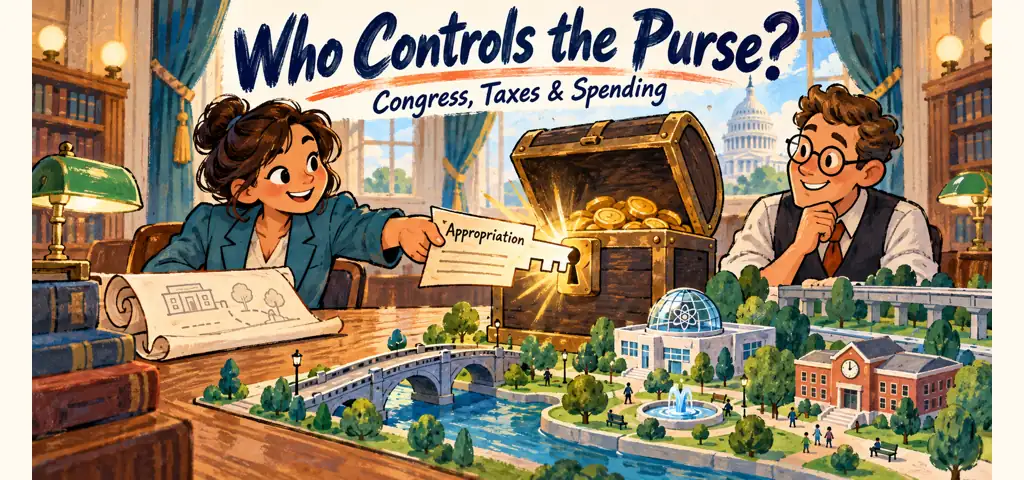
Congressional powers over taxes and spending include control of the public purse. Separate a program’s authorization, the budget authority available for it, an agency’s commitment to pay and the eventual payment. Announcing a program or proposing a budget does not by itself supply the legal funding authority.
Connect Taxing and Spending to the Power of the Purse
Congress may tax and spend for the general welfare. Appropriations determine whether money may be drawn from the Treasury, giving Congress leverage over programs and executive action.
Recognize That Spending Power Has Constitutional Limits
The taxing power raises national revenue, while the spending power permits Congress to fund programs serving the general welfare. Spending may reach objectives beyond direct federal regulation by offering funds on conditions, but those conditions must remain constitutionally permissible and cannot become a disguised unlimited police power.
Distinguish Authorization from Appropriation
The Appropriations Clause makes enacted legislative authority necessary before money is drawn from the Treasury. An authorization can create a program or set a maximum, yet an agency may still need an appropriation before obligating funds. Conversely, appropriations language can limit how available money is used.
Separate Revenue, Program Authority and Funding
Follow three separate decisions: how revenue is raised, what program is authorized, and what funding is legally provided. The president proposes and executes within law. Congress legislates taxes and appropriations through bicameralism and presentment. Neither a committee plan nor a presidential budget alone moves Treasury funds.
Read the Funding Language, Not Just the Program Name
Article I, Sections 8 and 9 supply the taxing-and-spending language and the rule that Treasury withdrawals require appropriations made by law. These provisions explain why the funding question remains distinct from an administration’s policy preference.
The Senate Appropriations Committee’s budget-process guide distinguishes authorizations of future appropriations from laws that provide direct spending. Some authorizing laws themselves supply budget authority. Do not assume every program needs a separate annual appropriation, or that the word “authorization” always answers whether money is available.
CBO’s guide to common budget terms separates budget authority, obligations and outlays. Budget authority permits financial commitments under law; an obligation is the commitment, and an outlay is the payment that settles it. A proposed budget, a program’s authorization ceiling and money actually paid are different things. Use the enacted law and its funding terms to classify a specific case.
Check Whether a Program Has Funding Authority
In a hypothetical program, an enacted law permits a new research grant program and authorizes future appropriations. It does not provide funding directly, no appropriation has been enacted for the program, and no other budget authority is available. May an agency promise grants just because the program is authorized?
Check your reasoning
No. On the stated facts, the law authorizes future appropriations but provides no budget authority, and no other funding source is available. The agency cannot treat the authorization alone as permission to make the grant commitments. This answer depends on those assumptions: some authorizing laws supply funding directly, so inspect the actual language rather than generalizing from the label.
Congress may tax and spend for the general welfare. Appropriations determine whether money may be drawn from the Treasury, giving Congress leverage over programs and executive action. The Commerce Clause authorizes regulation of interstate and foreign commerce and some activities substantially connected to it.
Try Three Congressional Funding Questions
Choose one answer, then check your reasoning. These are short learning checks, not an exam score. If the controls are unavailable, the explanations remain readable below each question.
Answer D. The hypothetical expressly withholds any available budget authority. Authorization of future appropriations alone does not provide it. Other laws can fund programs directly, so the wording and facts matter.
Answer B. These terms describe different stages: legal authority, a financial commitment and payment to settle that commitment. Amounts and timing can differ.
Answer A. Direct or mandatory funding can be provided in authorizing legislation. That exception does not remove the need for legal budget authority; it changes where that authority is found.
Video Lesson: Congressional Structures and Powers
Heimler's History gives a focused explanation of this topic in Structures, Powers, and Functions of CONGRESS [AP Gov Review, Unit 2 Topic 2].
If the player does not load, watch this lesson directly on YouTube.
Connect these funding choices to congressional oversight of agencies and the legal basis for executive orders.
Continue Studying Congress and Executive Action

Related to This Article
More math articles
- 6th Grade DCAS Math Worksheets: FREE & Printable
- Number Properties Puzzle – Challenge 11
- Full-Length 7th Grade PARCC Math Practice Test
- The Best Pre-Algebra Book to Build a Rock-Solid Foundation
- A Comprehensive Collection of FREE ACT Math Practice Tests
- The Best Grade 5 Math Book for Louisiana Students
- The Second New Deal, Social Security, and the Federal Safety Net
- 7th Grade MCAS Math Practice Test Questions
- Cleaning Tools, Chemicals, Dilution, and IFUs
- Minnesota MCA Grade 8 Math Free Worksheets: Printable Grade 8 Math Practice You Can Download Free











What people say about "Congressional Powers: Taxes, Spending and Appropriations"?
No one replied yet.