Free Grade 3 English Worksheets for ACT Aspire
If your third grader is taking ACT Aspire, you’re in a less-common situation than most parents on free-worksheet sites. ACT Aspire isn’t a state-mandated assessment for most kids in the U.S. It’s used by a smaller mix of districts, some private and parochial schools, and families whose schools want an earlier readiness check that ties back to the eventual ACT in high school. So if you’ve landed here, it’s probably because your school sends Aspire scores home each spring, or because you’re a homeschool family using Aspire as a benchmark, or because your kid is in an academically focused environment that takes early college-readiness signals seriously.
The good news is that ACT Aspire’s Grade 3 ELA portion isn’t measuring some exotic skill set. It’s looking at the same fundamental reading and writing work that any thoughtful Grade 3 ELA classroom teaches: comprehension, vocabulary in context, grammar in real sentences, and writing that makes a point and supports it. The worksheets on this page practice those skills directly, one at a time, in short focused PDFs you can print and use tonight.
Everything is free. No login, no email capture. Click a title, the PDF opens, print it, hand it over. Pass it on to a tutor or a friend whose kid is in the same class. That’s all welcome.
A little context on ACT Aspire
ACT Aspire is built on the ACT College and Career Readiness Standards, which are CCSS-aligned at the elementary grades. The Grade 3 ELA test mixes reading passages with multiple-choice and short constructed responses, plus a writing prompt. It’s designed to give a longitudinal readiness signal, the same family of skills measured in Grade 3 will show up again in Grade 4, in Grade 8, and ultimately on the ACT in high school. That’s part of why some schools use it: continuity across grades.
This page won’t pretend it’s a state test (it isn’t), and it won’t sell you “Aspire-specific” tricks. There aren’t any. What there *are* are clear underlying skills, and the worksheets below cover them.
What’s in here
These worksheets cover the Grade 3 English Language Arts skills that ACT Aspire draws on: reading literature, reading nonfiction, foundational reading work, three writing modes, listening and speaking, grammar, conventions, and vocabulary. Each sheet stays in one lane, one skill, one short passage where relevant, one set of practice items, one answer key with real explanations.
A focused fifteen-minute session usually gets more done than a forty-minute slog. That’s the design principle behind every worksheet here.
Reading: Literature
- Text Evidence in Stories, find proof in the story for what you say about it
- Central Message, Lesson, or Moral, figure out the lesson a story teaches
- Describing Characters in a Story, traits, feelings, motivations
- Literal and Nonliteral Language, the difference between what words say and what they mean
- Parts of Stories, Dramas, and Poems, chapters, scenes, stanzas
- Point of View in Stories, who’s telling the story
- Illustrations in Stories, reading the pictures alongside the words
- Comparing Stories, two stories side by side
Reading: Nonfiction
- Text Evidence in Nonfiction, back up answers with the article itself
- Main Idea and Key Details, what the passage is mostly about, and the facts that support it
- Sequence, Steps, and Cause & Effect, first, next, because, so
- Vocabulary in Nonfiction, the topic-specific words in science and social-studies texts
- Text Features in Nonfiction, headings, sidebars, captions
- Author’s Point of View in Nonfiction, what the writer thinks vs. Plain facts
- Using Maps, Photos, and Diagrams, the picture is doing some of the work
- Logical Connections in Nonfiction, how paragraphs connect
- Comparing Two Texts on the Same Topic, two articles, same topic, different angles
Foundational Reading Skills
- Prefixes and Suffixes, word parts that change meaning
- Words with Latin Suffixes, -tion, -sion, -able
- Decoding Multisyllable Words, break the long ones into pieces
- Irregularly Spelled Words (Sight Words), the tricky words that just have to be memorized
- Reading Fluency: Rate and Expression, read aloud so it sounds like talking
- Self-Correcting While You Read, fix it when the sentence stops making sense
Writing
- Opinion Writing, say what you think and back it up
- Informative/Explanatory Writing, teach someone something they didn’t know
- Narrative Writing, tell a story in order, with details
- Organizing Writing for Task and Purpose, different writing for different jobs
- Editing and Revising, make a draft better, one pass at a time
- Short Research Project, ask a question, find some answers
- Gathering Information and Taking Notes, write down what you find, not everything you see
Listening and Speaking
- Listening for Main Idea (Read-Aloud), what was that mostly about?
- Asking Questions of a Speaker, what to ask after a presentation
- Reporting on a Topic, telling a class about something, clearly
Grammar
- Parts of Speech, nouns, pronouns, verbs, adjectives, adverbs
- Regular and Irregular Plural Nouns, tables; geese; children
- Abstract Nouns, words for ideas and feelings
- Regular and Irregular Verbs, walked vs. Went
- Simple Verb Tenses, past, present, future
- Subject, Verb and Pronoun, Antecedent Agreement, the dog barks; the dogs bark
- Comparative and Superlative Adjectives and Adverbs, fast, faster, fastest
- Coordinating and Subordinating Conjunctions, and, but, because, when
- Simple, Compound, and Complex Sentences, all three sentence types
Capitalization, Punctuation, and Spelling
- Capitalizing Words in Titles, title-case rules
- Commas in Addresses and Dates, where the commas go
- Commas and Quotation Marks in Dialogue, punctuating what characters say
- Possessives, showing that something belongs
- Conventional Spelling, common words you’ll spell often
- Spelling Patterns and Generalizations, the rules behind the spellings
- Using Reference Materials to Check Spelling, look it up to confirm
Vocabulary and Word Study
- Word Choice for Effect, pick vivid words for a stronger sentence
- Spoken vs. Written English, casual vs. Formal
- Context Clues, use surrounding words to find meaning
- Affixes for Vocabulary, use word parts to figure out meaning
- Root Words, the base word inside a longer one
- Using Glossaries and Beginning Dictionaries, look up words to confirm meaning
- Figurative Language: Similes, Metaphors, and Idioms, read figurative phrases with confidence
- Real-Life Word Connections, connect words to real situations
- Shades of Meaning, tell apart words with similar meanings
- Academic and Domain-Specific Vocabulary, Grade 3 academic words
How to actually use these, without overdoing it
A note that’s especially relevant for the Aspire-using crowd, which tends to skew toward families and schools where there’s already plenty of motivation and a real risk of overpreparing:
Don’t add hours. Add quality. If your kid is already doing two hours of reading and writing at school each day, piling another forty-minute worksheet block on a Tuesday night won’t make them stronger. It’ll make them resentful. Ten focused minutes, twice a week, plus a real conversation, beats heroic sessions.
Read the Quick Review out loud. That little teaching box at the top is the lesson. Skipping it is the most common parent error on free worksheets. Don’t.
Use the answer key as a teaching tool. Each explanation is written so a third grader can follow it. When something is wrong, read the explanation together, then have your kid redo the problem in their own words. That redo with fresh information is where the actual learning sticks.
Don’t drill the same sheet again the next day. If a worksheet went badly, set it aside. Five or six days later, pick a *different* worksheet on the same skill. The space matters.
A word on the test itself
ACT Aspire at Grade 3 measures reading and the conventions of writing. There’s a writing portion that asks for short, organized responses. Multiple-choice items make up the bulk of the rest. The format is fully online for most schools using the digital version.
What ACT Aspire rewards is exactly what good Grade 3 ELA teaches all year: careful reading, vocabulary worked out from context, sentences that hold together, and writing that makes a clear point. The two highest-use worksheets to start with are Main Idea and Key Details and Context Clues. After those, Editing and Revising is a quietly important one, Aspire’s writing components reward kids who can recognize and fix problems in a draft, not just produce a draft.
Questions Aspire families ask
Is ACT Aspire harder than state tests? Not really. It just maps to a longitudinal college-readiness scale rather than a state-specific cut score. The Grade 3 reading load is comparable to most CCSS-aligned tests.
My child got “below the readiness benchmark” on Aspire last year. Should we panic? No. Aspire’s benchmarks are calibrated to long-range college readiness, so “below” at Grade 3 doesn’t mean what “below” means on a state proficiency test. Focus on the underlying reading skills your kid actually needs, Main Idea, Context Clues, and Decoding Multisyllable Words, and check in next year.
My child is reading well above grade level. What stretches them? Comparing Two Texts on the Same Topic and Author’s Point of View in Nonfiction. Both ask strong readers to do real comparative thinking, not just decode harder words.
Are these worksheets enough on their own? Not really. Reading actual chapter books with your kid, talking about what’s happening, and writing real notes and emails together does more for long-term reading than any worksheet stack. The worksheets are a structured supplement, not a substitute for actual reading life.
Before you print
ACT Aspire is a useful signal, not a verdict. A worksheet is a useful tool, not a magic wand. Print one tonight, talk through it, and come back next week when you need the next one. Everything here will stay free, and there’s no penalty for picking the same skill twice in a row if that’s what your kid needs.
Best Bundle to Ace the Act Aspire ACT Aspire Grade 3 ELA
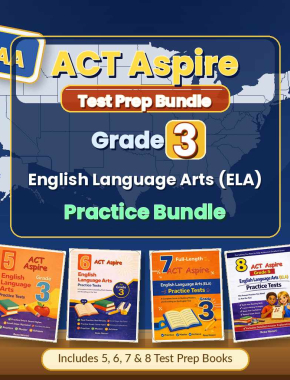
Looking for the best resource to help your kid ace the Act Aspire ACT Aspire? Try this bundle, four full practice-test books (5 + 6 + 7 + 8 tests) covering the same Grade 3 reading, writing, and language skills your child is already learning. Instant PDF download, answer keys included.

Related to This Article
More math articles
- The Legal Campaign, the Clark Studies, and Brown v. Board
- Culture Wars and the AIDS Crisis
- How to Graph a Horizontal or Vertical line?
- Top 10 Tips to ACE the SAT Mathematics
- Rhode Island RICAS Grade 6 Math Free Worksheets: Printable Grade 6 Math Practice, Fully Worked Keys
- Forming Plurals: Regular, Irregular, and Medical
- Graphing on the Coordinate Plane for 5th Grade: Plot Points
- Best Laptops for Teachers
- How to Use Elimination to Solve a System of Equations: Word Problems
- How long Is the SHSAT Test?








What people say about "Free Grade 3 English Worksheets for ACT Aspire"?
No one replied yet.