Reading Clocks for 4th Grade
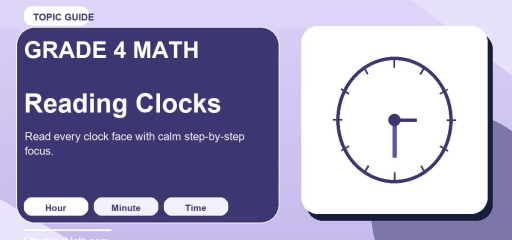
Reading analog clocks is an important time-telling skill in elementary math. Students use the positions of the hour hand and minute hand to read the exact time.
A strong clock-reading foundation supports elapsed time, schedules, and measurement word problems later on.
Key Ideas to Remember
- Read the hour and minute information separately before naming the full time.
- Use skip-counting by fives or a short timeline when the problem involves elapsed time.
- Check whether the final answer should be a clock time or a length of time.
Detailed Explanation
The short hour hand shows the hour, and the long minute hand shows how many minutes have passed. Each number around the clock stands for 5 minutes on the minute hand.
Students read the minute hand first, then decide which hour the short hand is closest to. If the hour hand is between two numbers, the smaller number is usually the current hour.
Worked Example
Problem: The minute hand points to 6 and the hour hand is halfway between 2 and 3. What time is it?
- A minute hand on 6 means 30 minutes.
- The hour hand is between 2 and 3, so the hour is 2.
- Combine the hour and minutes.
Answer: The time is 2:30.
Practice Tip
Ask students to explain what each hand is showing before they say the full time.
Common Mistakes
Students usually improve faster in reading clocks when they slow down and watch for a few repeated mistakes. These are the ones worth checking first:
- Mixing up the hour hand and minute hand on an analog clock.
- Counting minutes by ones instead of by fives around the clock face.
- Forgetting whether the question asks for a clock time or an elapsed interval.
Practice Strategy
A short but consistent review routine helps students build confidence with reading clocks without getting overwhelmed.
- Read a few times from an analog or digital clock and explain how you know each answer.
- Create a short schedule for the day and solve one elapsed-time question from it.
- Use a number line to show how the minutes change from start time to end time.
Frequently Asked Questions
How do you read a clock for kids?
Have kids look at the short hour hand to find the hour, then at the long minute hand. Each number on the clock face stands for 5 minutes on the minute hand, so they can skip-count by fives: the 3 means 15 minutes and the 9 means 45 minutes. If the hour hand sits between 4 and 5 and the minute hand points to 9, the time is 4:45.
What clock reading skills do 4th graders learn?
By 4th grade, students read analog clocks to the exact minute and use those readings to solve elapsed-time and schedule problems. For example, if the minute hand is two marks past the 7, that is 35 + 2 = 37 minutes. Fourth graders also convert hours to minutes and work out when an event ends, which all depends on reading the clock accurately.
Are there reading clock worksheets for grade 4?
Yes. Reading clock worksheets for grade 4 usually show clock faces to read to the nearest minute, ask students to draw the hands for a given time, and include a few elapsed-time questions. The practice with this lesson works well alongside them. Ask your child to say what each hand shows before writing the time, since mixing up the hour and minute hands is the most common slip.
What do students learn about reading clocks in grade 3?
In grade 3, students learn to tell and write time to the nearest minute and solve simple elapsed-time problems, building on grade 2 work with five-minute intervals. Grade 4 extends this to longer word problems and unit conversions. If a fourth grader feels unsure, a quick review of the grade 3 skill, counting by fives to the last number and then by ones, usually helps.
Keep Practicing
After finishing this lesson on reading clocks, spend a few minutes on mixed review so the skill stays connected to the rest of Grade 4 math.
Need more Grade 4 review? Explore the Grade 4 Mathematics Worksheets hub for extra guided practice, review sets, and printable support.

Related to This Article
More math articles
- Best Mobile Laptop Stands for Presentation in Schools
- Attending meetings
- The Importance Of Mathematics For Students Pursuing STEM
- Texas Revolution and Annexation: Slavery, Sovereignty and Statehood
- 10 Most Common ACCUPLACER Math Questions
- 4 Best Printers for Teachers in 2026
- 8th Grade SBAC Math FREE Sample Practice Questions
- Roads, Canals, Steamboats, Railroads and Telegraph: Freight vs. Information
- The Double V Campaign and the Second Great Migration
- Cultural Lag, Modernization, and Globalization



What people say about "Reading Clocks for 4th Grade"?
No one replied yet.