Identifying Angles for 4th Grade
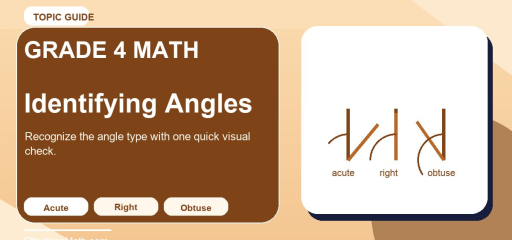
Identifying Angles for 4th Grade: this Effortless Math guide explains the topic in plain language, shows how it works through solved examples, and gives you free practice to try immediately, so the idea sticks instead of staying abstract.
Identifying angles helps students classify shapes and understand how rays meet to form different angle measures.
This lesson covers types of angles for fourth-grade math. Use the examples and practice below to build confidence and skill.
Key Ideas to Remember
- Focus on the attribute the problem is asking about, such as side lengths, angle type, or parallel sides.
- Sketching the figure or labeling the important parts often prevents simple mistakes.
- Check the final answer against the shape's properties, not just the arithmetic.
Detailed Explanation
An angle is formed by two rays sharing an endpoint. A right angle is 90°. An acute angle is less than 90°. An obtuse angle is greater than 90° but less than 180°.
Worked Example
Problem: What type of angle is 45°?
- Step 1: Apply the concept from the lesson above.
- Step 2: Carry out the operation or reasoning.
Answer: 45° is less than 90°, so it is an acute angle.
Common Mistakes
Students usually improve faster in identifying angles when they slow down and watch for a few repeated mistakes. These are the ones worth checking first:
- Looking at the wrong shape attribute when classifying or measuring.
- Confusing area with perimeter or angle type with side length.
- Forgetting that a square is also a rectangle with special properties.
Practice Strategy
A short but consistent review routine helps students build confidence with identifying angles without getting overwhelmed.
- Sketch shapes and label the attributes that matter for the problem.
- Use a ruler, grid, or protractor when the topic involves measurement.
- Sort a few examples and non-examples to strengthen the concept.
Watch Another Example
Use a second example video to hear the steps explained in a different way and reinforce the same skill from another angle.
Frequently Asked Questions
What does success in identifying angles usually depend on?
Students do best when they slow down and look carefully at the defining attributes of the figure instead of relying on appearance alone.
Should students always draw the figure?
A quick sketch or label is often helpful, especially when the problem involves side lengths, angle types, or parallel sides.
How can the answer be checked?
Compare the final answer to the shape's properties and ask whether the conclusion would still make sense if the picture were redrawn.
Keep Practicing
After finishing this lesson on identifying angles, spend a few minutes on mixed review so the skill stays connected to the rest of Grade 4 math.
Need more Grade 4 review? Explore the Grade 4 Mathematics Worksheets hub for extra guided practice, review sets, and printable support.

Related to This Article
More math articles
- Main Ideas, Vocabulary, and Conclusions
- 49 Free Grade 3 Math Worksheets for Montana MAST Prep, Built Around the Real Skill List
- Cabinet
- How to Multiply a Polynomial and a Monomial? (+FREE Worksheet!)
- How to Develop a Mindset for Math in 7 Steps?
- Free Grade 6 English Worksheets for Pennsylvania Students
- The Best Grade 3 Math Book for Utah Students
- CLEP U.S. History I 106: Reconstruction Amendments
- Grade 3 ELA Tests: A Calm Parent Guide (What the Test Measures—and What It Doesn’t)
- Propaganda, Wartime Civil Liberties, and Schenck




What people say about "Identifying Angles for 4th Grade"?
No one replied yet.