Massachusetts Algebra 1 Free Worksheets: Printable Algebra 1 PDF Practice with Student-Friendly Keys

Most ninth graders walk into Algebra 1 already aware that the course is supposed to matter. What they usually do not know yet is what makes it matter. The answer turns out to be deceptively simple: this is the year math becomes a language for describing change. Up to this point, students have been learning the vocabulary, operations, fractions, decimals, percents. Now they start putting that vocabulary into sentences. An equation is a sentence about an unknown. A function is a sentence about a relationship. A graph is a sentence drawn with a pen.
Once a student is fluent in those sentences, the rest of the year unfolds in a natural order. Linear equations lead to linear functions. Linear functions lead to systems, because two linear sentences in the same coordinate plane will either agree at one point, agree everywhere, or disagree completely. Exponents stretch the multiplication table into a curve, and quadratics introduce a whole new shape of relationship, one with a peak, a valley, two zeros, and a story all its own. By June, a student who has practiced steadily can take a real-world situation and translate it into algebra without thinking twice.
The work that gets a student there is mostly invisible, small, focused, repeated sittings at a desk. Whether your student rides the T into Boston for school, walks across a campus in Worcester, lives a block from a high school in Springfield, or studies in a Cambridge apartment with three books open at once, the practice that makes Algebra 1 stick is the same. These 64 worksheets are built to be that practice.
What’s on this page
Sixty-four single-skill PDFs aligned to the Massachusetts Algebra 1 standards. Each page targets one idea, solving inequalities, graphing in slope-intercept form, factoring a difference of squares, and only that idea. The Solving One-Step Equations page is not going to throw a quadratic at your student halfway through, and the Slope page is not going to wander into exponential decay. Single focus is what makes single sittings move the needle.
Each PDF opens with a one-page Quick Review: a plain-English definition of the skill plus one fully worked example. Then twelve practice problems that start gently and climb toward the difficulty an honest classroom test or final exam will use. The last page is a student-facing answer key with short, friendly explanations, written so a ninth grader reading it alone at the kitchen table can actually figure out where they went wrong and try again from scratch.
Algebra Foundations
- Variables, Expressions, and Properties, use letters for unknown values and the laws that govern them
- Order of Operations and Evaluating Expressions, PEMDAS in action, what to do first, second, and last
- Simplifying Algebraic Expressions, combine like terms and distribute to tidy any expression
- Introduction to Equations and Solutions, what it means for a value to ‘solve’ an equation
- Personal Financial Literacy, real-money algebra: interest, discount, markup, tax
Solving Linear Equations
- Solving One-Step Equations, undo one operation to isolate the variable
- Solving Two-Step Equations, two careful moves, in the right order
- Solving Multi-Step Equations, distribute, combine, then isolate, a full solve
- Equations with Variables on Both Sides, collect like terms on one side first
- Literal Equations and Formulas, solve a formula for a different letter
Inequalities and Absolute Value
- Solving One-Step Inequalities, one move, with one new rule for negatives
- Solving Multi-Step Inequalities, solve like an equation; flip the sign when dividing by a negative
- Compound Inequalities, AND vs. OR, and how to graph each
- Absolute Value Equations and Inequalities, split into two cases and read ‘and’ vs ‘or’ correctly
Functions and Sequences
- Relations and Functions, every input gets exactly one output, and how to check
- Function Notation and Evaluating Functions, read \(f(x)\) and plug in to evaluate
- Domain and Range, the inputs you may use and the outputs you get back
- Graphing Functions and Transformations, shift, stretch, and flip a parent graph
- Arithmetic Sequences as Linear Functions, add the same step each time, a line in disguise
- Geometric Sequences, multiply by the same ratio each time
- Graphing Square Root, Cube Root, and Piecewise Functions, graph nonlinear parent functions and split rules
- Comparing Functions, compare functions given as equations, tables, and graphs
- Combining Functions, add, subtract, multiply, and divide functions
- Inverse Functions, swap input and output, then solve for \(y\)
Linear Functions and Graphs
- Slope and Rate of Change, rise over run, a real-world rate of change
- Slope-Intercept Form, \(y = mx + b\), read slope and intercept right off it
- Point-Slope Form, build a line from one point and a slope
- Standard Form of a Linear Equation, \(Ax + By = C\), and when it’s most useful
- Writing Linear Equations from Graphs and Tables, turn a graph or a table into an equation
- Parallel and Perpendicular Lines, equal slopes for parallel, negative reciprocals for perpendicular
- Direct and Inverse Variation, \(y = kx\) versus \(y = k/x\)
- Understanding Graphs as Solution Sets, every point on the line satisfies the equation
Systems of Equations and Inequalities
- Solving Systems by Graphing, two lines, one shared point
- Solving Systems by Substitution, solve one equation for a variable, then substitute
- Solving Systems by Elimination, add or subtract the equations to cancel a variable
- Applications of Systems of Equations, two unknowns, two equations, one word problem
- Systems of Linear Inequalities, shade two regions and find where they overlap
- Solving Linear-Quadratic Systems, find where a line crosses a parabola
Exponents and Polynomials
- Properties of Exponents, product, quotient, power, zero, and negative-exponent rules
- Adding and Subtracting Polynomials, combine like terms in higher-degree expressions
- Multiplying Polynomials, FOIL and the box method, when each one helps
- Special Products of Polynomials, perfect squares and difference-of-squares patterns
- Rational and Irrational Numbers, tell a fraction-able number from one whose decimal never repeats
Factoring Polynomials
- Greatest Common Factor and GCF Factoring, pull out the biggest common piece first
- Factoring Trinomials: \(x^2 + bx + c\), two numbers that multiply to \(c\) and add to \(b\)
- Factoring Trinomials: \(ax^2 + bx + c\), the AC method and trial-and-error, side by side
- Factoring Special Products, spot difference of squares and perfect-square trinomials
Quadratic Functions
- Graphing Quadratic Functions, the parabola, its vertex, and the axis of symmetry
- Characteristics of Quadratic Functions, zeros, vertex, max/min, and end behavior
- Solving Quadratics by Factoring, set the product to zero, then each factor
- Solving Quadratics by Completing the Square, rewrite as \((x-h)^2 = k\) and take square roots
- The Quadratic Formula and the Discriminant, the formula every Algebra 1 student remembers, plus what the discriminant tells you
- Solving Quadratics by Square Roots, isolate the square, then take both roots
- Quadratic Applications and Modeling, real-world parabolas: projectiles, area, profit
Statistics and Probability
- Measures of Center and Spread, mean, median, range, and the feel of standard deviation
- Displaying Data: Histograms and Box Plots, two ways to picture a distribution
- Scatter Plots and Correlation, read clustering, outliers, and the direction of a trend
- Lines of Best Fit and Predictions, draw a trend line and predict the next value
- Probability and Counting Principles, count outcomes by multiplying and combine events
- Two-Way Frequency Tables, organize categorical data and read relative frequencies
Exponential Functions and Models
- Graphing Exponential Functions, the shape of \(y = ab^x\), growth or decay
- Exponential Growth and Decay, real-world doubling, half-life, and interest
- Comparing Linear, Quadratic, and Exponential Models, which model fits the pattern, and how to tell
- Interpreting Functions and Parameters, what every letter in the model actually means
How to use these worksheets at home
The most useful thing to know about Algebra 1 is that the brain learns it between sessions, not during them. That is why two fifteen-minute sittings spread across a week reliably outperform one long Sunday cram. Pick two evenings, treat them like any other appointment, and make each PDF a single short sitting with a clear stopping point at the end.
Pair related skills so each new worksheet builds on the one before it. Solving Two-Step Equations belongs before Solving Multi-Step Equations, the second page is the first one with one extra step. Slope and Rate of Change belongs before Slope-Intercept Form, because slope-intercept form is slope plus a starting value. Factoring Trinomials belongs before Solving Quadratics by Factoring, once a student can factor cleanly, solving is a single short line. The order of the worksheets is doing real teaching work, and following it pays off across the year.
Hand the answer key to your student at the end. Massachusetts teenagers are absolutely old enough to mark their own page, read the short explanation for a missed problem, and try it again from a clean sheet. That self-correction is the habit that distinguishes students who pass through high school math comfortably from students who keep getting stuck. Parents who hover often discover, three weeks later, that they have been doing the algebra and their student has been watching. Parents who step back find their ninth grader genuinely stronger by Thanksgiving.
A note about Algebra 1 in Massachusetts
Massachusetts does not currently administer a separately named Algebra 1 end-of-course test as a standalone exam in every district. Algebra 1 content lives inside the broader high school mathematics expectations and the assessments Massachusetts students sit later in their high school years. Within the course itself, classroom tests, midterms, and finals are built directly on the Massachusetts Algebra 1 standards, a framework that is closely aligned with the Common Core for high school mathematics.
Because each worksheet here targets one specific Massachusetts standard, you can use the set as a standard-by-standard map of the year. After your student finishes a unit, the matching PDFs give you a clean way to check what stuck and what slipped. If a midterm is on the calendar, the worksheets your student finds hardest are the two or three to come back to twice. That kind of pinpoint review, instead of broad, anxious cramming, is what turns the spring exam season into something manageable.
A short closing
Algebra 1 is the kind of course where every small page genuinely adds up. Bookmark this site, print a single PDF tonight, and let your Massachusetts ninth grader take one careful step. By spring, the quiet accumulation of fifteen-minute sittings will have done what no late-night cram ever can, left your student fluent enough in the language of algebra to walk into whatever comes next with their head up.
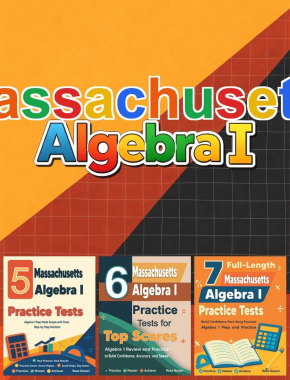
Best Bundle to Ace the Massachusetts Algebra 1 Test
Want the fastest path through Massachusetts Algebra 1 math? This bundle pulls it together, four full practice-test books with complete, step-by-step answer keys, instant PDF download.

Related to This Article
More math articles
- How to Use Area Models and the Distributive Property to Multiply?
- How to Prepare for the ALEKS Math Test?
- TOEFL Speaking Practice: Match Your Routine to the Current Tasks (2027 Prep)
- Table Tales: How to Finding the Rule in Word Problems
- Free Grade 4 English Worksheets for Wisconsin Students
- Place Values Relationship
- Single-Skill Grade 3 Math for New York (NYSTP): 49 Free Practice PDFs, No Signup
- How to Decode Decimals: Unveiling the Value of Each Digit
- 4th Grade TNReady Math Worksheets: FREE & Printable
- Full-Length ISEE Middle Level Math Practice Test










What people say about "Massachusetts Algebra 1: Free Worksheets"?
No one replied yet.