Citizenship, Participation, and Civil Society
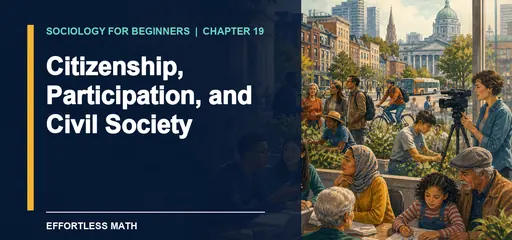
Chapter 19 of the Sociology for Beginners study guide on Effortless Math covers Citizenship, Participation, and Civil Society: the key terms, the core ideas, and worked examples showing how this topic is tested on this course.
Sociology for Beginners · Chapter 19
Citizenship, Participation, and Civil Society
Political participation includes voting, contacting officials, joining a campaign, protesting, attending meetings, donating, signing petitions, and discussing public issues. These actions require different resources. Registration rules, work schedules, language, transportation, disability access, political knowledge, and trust can shape who participates.
Participation rates should be compared with the correct denominator. Voter turnout among registered voters answers a different question from turnout among the voting-age population or voting-eligible citizens. A change in registration can alter one rate without changing the number of ballots. Careful comparison names the population before interpreting the percentage.
Political socialization is the process through which people learn political identities, expectations, and habits. Families, schools, peers, media, workplaces, religious communities, and public events can all act as agents. Learning is not simple copying. A person may accept, combine, or reject messages from several sources.
Civil society consists of associations and networks located between private life, markets, and the state. Neighborhood groups, unions, professional associations, advocacy organizations, congregations, and volunteer groups can build trust and skills. They can also exclude outsiders or amplify groups that already possess money and time. The existence of many organizations does not prove equal influence.
Social capital can support participation by creating information, trust, and reciprocal obligations. Bonding ties connect similar people and can provide strong support. Bridging ties connect across social differences and may widen information and coalition. Both can serve democratic action, but neither guarantees tolerant or equal outcomes.
Quick review: Political participation takes several forms and depends on resources and rules. Political socialization teaches identities and habits. Civil society organizes action outside the state, while social capital carries trust and information through ties. Formal openness does not establish equal voice.
Watch the lesson connection
Politics and Power gives you a second explanation of the ideas surrounding this lesson. As you watch, pause when the lesson concept appears and explain how the example fits.
Try the idea yourself
Write one original example, one close nonexample, and one observation that would help you tell them apart. That small exercise turns a definition into a sociological tool you can use in daily life.

Related to This Article
More math articles
- How to Find Variable and Fixed Expenses
- Civil War Home Fronts: Soldiers, Women, Shortages and Dissent
- Grants-in-aid
- How to Find Fractions of Time Units
- Affordable Alternatives to Expensive School Health Plans (International Students)
- 8th Grade SOL Math Worksheets: FREE & Printable
- The Best Grade 5 Math Book for Washington Students
- The Ultimate HSPT Math Course (+FREE Worksheets & Tests)
- Industrialization, the Gilded Age, and Reform
- Surveys, Samples, and Nonresponse





















What people say about "Citizenship, Participation, and Civil Society"?
No one replied yet.