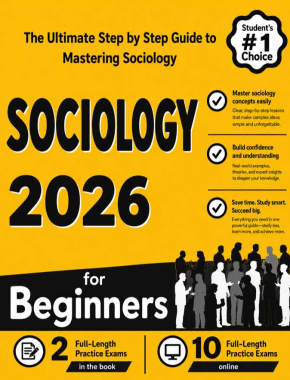
Sociology for Beginners
Sociology for Beginners is a 380-page instant downloadable PDF that turns an introductory sociology course into a clear sequence of lessons, examples, practice, and feedback. Readers work through 22 chapters, 330 chapter questions, two in-book Sociology Practice Tests, and ten additional online tests. It is a practical choice for independent learners, first-course students, tutors, homeschool families, and adult-education programs that want patient explanations and useful review tools.
Students also viewed
Related books students often compare before choosing the right next step.
 CLEP American Government for Beginners
Original price was: $28.99.$18.99Current price is: $18.99.
CLEP American Government for Beginners
Original price was: $28.99.$18.99Current price is: $18.99.
 CLEP History of the United States II for Beginners
Original price was: $28.99.$18.99Current price is: $18.99.
CLEP History of the United States II for Beginners
Original price was: $28.99.$18.99Current price is: $18.99.
 CLEP Introductory Sociology for Beginners
Original price was: $28.99.$18.99Current price is: $18.99.
CLEP Introductory Sociology for Beginners
Original price was: $28.99.$18.99Current price is: $18.99.
 CLEP Natural Sciences for Beginners
Original price was: $28.99.$18.99Current price is: $18.99.
CLEP Natural Sciences for Beginners
Original price was: $28.99.$18.99Current price is: $18.99.
See the Social Patterns Behind Everyday Life
Sociology for Beginners: The Ultimate Step-by-Step Guide to Mastering Sociology is an instant downloadable PDF for readers who want a clear first course in how societies work. It begins with ordinary situations, then gives learners the concepts and evidence needed to explain what they see.
What You Get Inside
A Study Rhythm That Makes Sense
The book asks learners to do four things: notice a social pattern, name the concept, check the evidence, and explain why a close alternative does not fit. That rhythm carries from the opening lesson through the final test. A student can read in sequence for a first course or start with a practice test and return to the chapters named in the explanations.
Practice That Teaches the Difference
A sociology question often includes two answers that sound plausible until you identify the level of analysis, the kind of evidence, or the exact social process in the example. The practice sections are built around those close choices. After answering, readers can check a short response first, then use the longer explanation to see why the correct concept fits and why the nearby alternatives do not.
This makes review more useful than simply memorizing a list of terms. A learner can mark the question, return to the named chapter, write a fresh example, and try the distinction again. Teachers and tutors can also use the explanations as compact discussion prompts.
What You Will Learn
| Seeing society | Sociological imagination, major theories, levels of analysis, research design, evidence, and ethics |
|---|---|
| Culture and interaction | Culture, social structure, self, socialization, groups, organizations, deviance, media, and technology |
| Inequality and difference | Class, poverty, mobility, global inequality, race, ethnicity, migration, gender, sexuality, and aging |
| Institutions and change | Family, religion, education, work, politics, health, population, cities, environment, movements, and social change |
Why Choose the Instant PDF?
- Start reading as soon as the download is ready.
- Print selected lessons or practice pages.
- Read on a laptop, desktop, or tablet.
- Keep linked companion materials one click away.
Flexible Ways to Use It
- Independent first course in sociology
- Companion for an introductory class
- Tutoring and adult-education instruction
- Homeschool or family study
- Focused review before a cumulative assessment
Is This the Right Book for You?
A good fit if:
You want a patient introduction, specific examples, plenty of practice, and explanations that teach the distinction behind each answer.
May not be the best fit if:
You need a short dictionary of terms, an official exam publication, an editable question bank, or a physical book shipped to your address.
Digital PDF and Paperback Options
Choose the instant PDF for immediate access. Prefer a physical copy? The paperback is available on Amazon.
Is this a digital product?
Yes. Your purchase delivers one 380-page PDF eBook. No physical item is mailed.
Can I print it?
Yes. You can print selected pages for your own permitted use, or keep the complete book on a device.
Are answers included?
Yes. The book contains short answers, full chapter explanations, test answer records, test keys, and complete explanations for both in-book tests.
Do the online materials require internet access?
Yes. The PDF works offline after download, while the companion hub, chapter resources, and ten online tests require an internet connection.
Begin With One Ordinary Question
Download the PDF, open the first chapter, and start learning how sociologists connect daily life with evidence about institutions, culture, power, and change.
You must be logged in to post a review.
There are no reviews yet.