Fiscal Federalism in Practice
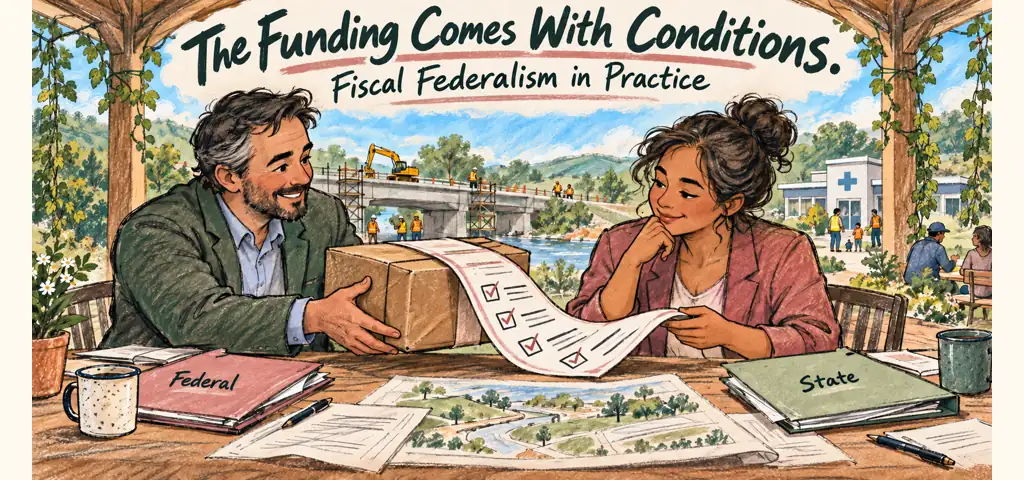
Fiscal federalism studies how taxing, spending, grants, and mandates shape relations among levels of government. National money can influence state priorities even when states administer programs.
Because the national government has greater revenue capacity, federal dollars can shape policy beyond programs directly administered in Washington. States weigh the value of funds against compliance costs and restrictions, while Congress uses conditions to promote national priorities and some interstate uniformity.
The mechanism behind fiscal federalism in practice
Follow the money before naming the relationship. Identify the grantor, recipient, matching requirement, maintenance-of-effort rule, reporting duty, and permitted uses. A program can transfer resources downward while moving policy discretion upward, so the location of administration does not by itself reveal who controls design.
Fiscal Federalism in Practice: key distinctions
Fiscal influence differs from direct regulation. Declining a grant may be legally possible but financially difficult. That pressure is analyzed under spending doctrine rather than preemption or commandeering. Compare the clarity, relevance, and coerciveness of conditions instead of assuming that acceptance of any federal dollar gives Congress unlimited control.
Practice with fiscal federalism in practice
Take one current or historical example of fiscal federalism in practice, explain the mechanism, and identify the strongest competing principle.
Video lesson: Fiscal Federalism in Practice
Khan Academy gives a focused explanation of this topic in Categorical grants, mandates, and the Commerce Clause | US government and civics.
If the player does not load, watch this lesson directly on YouTube.
Connect this lesson to the larger course
For a broader map connecting fiscal federalism in practice to founding ideals, the Constitution, and federalism, use the AP U.S. Government and Politics learning hub.

Related to This Article
More math articles
- Racism, Institutional Discrimination, and Privilege
- Grade 5 Math Flashcards (Free Online: Formulas, Terms & Concepts)
- The Ultimate ASTB Math Course (+FREE Worksheets & Tests)
- Purpose vs. Point of View
- The Best Algebra 1 Book for West Virginia Students
- How to Find the Volume and Surface Area of a Triangular Prism?
- How to Use Exponents to Write Powers of Ten?
- Top 10 Math Books for Grade 4: Empowering Young Minds to Discover Numbers
- Divide and Conquer: How to Tackle Word Problems with Division Facts up to Twelve
- Find the Key: “AFOQT Math for Beginners” Complete Answer Book




















What people say about "Fiscal Federalism in Practice"?
No one replied yet.