Agents and Conflicting Messages
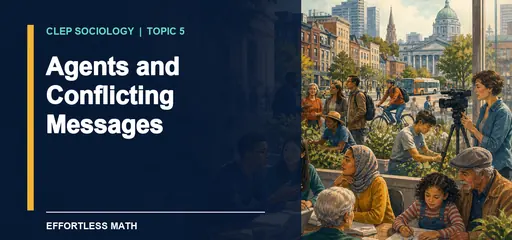
Chapter 5 of the CLEP Sociology study guide on Effortless Math covers Agents and Conflicting Messages: the key terms, the core ideas, and worked examples showing how this topic is tested on the exam.

CLEP Sociology – Chapter 5
Agents and Conflicting Messages
CLEP Introductory Sociology · Chapter 5
An agent of socialization is a person, group, or institution that transmits cultural knowledge, identities, roles, or expectations. Families, schools, peers, media, religious organizations, workplaces, and the state all socialize. They differ in timing, intimacy, reach, authority, and control over rewards.
Primary socialization is the early learning through which a child first acquires language, attachment, basic norms, and a sense of self. Family and close caregivers usually carry much of it. Secondary socialization occurs as people learn the expectations of a later group, institution, or specialized role. Lina learned ordinary turn taking at home and now learns when a classroom requires a raised hand. The second lesson is secondary because it belongs to a new institutional setting.
Families teach language, trust, routines, social identity, and ways of dealing with institutions. Families vary by culture, resources, structure, neighborhood, and experience. No single family lesson represents every childhood. Caregivers may also disagree with one another, and children may interpret the same message differently.
Schools teach academic subjects and a hidden curriculum of unofficial lessons built into schedules, rankings, permission rules, discipline, and evaluation. A bell teaches time discipline. Waiting to be called on teaches a relation to authority. Group projects can reward cooperation while ranked grades encourage competition. Hidden means absent from the formal course description, not deliberately secret.
Peer groups give people practice with age-mates or others in a similar position. Peers can supply belonging, independence, language, taste, and standards that differ from adult expectations. The source becomes clear when peer approval or exclusion changes behavior. Media have wider reach and can circulate images of success or beauty, while daily caregivers usually have greater intimacy.
Agents often send conflicting messages. Lina’s family may reward helping a classmate, while a classroom competition rewards finishing first. Her father may hear a hospital’s official message about reporting mistakes and a coworker’s warning that speaking up harms promotion. People learn to move between settings, weigh sanctions, and decide which relationship matters in the moment.
Sanction strength is not measured only by formality. A peer’s laugh may be informal but emotionally powerful. A school detention is formal but brief. Family approval may carry no written rule and still shape conduct for years. Researchers ask who controls the reward, whether the relationship matters to the learner, how often the message appears, and what practical cost follows refusal.
The same agent can teach explicit and implicit lessons. A workplace handbook explains safety rules. Coworkers demonstrate which shortcuts supervisors tolerate, who may ask for help, and how errors are discussed. If the written and enacted lessons conflict, the learner must interpret both rather than absorb one unified organizational culture.
Agency remains visible. A teenager can comply with family expectations at home, resist a peer norm online, and form a new friend group that supports another identity. The available choices and consequences are socially organized, but no message writes behavior directly onto the person.
Media act as an agent when repeated stories, images, categories, and models teach what kinds of people or conduct seem normal. A child who sees scientists portrayed in one narrow way may learn who appears to belong in science. The message becomes stronger when peers repeat it and schools distribute opportunities through the same assumption. Media exposure alone does not prove an effect on one viewer. Researchers need evidence about attention, interpretation, repetition, and later conduct.
Agents can disagree. A family may teach that helping relatives comes before individual advancement, while a workplace rewards employees who relocate without hesitation. The person does not simply absorb one message. She weighs relationships, sanctions, resources, and identity. This conflict is useful on the CLEP because the immediate agent is the one whose lesson or sanction explains the action described. The presence of a family in the story does not make family the answer if a peer group or organization supplied the deciding pressure.
Quick review: Identify the agent, the lesson, the sanction, and the setting. Primary socialization builds early foundational competence. Secondary socialization teaches a later institution or role. Hidden curriculum is the unofficial lesson carried by school organization.
Watch the chapter connection
Socialization gives you a second explanation of the chapter ideas surrounding this lesson. As you watch, pause when the lesson concept appears and explain how the example fits.
Use this lesson for CLEP practice
Write one original example, one close nonexample, and one observation that would help you choose between them. This turns vocabulary recognition into the kind of applied reasoning the exam expects.

Related to This Article
More math articles
- Signing statements
- Missing Numbers for 4th Grade
- Grade 3 Math: Equivalent Fractions
- How to Prepare for the Next-Generation ACCUPLACER Math Test?
- FREE 4th Grade FSA Math Practice Test
- Divided government
- Your Coach’s Playbook: How to Understand Percent of Change
- Chinese Exclusion, Nativism, and Immigration Law
- Arkansas ATLAS Grade 4 Math Free Worksheets: Free PDF Worksheets with Friendly Answer Keys
- Top 10 Tips to Create the CLEP College Algebra Study Plan


















What people say about "Agents and Conflicting Messages | CLEP Sociology"?
No one replied yet.