Demand shifts when a nonprice determinant changes
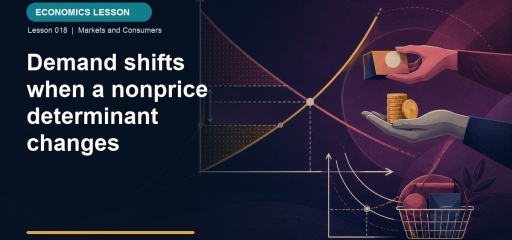
Demand shifts when a nonprice determinant changes: this Effortless Math guide explains the topic in plain language, shows how it works through solved examples, and gives you free practice to try immediately, so the idea sticks instead of staying abstract.
Use tastes, income, expectations, buyers, and related-good prices.
Stronger preference for a good shifts demand right. Weaker preference shifts it left. More buyers increase market demand. Fewer buyers reduce it. If consumers expect a storable good’s price to rise soon, current demand may rise as purchases move forward. Expectations about future income can also affect present buying.
A rightward shift means more is demanded at each possible own price. A leftward shift means less. This definition is safer than saying “the curve goes up” because a graph’s drawing and axis scale can make direction feel ambiguous. Choose an old price, hold it fixed, and ask whether the event makes buyers plan to purchase more or less. That counterfactual identifies the shift.
Preferences can change through information, advertising, seasons, demographics, or social norms. The model groups these under tastes without claiming that all preference change is irrational. An announcement that a food lowers health risk can shift demand right. News of a safety defect can shift it left. Do not also shift supply unless the event changes producers’ costs or plans.
Income requires classification. Higher income increases demand for a normal good and decreases demand for an inferior good. “Inferior” describes the income relationship, not quality. Bus travel might be inferior for a household that buys a car after income rises, while restaurant meals may be normal.
The classification belongs to a consumer or market over a relevant income range. A good is not universally normal or inferior for all households. Store-brand food can be inferior for one family and normal for another. If the stem states that purchases decline when income rises, that evidence defines the good as inferior in the case. Do not override it with your opinion about quality.
Related goods require the direction of use. Substitutes serve similar purposes: if coffee price rises, demand for tea rises. Complements are used together: if printer prices rise and fewer printers are purchased, demand for ink falls. Do not shift coffee demand because coffee’s own price changed. Shift it because the price of another good changed.
Trace complements through two steps. A higher printer price lowers the quantity of printers demanded. Because fewer printers are used, demand for ink shifts left. The ink price did not cause that shift. For substitutes, a higher coffee price makes tea relatively attractive, shifting tea demand right. A strong option states both the relationship and direction rather than merely calling the goods “related.”
Expectations require a time label. If buyers expect next month’s price of a storable good to rise, current demand may shift right as purchases are advanced. This is not movement along current demand because the current own price has not initiated the change. For services that cannot be stored, the timing response may differ. Use the facts given.
| Event | Demand for the focal good | Reason |
|---|---|---|
| Own price falls | Quantity demanded rises along the curve | The axis variable changed |
| Income rises. Good is normal | Shifts right | Buyers want more at each price |
| Income rises. Good is inferior | Shifts left | Buyers substitute toward preferred alternatives |
| Substitute’s price rises | Shifts right | The focal good becomes relatively attractive |
| Complement’s price rises | Shifts left | Use of the paired good declines |
| Number of buyers rises | Shifts right | More individual quantities are added |
Three events, three diagrams
A streaming service lowers its own monthly price: movement down its demand curve. A rival service raises its price: demand for the first service shifts right. Household income falls and the service is normal: demand shifts left. The observed number of subscriptions depends on both the curve and the price.
When an event could affect several determinants, state the information needed. A higher gasoline price may reduce demand for large vehicles and increase demand for fuel-efficient vehicles. Calling “cars” one broad market would hide opposite responses among categories. Exam questions define the focal good narrowly enough for a single-best answer. Preserve that definition rather than silently changing the market.
After finding the shift, do not stop before the question’s requested outcome. A demand increase alone means more is desired at each price. In an upward-sloping supply market, the new equilibrium also has higher price and quantity. If the stem asks about seller revenue, consumer surplus, or a related market, additional analysis may be required. The shift is the first link in a chain, not always the final answer.
Watch the idea in action
A focused video lesson from Marginal Revolution University.

Reza is an experienced Math instructor and a test-prep expert who has been tutoring students since 2008. He has helped many students raise their standardized test scores--and attend the colleges of their dreams. He works with students individually and in group settings, he tutors both live and online Math courses and the Math portion of standardized tests. He provides an individualized custom learning plan and the personalized attention that makes a difference in how students view math.
Related to This Article
More math articles
- Hawaii SBAC Grade 4 Math Free Worksheets: Printable Practice Worksheets with Worked Solutions
- How to Find The Derivative of A Function
- Grade 3 Math: Quadrilaterals
- A 4-Week Grade 4 ELA Study Plan: Reading, Writing, Vocabulary, and Review That Actually Fits Real Life
- The Ultimate SSAT Middle Level Math Formula Cheat Sheet
- How to Find x- and y-intercepts in the Standard Form of Equation?
- High School Geometry Survival Guide: Pass and Excel in 2026
- Why Do I Need MATLAB Assignments Experts Help and Where One Get It
- SAT Calculator Policy
- Virginia SOL Algebra 1 Free Worksheets: Printable SOL-Aligned Algebra 1 Practice, No Signup Needed






















What people say about "When Demand Shifts and Why"?
No one replied yet.