Shutdown is a short-run comparison with variable cost
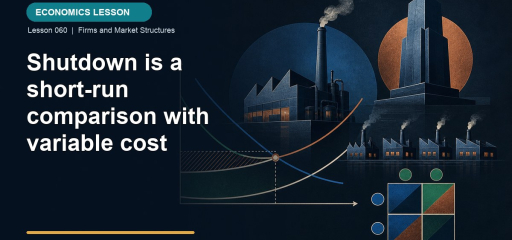
Shutdown is a short-run comparison with variable cost: this Effortless Math guide explains the topic in plain language, shows how it works through solved examples, and gives you free practice to try immediately, so the idea sticks instead of staying abstract.
The firm cannot avoid fixed cost by producing zero now.
If P≥ AVC, operating revenue covers variable cost and contributes something toward fixed cost, so producing at MR=MC loses less than shutdown. If P<AVC, revenue does not cover variable cost, so shutdown minimizes the loss at fixed cost. At P=min AVC, the firm is indifferent at the shutdown point.
Compare totals to see why. If production gives revenue of $1,000 and variable cost of $800, operation contributes $200 toward fixed cost. With fixed cost of $500, the operating loss is $300. Shutdown loses the entire $500. If variable cost were $1,100, operating would add $100 to the unavoidable fixed loss, so shutdown is better.
The average rule is the per-unit version. At the chosen output, P≥ AVC means PQ≥ AVC× Q=VC. Revenue covers variable cost. It need not cover ATC. A firm can operate with AVC<P<ATC and incur a smaller loss than shutdown.
Exit is a long-run decision. All costs are avoidable, so a firm leaves if revenue cannot cover total economic cost. This distinction matters: a firm can rationally operate at a short-run loss and later exit if conditions persist.
Shutdown means temporary zero production while fixed cost remains. Exit means releasing all avoidable inputs and leaving the industry. A seasonal firm may shut down during low demand and reopen. A persistently unprofitable firm exits when leases and commitments can end.
| Price at best output | Short-run action | Result |
|---|---|---|
| P>ATC | Produce | Positive economic profit |
| P=ATC | Produce | Zero economic profit |
| AVC<P<ATC | Produce | Loss smaller than fixed cost |
| P<AVC | Shut down | Lose fixed cost only |
Operate now, exit later
At its best output, a firm has price $9, AVC $7, and ATC $12. It loses $3 per unit but covers variable cost and $2 per unit of fixed cost, so it operates now. If expected long-run price remains below minimum ATC, it exits when all inputs become avoidable.
Apply the shutdown rule after finding the best positive output. A fixed-cost increase changes neither MC nor AVC and therefore does not change short-run output or shutdown. A variable-cost increase can change both.
Shutdown is not bankruptcy or permanent closure. It is a current output choice of zero while fixed commitments remain. A firm can reopen when price again covers AVC. At P=min AVC, operation and shutdown both lose fixed cost. Above it operation contributes toward fixed cost, and below it operation adds to the loss.
A payment covering fixed cost can keep the firm solvent without changing its short-run output when MR and MC are unchanged. A per-unit subsidy changes effective MC and can expand output. This contrast tests whether the student understands the marginal reason behind shutdown rather than memorizing the word “loss.”
Apply the rule at the profit-maximizing positive output, not an arbitrary row. First find MR=MC, then read AVC there. A low AVC at an output the firm would never choose does not justify operation. If every feasible positive output has price below AVC, current output should be zero.
At the P=MC output, price is $15, AVC is $12, and ATC is $18. In the short run the firm should
- shut down and lose total fixed cost plus variable cost
- raise price to $18
- exit the industry immediately
- produce and incur an economic loss
- produce and earn economic profit
produce and incur an economic loss Price covers variable cost but not total cost, so producing minimizes the short-run loss.
A firm’s price is above AVC but below ATC. Which conclusion avoids the short-run-versus-long-run trap?
- The firm earns positive profit in both periods.
- The firm must shut down immediately.
- It may produce in the short run but will exit if the loss persists.
- It should raise price regardless of market structure.
- It has zero economic profit.
It may produce in the short run but will exit if the loss persists. Covering AVC makes production worthwhile for now, but price below ATC cannot sustain the firm after all costs become avoidable.
A profit-maximizing firm is producing where MR=MC. Under the usual conditions, which statement must be true?
- The firm must be earning positive economic profit.
- The firm must have price equal to average total cost.
- The firm must minimize its loss by shutting down.
- A small change in output cannot increase the firm’s profit.
- The firm must be producing where total revenue is largest.
A small change in output cannot increase the firm’s profit. At the optimum, expanding would add more cost than revenue and contracting would forgo units whose revenue covers cost. Profit need not be positive.
Watch the idea in action
A focused video lesson from Economics in Many Lessons.

Reza is an experienced Math instructor and a test-prep expert who has been tutoring students since 2008. He has helped many students raise their standardized test scores--and attend the colleges of their dreams. He works with students individually and in group settings, he tutors both live and online Math courses and the Math portion of standardized tests. He provides an individualized custom learning plan and the personalized attention that makes a difference in how students view math.
Related to This Article
More math articles
- How to Master the ISEE Math Section: 2026 Guide for Lower, Middle & Upper Level
- 7th Grade RISE Math Worksheets: FREE & Printable
- Free Grade 3 English Worksheets for Nevada Students
- Denotation and Connotation
- 7th Grade PARCC Math Practice Test Questions
- Which Test Is Better for You; GED, TASC, or HiSET? Find Out Now
- Invention, Discovery, Diffusion, and Cultural Change
- The Ultimate 7th Grade TNReady Math Course (+FREE Worksheets)
- How to Find Fractions of Time Units
- Marginal is not average or total


















What people say about "Shutdown Is a Short-Run Comparison"?
No one replied yet.