States of Matter and Changes
Water can be ice, liquid, or steam — the same substance in three different forms. These forms are the states of matter, and the changes between them are driven by heat. This is a common, approachable test topic, and it comes down to how tightly the particles are packed and how much energy they have.
Solid, Liquid, and Gas
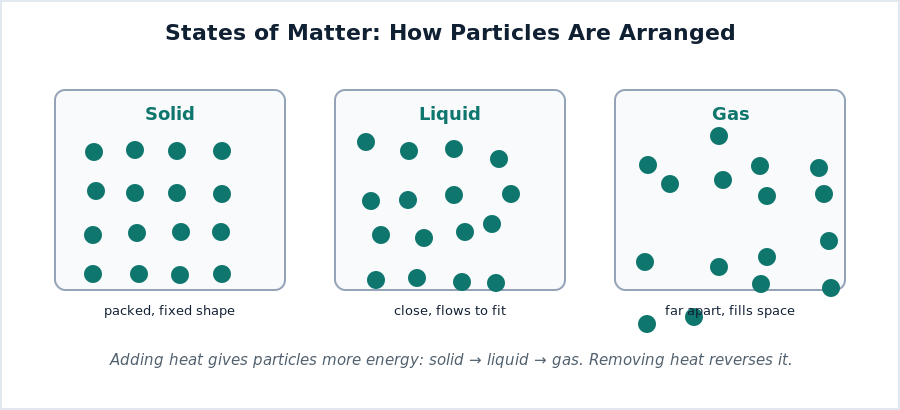
The three main states differ in how their particles are arranged. In a solid, particles are packed tightly in a fixed arrangement, so a solid keeps its shape. In a liquid, particles are still close but can slide past each other, so a liquid flows and takes the shape of its container. In a gas, particles are far apart and move freely, so a gas spreads out to fill whatever space it is in.
Changes of State
Heating and cooling move a substance between states by changing how much energy the particles have. Melting turns a solid to a liquid; freezing turns a liquid to a solid. Evaporation (or boiling) turns a liquid to a gas; condensation turns a gas back to a liquid. Adding heat generally moves a substance toward gas; removing heat moves it toward solid. One special case is sublimation, where a solid turns straight into a gas, as dry ice does.
Physical, Not Chemical
An important point the test checks: a change of state is a physical change, not a chemical one. Melting ice is still water — the substance itself does not change, only its form. No new substance is made. This is different from a chemical reaction, where atoms rearrange into new substances. If a question describes ice melting or water boiling, that is a physical change.
Watch: A Short Video Lesson
FuseSchool walks through this skill clearly in a few minutes. It is a helpful companion to the reading above:
A Routine for These Questions
- Solid = packed and fixed; liquid = close and flowing; gas = spread out.
- Adding heat moves toward gas; removing heat moves toward solid.
- Know the names: melting, freezing, evaporation, condensation, sublimation.
- A change of state is a physical change — no new substance forms.
Practice
- In which state are particles packed most tightly?
- What is the change from liquid to gas called?
- What is the change from gas to liquid called?
- Does adding heat move a substance toward solid or gas?
- Is melting ice a physical or chemical change?
- What is it called when a solid turns straight into a gas?
Answers
- Solid.
- Evaporation (or boiling).
- Condensation.
- Toward gas.
- A physical change.
- Sublimation.
Where This Fits in Your Science Prep
States of matter build on elements, compounds, and mixtures and contrast with chemical reactions, where new substances form. See all topics on the Science Topics Hub.

Related to This Article
More math articles
- Full-Length 7th Grade ACT Aspire Math Practice Test
- RBT DRA vs DRI vs DRO: Learn the Difference With Examples (2027 Prep)
- PSAT 10 Math Practice: Official Tests and 48 Skill Questions
- How to Choose the Best Laptop for College?
- Magic Square Puzzle — Make Every Line Equal
- Political speech
- 10 Most Common 8th Grade MCAS Math Questions
- Delegated, Expressed, Implied, Inherent, Reserved, and Concurrent Powers
- Top 10 Tips to Overcome ISEE Math Anxiety
- 5th Grade STAAR Math Practice Test Questions






















What people say about "States of Matter and Changes"?
No one replied yet.