Moral hazard changes behavior after an agreement
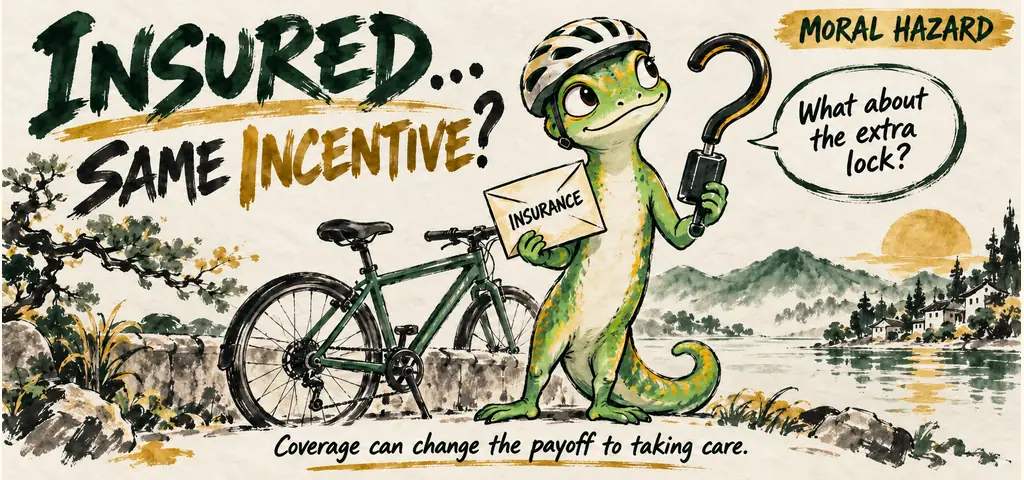
A bicycle owner buys theft insurance. The insurer now bears part of a financial loss that the owner previously bore alone, changing the owner's reward for taking an extra precaution.
Can the insurer observe that precaution? If taking care is difficult to monitor, the changed incentive can create moral hazard even when the customer never lies or breaks a rule.
Calculate the private incentive
Suppose secure storage costs the owner $20 a year in time and inconvenience. It reduces expected theft losses by $40. Without insurance, paying for the precaution is worthwhile under these assumptions because the avoided expected loss exceeds the cost of using the storage area.
Now add 90 percent reimbursement. Assume the policy has no other conditions, future premium effects or nonfinancial consequences, so the owner personally bears only 10 percent of each relevant theft loss. The precaution saves an expected $4, which may lead the owner to stop paying the $20 storage cost.
Real owners have other concerns. Losing a bicycle can interrupt a commute or mean losing a treasured possession, and these consequences can preserve an incentive to take care despite financial coverage. The example isolates one channel of response.
Keep the protection in the calculation
Insurance pools uncertain losses. It can protect a household from an expense it could not comfortably absorb, which means an incentive problem has to be weighed alongside the benefit of risk sharing.
A deductible leaves some loss with the customer. Safety requirements or monitoring can encourage precautions too, although monitoring uses resources and can intrude on privacy while greater cost sharing exposes the customer to additional risk.
Healthcare requires particular care here. Cost sharing can discourage useful treatment along with low-value use, so counting every additional visit under insurance as waste would leave its possible health benefits out of the evaluation.
Follow hidden action into the workplace
A shop owner hires a manager whose effort is hard to observe. The owner wants service quality and repeat business as well as sales, but a bonus based only on today's sales might reward pressure that drives customers away.
This is a principal-agent setting. One party delegates action to another whose interests may differ, and a poorly chosen performance measure can reward behavior that harms the person who designed it. Oversight and reputation may help, at a cost.
Keep the timing clear. Hidden risk that changes who buys coverage is an adverse-selection mechanism, whereas hard-to-observe behavior that responds to the agreement is a moral-hazard mechanism. Identify the action and explain why the other party cannot easily monitor it or make an enforceable contract about it.
Watch the idea in action
A related lesson from Marginal Revolution University. Read the examples above alongside the video.

Reza is an experienced Math instructor and a test-prep expert who has been tutoring students since 2008. He has helped many students raise their standardized test scores--and attend the colleges of their dreams. He works with students individually and in group settings, he tutors both live and online Math courses and the Math portion of standardized tests. He provides an individualized custom learning plan and the personalized attention that makes a difference in how students view math.
Related to This Article
More math articles
- Weight Measurement for 4th Grade
- How Math Skills Give Players a Competitive Edge in Various Online Games
- 49 Printable Arkansas ATLAS Grade 3 Math Worksheets — Free Download with Step-by-Step Keys
- The Best Grade 3 Math Book for Washington Students
- 10 Most Common 7th Grade ACT Aspire Math Questions
- A Deep Dive Into The World of Vector-Valued Function
- The Mathematics Chances and Odds of CS2 Skins and Cases
- Deskilling, Taylorism, Child Labor, and Women’s Wage Work
- 4th Grade IAR Math FREE Sample Practice Questions
- How to Use Order of Operations? (+FREE Worksheet!)






What people say about "Moral Hazard Changes Behavior After an Agreement"?
No one replied yet.