Biotechnology: PCR, DNA Gels, and Gene Editing
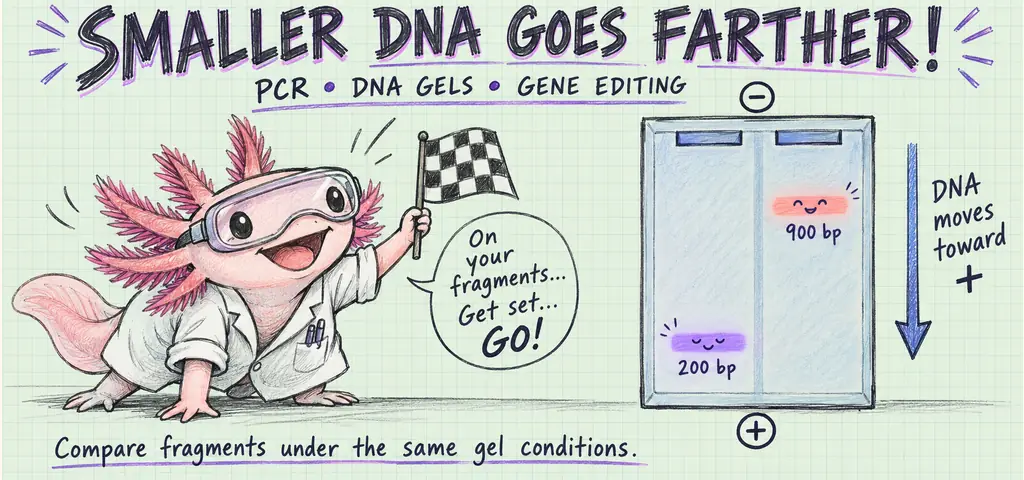
A DNA sample produces a band on a gel near a 500-base-pair marker. What have you learned? You have evidence about fragment size, but you still need other tests to establish the sequence or identify its source. Each biotechnology tool answers a particular kind of question.
Biotechnology uses organisms, cells, or biological molecules to develop products and investigate biological problems. DNA tools can copy selected sequences, separate fragments, introduce genes, or make targeted changes. Interpreting the result requires controls and an understanding of what each tool measures, rather than treating every DNA result as a complete identification.
What does PCR copy?
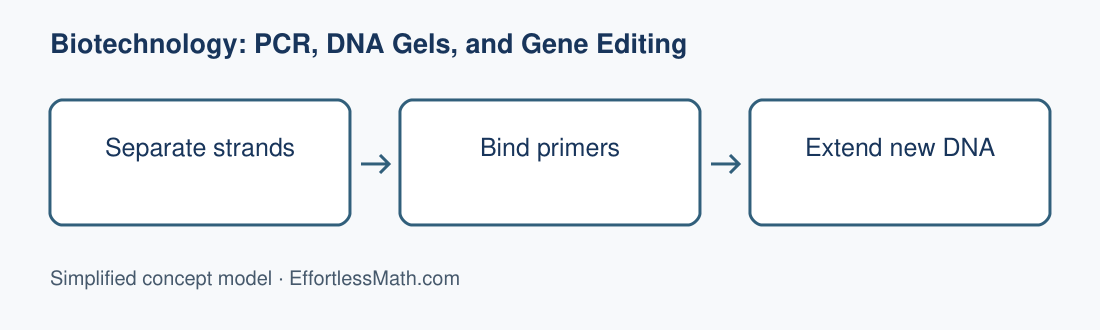
PCR amplifies a DNA region bounded by a pair of primers. Heating separates DNA strands, cooling allows primers to bind, and a suitable DNA polymerase extends them. Repeated cycles can greatly increase the target. PCR does not copy a whole organism, and a positive signal can arise from contamination unless the experiment includes appropriate controls.

How do you read a DNA gel?
DNA carries a negative charge and moves toward the positive electrode in a typical agarose gel. For ordinary linear fragments under comparable conditions, smaller fragments generally travel farther. A DNA ladder provides known fragment sizes. Band position estimates size. It does not directly reveal the nucleotide sequence or prove that two samples came from the same individual.
How is gene editing different from copying DNA?
A CRISPR system can use a guide RNA to direct a suitable enzyme to a target sequence. The cell’s repair processes help determine the resulting DNA change. Target recognition, delivery, unintended changes, and differences among cells all affect an experiment. A targeted edit is not automatically a complete or successful change in every cell.
Which process does each term describe?
| Term | Meaning in this lesson |
|---|---|
| PCR | Amplifies a selected DNA region |
| Gel electrophoresis | Separates DNA fragments mainly by size under defined conditions |
| Gene editing | Changes a target DNA sequence through an editing and repair process |
How can you reason through an example?
Suppose a sample produces a band near the 500-base-pair ladder band. The positive control has the expected band, and the no-template control has no visible band. Those controls support a working reaction without detected contamination in the blank. The sample result supports a product near the expected size. Sequencing or another specific check may still be needed to confirm its identity.
- State the purpose of the tool before interpreting its output.
- Check the ladder, positive control, and negative control where appropriate.
- Write the narrow conclusion supported by the result.
Can you apply the ideas?
Answer these six questions before opening the explanations.
- What sets the boundaries of a standard PCR target?
- Which electrode attracts DNA in a typical agarose gel?
- Which usually travels farther: a 200-base-pair or a 900-base-pair linear fragment?
- What does a band in a no-template PCR control suggest?
- Do equal-size gel bands prove identical sequences?
- Does a successful edit in one cell prove all cells were edited?
Check the six answers and explanations
- The primer pair, together with the template sequence.
- The positive electrode because DNA is negatively charged.
- The 200-base-pair fragment under the same suitable gel conditions.
- Possible contamination or an unwanted product. The sample result needs investigation.
- No. Different sequences can have the same length.
- No. Editing outcomes can differ among cells and require verification.
What does the video explain?
Watch PCR (Polymerase Chain Reaction) by Amoeba Sisters. As you watch, name what happens to the template and primers during heating, cooling, and extension. Then explain why the no-template control should remain blank.
Where does this lesson fit?
Use the Biology Learning Hub to choose your next topic. Related lessons explain testing a biological explanation, how DNA instructions become proteins, organisms in ecosystems.
Further reading: OpenStax Biology 2e topic reference. Lesson text and diagrams are original educational material. Examples marked hypothetical are teaching scenarios.
Recommended study resources
The algebra bundle below supports quantitative skills used in science, including reading relationships, working with units, and solving for unknown quantities.

For the AP course sequence and practice tests, use the AP Biology study hub.

Related to This Article
More math articles
- Urbanization, Urban Growth, Suburbanization, and Metropolitan Regions
- Natural-monopoly regulation trades efficiency for cost recovery
- Categorical grants
- Marginal product pulls average product
- How to Factor Numbers? (+FREE Worksheet!)
- South Carolina Grade 2 English Worksheets — Free Printable PDFs
- One-Variable Inequalities Practice — Solve & Type the Answer
- How to Divide Mixed Numbers? (+FREE Worksheet!)
- Word Problems Involving Volume of Cubes and Rectangular Prisms
- Implementation








What people say about "Biotechnology: PCR, DNA Gels, and Gene Editing"?
No one replied yet.