Natural-monopoly regulation trades efficiency for cost recovery
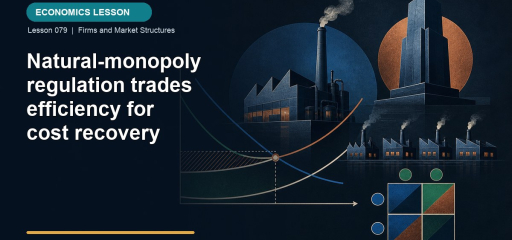
Natural-monopoly regulation trades efficiency for cost recovery: this Effortless Math guide explains the topic in plain language, shows how it works through solved examples, and gives you free practice to try immediately, so the idea sticks instead of staying abstract.
Declining average cost puts MC below ATC.
A regulator wants a natural monopoly to earn a normal return without an operating subsidy. The regulated price is set where
- demand intersects average total cost
- demand intersects marginal revenue
- marginal revenue intersects marginal cost
- average variable cost is minimized
- demand becomes unit elastic
demand intersects average total cost Average-cost regulation chooses the quantity where the demand price covers ATC, allowing normal return.
A city is served most cheaply by one water-pipe network because average cost falls throughout market demand. Which policy most directly addresses the resulting market-power problem?
- Prosecute consumers who reduce water use
- Require several firms to build duplicate pipes regardless of cost
- Regulate the natural monopoly’s price and service conditions
- Impose a corrective pollution tax without evidence of an externality
- Guarantee the provider positive economic profit at every output
Regulate the natural monopoly’s price and service conditions The cost structure favors one network, so economic regulation can constrain price and service without requiring wasteful duplication.
For a natural monopoly with declining average cost over the relevant range, marginal-cost pricing will often
- create economic profit
- raise price above the unregulated monopoly price
- reduce output below monopoly output
- produce a loss that may require a subsidy
- set price equal to average total cost automatically
produce a loss that may require a subsidy With declining average cost, marginal cost lies below average cost. Setting price equal to MC therefore fails to cover total cost.
Watch the idea in action
A focused video lesson from DiagKNOWstics Learning.
Marginal-cost pricing sets P=MC and reaches the efficient quantity, but revenue may not cover total cost. A subsidy can cover the loss but requires tax funds and information. Average-cost pricing sets P=ATC, allowing normal profit without subsidy, but price remains above MC and output below efficient quantity.
Natural monopoly arises when large fixed network costs and scale economies make ATC decline across relevant demand. With falling ATC, MC lies below ATC. Pricing at MC therefore gives revenue MC× Q below total cost ATC× Q. The resulting loss is structural, not evidence of waste by itself.
Average-cost pricing chooses the demand quantity where P=ATC. The utility covers economic cost and earns normal profit. Because ATC>MC, some buyers whose willingness to pay exceeds MC are still excluded, so a smaller deadweight loss remains. The rule trades some allocative efficiency for financial viability.
| Rule | Main advantage | Main problem |
|---|---|---|
| Marginal-cost pricing | Efficient quantity. P=MC |
Revenue below total cost. Subsidy needed |
| Average-cost pricing | Covers economic cost. P=ATC |
P>MC and output below efficient level |
| Unregulated monopoly | No subsidy or cost guarantee | Higher price, lower output, monopoly profit/DWL |
Rate-of-return regulation lets a utility recover approved cost plus a return, but it can weaken cost control or encourage excessive capital use. Price-cap regulation lets the firm keep savings for a period, strengthening efficiency incentives while requiring regulators to monitor service quality. Both respond to natural monopoly without creating identical incentives.
Under rate-of-return regulation, higher reported cost can justify higher allowed revenue, weakening the reward for cost saving. The firm may prefer capital-heavy methods if the approved return applies to capital. A price cap sets a maximum price path, allowing temporary profit from reducing cost. This strengthens incentives but may encourage quality reduction if quality is difficult to observe.
The cost-recovery gap
At 1,000 units, efficient price equals MC of $4, while ATC is $7. Marginal-cost pricing yields $4,000 revenue against $7,000 cost, a $3,000 loss. Average-cost pricing at $7 can cover cost but moves to a smaller quantity on demand. The regulator cannot obtain both full cost recovery and P=MC without another funding source.
A subsidy itself has opportunity cost and may require distortionary taxation. Regulators also need information about the firm’s true cost. The basic graph identifies the tradeoff. It does not make implementation costless.
Natural monopoly regulation differs from antitrust breakup. Splitting one declining-cost network may duplicate fixed infrastructure and raise average cost. The policy question becomes how to constrain price and preserve service while recognizing the cost structure.
Regulators also face an information problem: the firm knows more about its efficient cost than the regulator. A guaranteed cost recovery rule can weaken savings, while an aggressive cap can threaten quality or investment. The static P=MC and P=ATC graph is the starting point, not the whole administrative problem.
Breaking up a natural monopoly may duplicate the large fixed network and raise total cost. This is why policy can regulate a single provider rather than force textbook competition. The cost structure determines the instrument.

Reza is an experienced Math instructor and a test-prep expert who has been tutoring students since 2008. He has helped many students raise their standardized test scores--and attend the colleges of their dreams. He works with students individually and in group settings, he tutors both live and online Math courses and the Math portion of standardized tests. He provides an individualized custom learning plan and the personalized attention that makes a difference in how students view math.
Related to This Article
More math articles
- Atoms and Their Parts
- Free Grade 3 English Worksheets for Maryland Students
- SHSAT Math Worksheets: FREE & Printable
- Symbolic speech
- Michigan Algebra 1 Free Worksheets: Free Standards-Aligned Algebra 1 Worksheets, Answers Included
- Best Smartphones for Math Teachers
- The Best Grade 6 ELA Practice Tests for Louisiana Students
- The Best Grade 8 Math Book for New Jersey Students
- The Best Grade 5 Math Book for Kentucky Students
- Physical Monitoring, Cooling, Staging, and Handling






















What people say about "Natural Monopoly Regulation and Cost Recovery"?
No one replied yet.