Atoms and Their Parts
Everything around you is made of atoms — the tiny building blocks of all matter. Atoms are far too small to see, but their structure is simple enough to sketch, and knowing the three particles inside them explains a great deal of chemistry. This lesson introduces the atom and its parts.
The Three Particles
An atom has three kinds of particles. Protons carry a positive charge and sit in the center. Neutrons have no charge and sit in the center alongside the protons. Together, protons and neutrons form the nucleus, the dense core of the atom. Electrons carry a negative charge and move around the nucleus in regions called shells.
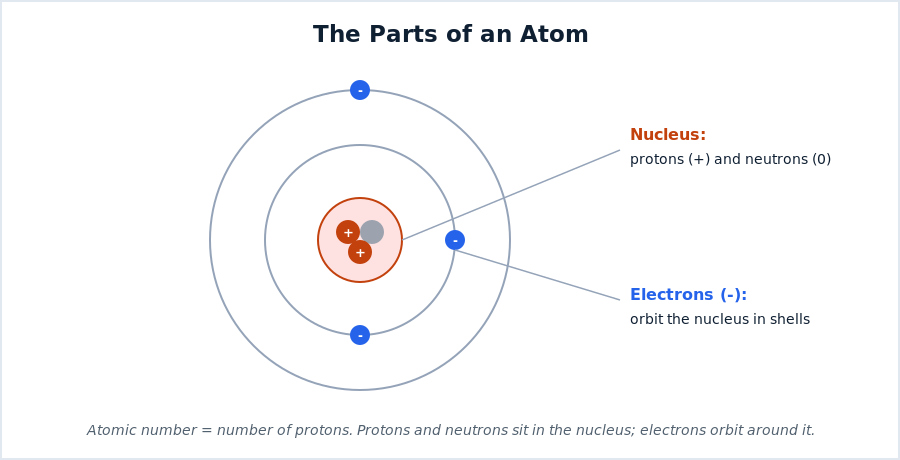
A simple way to keep them straight: protons are positive and in the center, neutrons are neutral and in the center, and electrons are negative and on the outside.
Atomic Number and Charge
The number of protons is called the atomic number, and it defines which element an atom is. An atom with 6 protons is always carbon; one with 8 is always oxygen. In a neutral atom, the number of electrons equals the number of protons, so the positive and negative charges balance out. If an atom gains or loses electrons, it becomes charged and is called an ion.
Why the Structure Matters
Almost all of chemistry comes back to these particles. Electrons on the outside are what let atoms bond and react. The number of protons tells you the element. The nucleus holds most of the atom’s mass. When the test asks about atomic number, charge, or what makes one element different from another, it is really asking about protons, neutrons, and electrons.
Watch: A Short Video Lesson
Khan Academy walks through this skill clearly in a few minutes. It is a helpful companion to the reading above:
A Routine for Atom Questions
- Protons (+) and neutrons (0) are in the nucleus; electrons (-) orbit outside.
- Atomic number = number of protons = the element’s identity.
- A neutral atom has equal protons and electrons.
- Gain or lose electrons and the atom becomes an ion.
Practice
- Which particle is positive?
- Which particle has no charge?
- Where are electrons found?
- What does the atomic number tell you?
- In a neutral atom, how do the numbers of protons and electrons compare?
- What is an atom called after it gains or loses electrons?
Answers
- The proton.
- The neutron.
- Orbiting the nucleus in shells.
- The number of protons, which identifies the element.
- They are equal.
- An ion.
Where This Fits in Your Science Prep
Atoms are the foundation of chemistry. Next, see how atoms combine in elements, compounds, and mixtures, then how they rearrange in chemical reactions. See all topics on the Science Topics Hub.

Related to This Article
More math articles
- Political tolerance
- Other Topics Puzzle – Challenge 98
- SSAT Middle Level Math FREE Sample Practice Questions
- Free Grade 8 English Worksheets for North Carolina Students
- How to Break Fractions and Mixed Numbers Apart to Add or Subtract
- Evolution and Natural Selection
- Equivalent Fractions for 4th Grade
- How to Evaluate Credit Reports: Personal Financial Literacy
- Free Grade 4 English Worksheets for ACT Aspire Students
- Hard and soft money



















What people say about "Atoms and Their Parts"?
No one replied yet.