Plant Structure and Function: A Beginner’s Guide
A growing fruit can depend on a leaf several branches away, where light capture supplies energy for sugar production and transport tissues connect the exporting leaf with the fruit. Plant organs work together even when their different jobs are not visible from outside.
Roots anchor a plant and absorb water and mineral ions. Stems support the shoot and connect its transport tissues. Leaves provide surfaces for light capture and gas exchange. Each organ contains several tissue systems. A leaf combines photosynthetic cells with protective surface layers and vascular bundles that carry water, sugars, and other substances between the leaf and the rest of the plant.
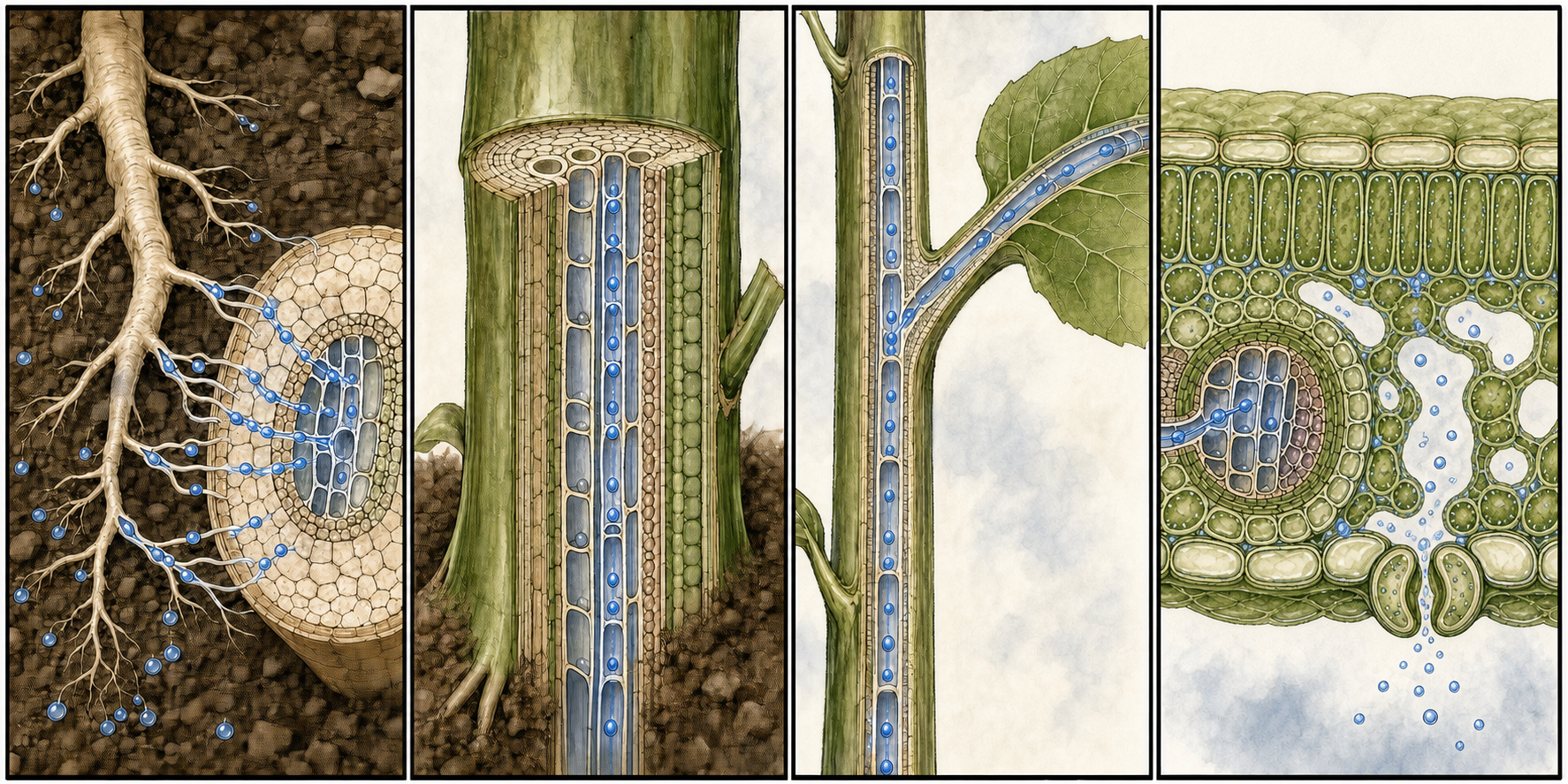
Trace water from soil to air
Root hairs are extensions of epidermal cells. By extending into the thin water films around soil particles, root hairs increase the surface available for water entry before water moves toward vascular tissue along a water-potential path.
Xylem carries water and dissolved minerals through reinforced conducting cells, with evaporation from leaf cell surfaces helping create tension in the connected water column. Cohesion between water molecules transmits that pull through the xylem. The visible droplets in a teaching illustration are symbols for water movement, not separated drops traveling through an air-filled pipe.
Stomata connect internal leaf air spaces with the atmosphere. Opening them permits carbon dioxide entry and increases water-vapor loss. Guard cells adjust the openings. During drought, closure can conserve water while restricting the carbon dioxide available for photosynthesis.
Follow sugar from source to sink
Phloem distributes sugars and other organic solutes. A mature leaf exporting newly made sugar acts as a source for a growing fruit, root, or young leaf that imports the sugar and acts as a sink. Storage organs can switch roles as a plant’s needs change.
Because a sink may lie above or below a source, phloem transport cannot be described reliably as always downward. Different tubes can carry material in different directions. The source-to-sink relationship identifies the direction for a particular pathway.
Removing a complete ring of bark can interrupt phloem while initially leaving much of the inner xylem intact. As sugars accumulate above the interruption and roots below receive less, water may continue rising for a time, but damage to the carbohydrate supply eventually affects the living roots.
Growth continues at meristems
Cells divide in regions called meristems. Apical meristems at root and shoot tips contribute to lengthening. Lateral meristems increase thickness in many woody plants. The new cells enlarge and specialize as tissues develop.
A shoot bending toward light grows unequally on its two sides. Hormone signaling helps coordinate that response. Plants can also respond to gravity, touch, water availability, and seasonal cues. These responses involve physiological changes and growth rather than animal-like muscles.
Distinguish pollen arrival from fertilization
A pollen grain is the male gametophyte of a seed plant, and pollination in flowering plants delivers that grain to a stigma where further development can begin. A compatible grain can grow a pollen tube that carries sperm toward an ovule. Fertilization occurs when gametes fuse.
An ovule can then develop into a seed containing an embryo, stored resources, and a protective coat. The ovary contributes to the fruit, and other floral tissues contribute in some species. Germination resumes embryo growth when suitable conditions permit.
The carbon in much of a plant’s dry organic matter came from carbon dioxide. Soil supplies essential minerals and water, but it is not the main source of that carbon. Plants also respire, transferring energy from organic molecules into forms their cells can use.
Watch a short lesson
This verified Khan Academy lesson introduces xylem and phloem. Listen for the different cargo each tissue carries and the reason plants need two long-distance transport systems.
Can you check your understanding?
Answer before opening each explanation.
-
What are root hairs?
Check the answer
Narrow extensions of root epidermal cells that increase contact with soil water.
-
What helps pull water through xylem?
Check the answer
Evaporation from leaves creates tension, and cohesion helps transmit the pull through a connected water column.
-
Why is a growing fruit a sink?
Check the answer
It imports sugars and uses or stores them during development.
-
What tradeoff follows stomatal opening?
Check the answer
Carbon dioxide can enter, while water vapor can escape more readily.
-
Is pollen the same as a sperm cell?
Check the answer
No. A pollen grain is a male gametophyte. It produces or carries sperm cells, depending on the stage and species.
-
Does pollination guarantee fertilization?
Check the answer
No. Pollen must be compatible and complete further steps, including tube growth and delivery of sperm to the female gametophyte.
Where does plant biology connect to other topics?
Plant function brings together cell transport, photosynthesis and cellular respiration, reproduction, and ecology and ecosystems. Return to the Biology Learning Hub for every chapter lesson.

Related to This Article
More math articles
- What does TSI Test Stand for?
- 3rd Grade OSTP Math Worksheets: FREE & Printable
- Is a Calculator Allowed on the CBEST Test?
- Oregon Algebra 1 Free Worksheets: Printable Algebra 1 Practice with Answer Keys
- How to Understand Co-Function, Even-Odd, and Periodicity Identities in Trigonometry
- Slope from Two Points Practice — Free Drills
- ISEE Lower Level Math Flashcards (Free Online: Formulas, Terms & Concepts)
- The Challenge for The Future of Math Education
- CPA FAR Blueprint: What to Recheck in a Course (2027 Prep)
- ATI TEAS 7 Math Practice Test Questions






















What people say about "Plant Structure and Function: A Beginner's Guide"?
No one replied yet.