The Reproductive Systems
Students often see the reproductive systems as a cluster of new terms. A steadier route is to connect Testes with Ovaries, then place Uterine tube and Uterus into the same working picture.
Definition: The reproductive systems produce gametes and sex hormones and provide pathways for fertilization and development. Sperm form in the testes; oocytes develop in the ovaries. Fertilization most often occurs in a uterine tube, while implantation and fetal development occur in the uterus.
What do you need to know about the reproductive systems?
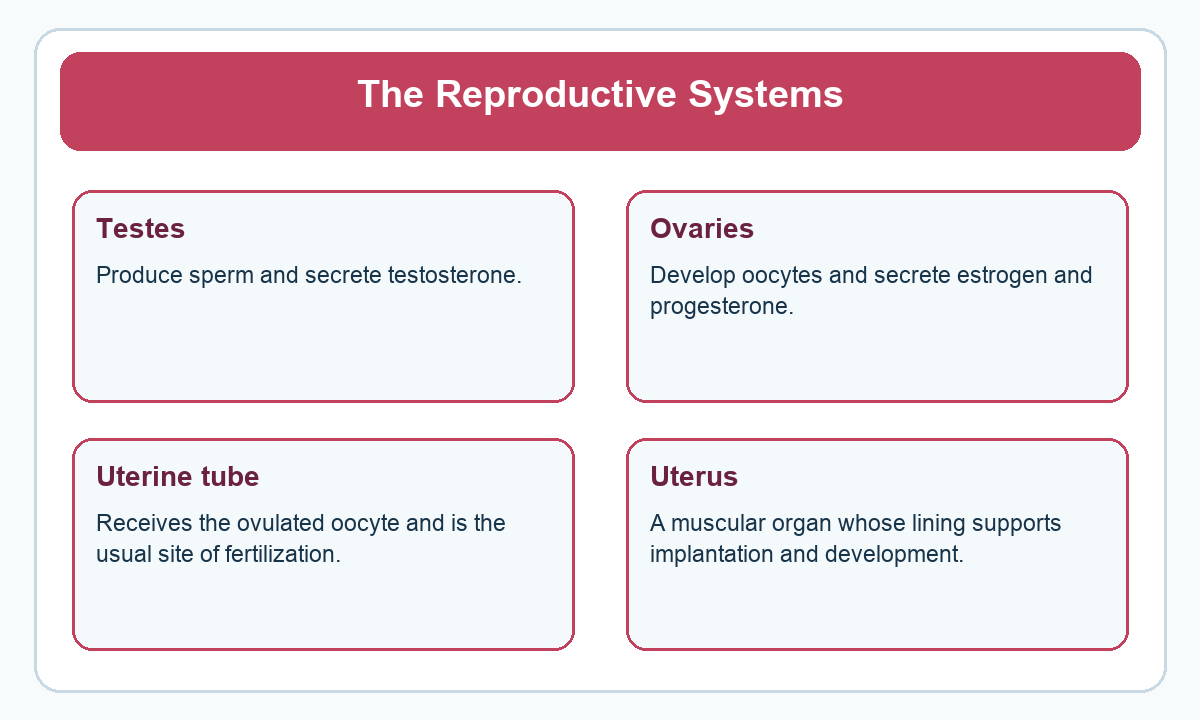
Use the visual as a recall tool: read the Testes box, cover it, and explain it from memory. Repeat that move for Ovaries, Uterine tube, and Uterus; then explain how the four ideas connect.
What should you remember about the reproductive systems?
| Idea | What it means |
|---|---|
| Testes | Produce sperm and secrete testosterone. |
| Ovaries | Develop oocytes and secrete estrogen and progesterone. |
| Uterine tube | Receives the ovulated oocyte and is the usual site of fertilization. |
| Uterus | A muscular organ whose lining supports implantation and development. |
How can each anchor help you answer a question?
Testes as a question clue
Produce sperm and secrete testosterone. A useful contrast is ovaries: develop oocytes and secrete estrogen and progesterone.
Ovaries as a question clue
Develop oocytes and secrete estrogen and progesterone. A useful contrast is uterine tube: receives the ovulated oocyte and is the usual site of fertilization.
Uterine tube as a question clue
Receives the ovulated oocyte and is the usual site of fertilization. A useful contrast is uterus: a muscular organ whose lining supports implantation and development.
Uterus as a question clue
A muscular organ whose lining supports implantation and development. A useful contrast is testes: produce sperm and secrete testosterone.
What else helps this topic make sense?
Hormonal cycles coordinate gamete development with changes in reproductive tissues. In the ovarian cycle, follicle development, ovulation, and formation of the corpus luteum occur in sequence. Hormones from these structures influence the uterine lining. If pregnancy does not occur, changing hormone levels contribute to shedding of that lining. The safest way to study the cycle is to track structure, hormone, and tissue response together rather than memorizing isolated dates.
How does this idea work in a real question?
After ovulation, an oocyte enters a uterine tube. If fertilization occurs, early cell divisions begin as the developing structure moves toward the uterus. Implantation normally occurs in the uterine lining, not in the ovary or tube.
For this example, first identify which of the four anchors is changing or acting. Follow its effect through the situation and name the result before comparing choices. This keeps your reasoning tied to evidence rather than to a familiar-looking term.
What is a reliable way to reason through it?
- Decide whether the question is mainly about Testes, Ovaries, Uterine tube, or Uterus.
- Restate the job of the named idea before reading the answer choices.
- Use the Testes, Uterus map above to trace direction, cause, evidence, or outcome in the order supplied.
- Test the remaining choice against this specific warning: Ovulation and menstruation are not the same event. Ovulation releases an oocyte; menstruation sheds part of the uterine lining when pregnancy has not occurred.
What mistake should you watch for?
Ovulation and menstruation are not the same event. Ovulation releases an oocyte; menstruation sheds part of the uterine lining when pregnancy has not occurred.
If two choices survive, ask which one preserves the stated relationship between Testes and Ovaries. Then check it against Uterine tube or Uterus if either appears in the prompt.
Watch a short lesson
The reproduction-and-development video provides a system overview and follows major events from gamete production through development. Pause the lesson when a diagram or process appears and connect it with the four anchors in this page’s visual.
Can you check your understanding?
Try these six checks from memory. Open an answer only after you have said or written your own response.
-
In your own words, what is the central idea in this lesson?
Check the answer
The reproductive systems produce gametes and sex hormones and provide pathways for fertilization and development. Sperm form in the testes; oocytes develop in the ovaries. Fertilization most often occurs in a uterine tube, while implantation and fetal development occur in the uterus.
-
What should you remember about testes?
Check the answer
Produce sperm and secrete testosterone.
-
What should you remember about ovaries?
Check the answer
Develop oocytes and secrete estrogen and progesterone.
-
What should you remember about uterine tube?
Check the answer
Receives the ovulated oocyte and is the usual site of fertilization.
-
What should you remember about uterus?
Check the answer
A muscular organ whose lining supports implantation and development.
-
What final check is most useful for a question about the reproductive systems?
Check the answer
Compare the choice with the relationship among Testes, Ovaries, Uterine tube, and Uterus. Then apply this warning: Ovulation and menstruation are not the same event. Ovulation releases an oocyte; menstruation sheds part of the uterine lining when pregnancy has not occurred.
Where does this fit in your science review?
The ATI TEAS Science Study Hub places this lesson inside the larger anatomy and physiology review. Continue with these connected lessons:
- The Immune and Lymphatic Systems
- How Body Systems Work Together
- The Urinary System
- The Digestive System
Recommended ATI TEAS resources

Related to This Article
More math articles
- Descriptive Statistics Calculator — Mean, SD, Quartiles (Free)
- The Best Grade 6 ELA Practice Tests for California Students
- How to Use Graphs to Write Proportional Relationship
- How to Add and Subtract Rational Numbers
- Distance Measurements
- 7th Grade NYSE Math Practice Test Questions
- Exterior Angle Theorem
- CHSPE Math-Test Day Tips
- How Probability Models Shape Decision-Making Across Finance, Gaming, And Online Platforms
- The Best Grade 7 Math Book for Mississippi Students













What people say about "ATI TEAS 7: The Reproductive Systems"?
No one replied yet.