The Legal Campaign, the Clark Studies, and Brown v. Board
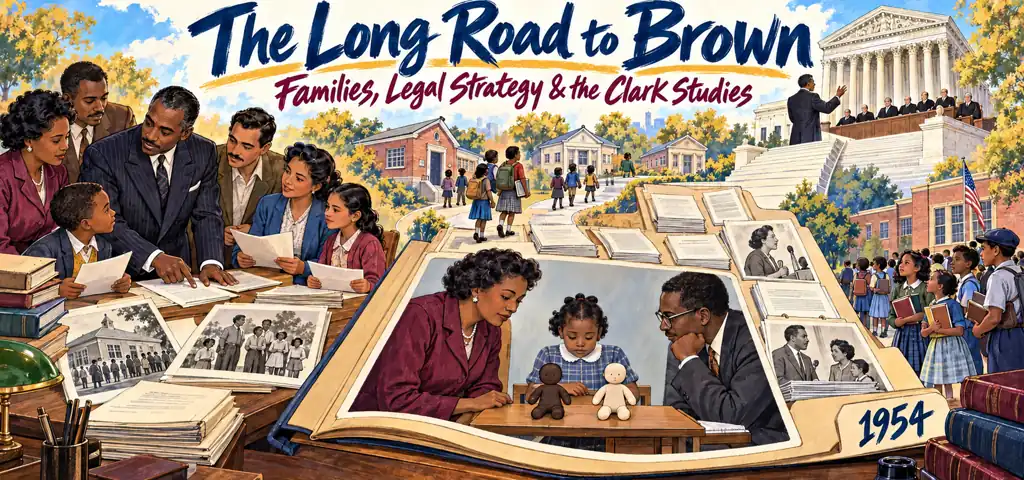
Chapter 13 of the CLEP History of the United States II study guide on Effortless Math covers The Legal Campaign, the Clark Studies, and Brown v. Board: the key terms, the core ideas, and worked examples showing how this topic is tested on the exam.
CLEP History of the United States II, Chapter 13
A courtroom campaign began with people who had already taken serious risks
In 1931 nine Black teenagers accused at Scottsboro, Alabama, faced hurried capital trials, all-white juries, and lawyers who had almost no time to prepare. The Supreme Court's ruling in Powell v. Alabama required meaningful counsel in a capital case. It did not dismantle Jim Crow, but it exposed how procedure could hide racial power behind the appearance of a trial. The later school campaign likewise turned individual injuries into constitutional records.
Charles Hamilton Houston attacked the weakest legal seams first
Houston, dean of Howard Law School and later NAACP counsel, trained lawyers to make states prove the equality promised by Plessy. Graduate and professional schools were strategic targets because southern states rarely maintained separate Black law or graduate programs. In Murray, Gaines, Sweatt, and McLaurin, litigation made delay, distance, faculty, libraries, reputation, and professional contact part of the equality question. Thurgood Marshall carried that method toward elementary and secondary schools.
Equalization campaigns changed state budgets without making segregation equal
NAACP suits prompted some southern officials to raise spending for Black schools during the 1940s and early 1950s. New buildings, buses, and teacher salaries narrowed visible gaps, particularly where officials hoped to defend segregation in court. That spending mattered to students, yet it could not reproduce the networks and social standing of established white institutions. More important, Brown ultimately rejected the premise that a dual public-school system could be made constitutional through matched expenditures.
Other cases broadened the meaning of state action
In Smith v. Allwright (1944), the Court held that a party primary selecting nominees for public office performed a public function. Texas therefore could not evade the Fifteenth Amendment by calling its white primary private. Black registration rose after the ruling as veterans and NAACP branches organized drives. The case supplied a useful legal habit: ask whether nominally private machinery actually exercises governmental power. That habit also shaped challenges to courts enforcing restrictive housing covenants.
Community organization could make litigation possible outside the Black-white South
When the Lemon Grove, California, school board sent Mexican American children to a separate building in 1931, parents formed a neighborhood committee, boycotted the makeshift school, and secured a state-court order admitting the children to the regular school. The case did not establish a nationwide constitutional rule. It does show that desegregation history included Mexican American families and that a lawsuit depended on coordinated families willing to supply plaintiffs, testimony, money, and sustained attendance.
New scholarship challenged the history used to justify disfranchisement
The Dunning School had depicted Reconstruction as a tragic period of misrule imposed on an incapable South. W. E. B. Du Bois's Black Reconstruction in America (1935) instead treated freedpeople as workers, voters, soldiers, officeholders, and active makers of democracy. Gunnar Myrdal's An American Dilemma (1944) framed segregation as a conflict between the American creed of equality and discriminatory practice. Historical interpretation became part of a wider argument over whether racial hierarchy was natural or politically constructed.
War expanded the organizations that could sustain a legal campaign
NAACP membership grew from roughly fifty thousand in 1940 to several hundred thousand by the war's end. Defense work, military service, the Double V campaign, and Allied claims about democracy drew new members into branches. Ella Baker and other organizers helped convert membership into durable local action. After Smith, veterans and branch activists confronted registrars across the South. A Supreme Court victory mattered most when an organization could translate a rule into applications, witnesses, follow-up suits, and protection against retaliation.
The Clark studies supplied social evidence about segregation's injury
Kenneth and Mamie Clark asked children to choose between otherwise similar white and brown dolls and examined how children assigned positive or negative qualities. The results suggested that a racial order could damage children's self-perception. Social science entered the record in the South Carolina case Briggs v. Elliott, later consolidated into Brown. The Supreme Court cited psychological studies in a footnote, but its constitutional holding did not rest on a doll experiment alone. Law, school history, testimony, and the status imposed by separation all mattered.
Brown rejected state-imposed separation in public schools
On May 17, 1954, a unanimous Court held that separate public schools are inherently unequal under the Fourteenth Amendment. Chief Justice Earl Warren emphasized education's central place in citizenship and the stigma imposed when government separates children by race. Brown did not outlaw every private discriminatory act, dictate a single integration plan, or instantly enroll children together. It invalidated the state rule supporting dual school systems; implementation required later orders, district litigation, executive enforcement, and local action.
Cold War diplomacy strengthened the federal government's interest
The Justice Department's brief warned that segregation damaged American standing as newly independent African and Asian nations assessed rival Cold War claims. Soviet broadcasts used racial violence and Jim Crow as evidence against United States professions of freedom. This argument did not create the children's constitutional right, but it shows why domestic racial policy had foreign-policy costs. International pressure and constitutional principle can reinforce one another without becoming the same causal claim.
separate a ruling from the machinery that makes it usable
Suppose registration rises after Smith and school spending rises before Brown.
A sound interpretation neither dismisses social science nor makes it the whole case
A common misconception says the Clark dolls "proved" segregation unconstitutional. The studies offered evidence of harm; constitutional judgment still concerned state action and equal protection. Another error treats Brown as the opening of civil-rights history. Scottsboro defense work, Lemon Grove parents, Du Bois's revision of Reconstruction, wartime NAACP growth, graduate-school cases, white-primary litigation, and local equalization suits had already built legal ideas, trained personnel, and organized constituencies. Brown was a decisive turn in a long campaign.
Watch the history in motion
This short lesson adds voices, images, and chronology to the ideas you just studied.
Video: Landmark Cases: Brown v Board Doll Test (C-SPAN), C-SPAN.
Try four CLEP-style questions
- Which pair of developments most directly narrowed two different defenses of Jim Crow before Brown?
- Wartime NAACP branches expanded legal capacity, while white-primary litigation treated nominating elections as private clubs.
- Scottsboro appeals required meaningful counsel, while school equalization suits transferred control of education to Congress.
- Lemon Grove parents challenged a local separation order, while Clark's studies measured interstate differences in school finance.
- Du Bois recast freedpeople as political actors, while Myrdal argued that discriminatory practice fulfilled the American creed.
- Graduate-school suits exposed facilities states could not duplicate, while voting suits treated party primaries as public action.
- A state sharply raises spending on Black schools after litigation begins. What is the strongest interpretation of that evidence?
- The state had accepted integrated schooling but lacked a timetable for transfer.
- The Supreme Court had required identical per-pupil spending in every district.
- Officials tried to preserve segregation by making the facilities appear more equal.
- Black parents had shifted their campaign away from courts and toward taxation.
- Federal education grants had replaced local revenue throughout the South.
- What did the Lemon Grove campaign and the NAACP school campaign have most clearly in common?
- Both relied chiefly on psychological studies rather than testimony about school administration.
- Both relied chiefly on federal judges to impose one statewide remedy from the start of litigation.
- Both asked states to create genuinely equal separate schools rather than admit children together.
- Both depended on organized families and communities to turn exclusion into a litigated record.
- Both ended when local boards adopted integration plans before a court issued judgment.
- Which chronology of legal and intellectual milestones is correct?
- Brown v. Board, Lemon Grove school challenge, Smith v. Allwright, Du Bois's Black Reconstruction
- Du Bois's Black Reconstruction, Scottsboro appeals, Smith v. Allwright, Lemon Grove school challenge
- Lemon Grove school challenge, Scottsboro appeals, Smith v. Allwright, Brown v. Board
- Scottsboro appeals, Lemon Grove school challenge, Myrdal's American Dilemma, Brown v. Board
- Smith v. Allwright, Scottsboro appeals, Du Bois's Black Reconstruction, Brown v. Board
Check your answers and reasoning
Independent preparation. CLEP is a registered trademark of the College Board, which does not endorse this lesson.

Related to This Article
More math articles
- 3rd Grade LEAP Math Worksheets: FREE & Printable
- FREE Praxis Core Math Practice Test
- How to Write Two-variable Inequalities Word Problems?
- Top 10 Tips to Overcome SSAT Math Anxiety
- How to Find a Coordinate: Dilation
- 4th Grade SBAC Math FREE Sample Practice Questions
- How to Perform Operations of Decimals: Word Problems
- The Best Grade 3 ELA Practice Tests for Georgia Students
- Math Tutor Online: Practice Guide
- The Vermont SBAC Grade 3 Math Worksheet Set — 49 Free Printable PDFs













What people say about "The Legal Campaign and Brown v. Board"?
No one replied yet.