Massive Resistance and Little Rock
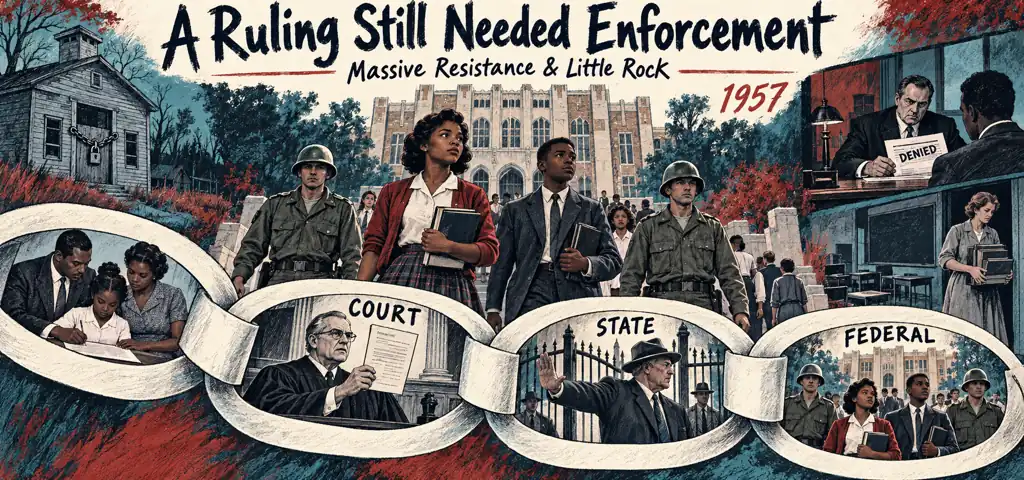
Chapter 13 of the CLEP History of the United States II study guide on Effortless Math covers Massive Resistance and Little Rock: the key terms, the core ideas, and worked examples showing how this topic is tested on the exam.
CLEP History of the United States II, Chapter 13
Brown created a duty before it supplied an enforcement plan
After the 1954 ruling, school boards, judges, governors, families, and federal officials still had to decide what compliance meant. The Court's 1955 implementation decision, often called Brown II, ordered desegregation with "all deliberate speed." The phrase gave district judges flexibility, but resistant officials turned flexibility into delay. Enrollment plans, attendance zones, pupil-placement rules, and school construction became contested administrative tools. The central question shifted from whether state segregation was lawful to who would make a reluctant district obey.
The Southern Manifesto gave political cover to defiance
In 1956, 101 southern members of Congress signed the Declaration of Constitutional Principles. It attacked Brown as an abuse of judicial power and urged resistance through lawful means. The document could not overturn a judgment or bind a school district. Its importance was political: it made delay respectable, warned white officeholders that compliance could end careers, and linked local obstruction to a regional defense of states' rights. A declaration without legal force can still change the risks facing administrators.
Citizens' Councils enforced resistance through everyday economic power
The councils that spread from Mississippi after 1954 presented themselves as respectable alternatives to the Ku Klux Klan. Bankers could call loans, merchants could deny credit, and employers could dismiss Black residents who signed petitions or sought integration. Such retaliation rarely required a new segregation statute. It worked through unequal access to jobs, land, and credit. The lesson is institutional: coercion can be decentralized and formally private while serving a public campaign of resistance.
Black travelers already knew that formal citizenship did not ensure safe access
From 1936 into the 1960s, Victor Hugo Green's Negro Motorist Green Book listed hotels, tourist homes, restaurants, and service stations willing to serve Black customers. The guide helped families navigate sundown towns and exclusion along expanding highways. It did not celebrate a separate travel culture as equal. Its practical usefulness documented the reach of discrimination beyond schools and showed why mobility required information networks until public-accommodations law changed.
Little Rock made federal authority visible
Arkansas governor Orval Faubus used the National Guard to block nine Black students from Central High School in September 1957. A federal judge had ordered their admission. President Dwight Eisenhower then federalized the Guard and sent troops from the 101st Airborne Division to enforce the order. Eisenhower did not announce a broad social crusade; he insisted that state officials could not nullify federal law. Soldiers escorted students, but military protection could not prevent every insult, attack, or later local maneuver.
Closing a school system could preserve exclusion at enormous public cost
Prince Edward County, Virginia, shut its public schools from 1959 through 1964 rather than desegregate them. Public tuition grants helped white children attend a private academy, while many Black children lost years of formal schooling unless families or outside groups found alternatives. The episode was more than delay. Officials withdrew a public institution to avoid operating it equally, revealing how local control could be used to distribute education as a racial privilege.
Ole Miss repeated the enforcement conflict at a state university
In 1962 James Meredith tried to register at the University of Mississippi under a federal court order. Governor Ross Barnett blocked him. Federal marshals arrived, a riot left two people dead, and President John Kennedy sent army units to restore order and secure Meredith's enrollment. Little Rock and Ole Miss therefore share an enforcement structure: a plaintiff wins in federal court, a governor obstructs, and the executive supplies force. They differ in institution, president, and scale of violence.
Desegregation could dismantle Black institutions as well as dual enrollment
When southern districts finally accelerated desegregation after 1968, officials often closed Black schools and dismissed or demoted Black teachers and principals. White schools and personnel were more likely to remain the institutional norm. Students gained access to previously white facilities, yet Black communities lost educators, school names, leadership positions, and neighborhood institutions. Counting bodies in integrated classrooms alone can miss who paid the organizational cost of merger.
Northern school segregation produced its own mass confrontation
In February 1964 nearly half of New York City's public-school pupils stayed home during a one-day boycott. Organizers demanded a Board of Education timetable for desegregation. There was no southern statute commanding separate schools; residential segregation, attendance zones, administrative decisions, and unequal neighborhoods produced racial concentration. The boycott prevents a regional shortcut: resistance in the South often defended explicit dual systems, while northern officials could deny responsibility for segregation created through housing and district practice.
trace the full enforcement chain
A photograph shows federal troops escorting students through a hostile crowd.
Massive resistance changed form as courts closed one route
A common misconception reduces resistance to mobs. Crowds mattered, but legislators wrote placement laws, counties closed schools, councils applied credit pressure, governors created confrontations, and districts displaced Black educators. Another misconception treats federal force as the end of the problem. Little Rock and Ole Miss secured particular enrollments; they did not produce immediate regional compliance. By the mid-1960s, federal funding threats and stronger court orders would make continued delay more expensive.
Watch the history in motion
This short lesson adds voices, images, and chronology to the ideas you just studied.
Video: GCSE USA L12 Little Rock Nine, Ms. M Stevenson.
Try four CLEP-style questions
- What gave the Southern Manifesto its chief influence despite its lack of legal force?
- It authorized governors to command federal troops during school disputes.
- It replaced district-court supervision with congressional school boards.
- It made regional defiance politically respectable for southern officeholders.
- It funded private academies in counties that closed public schools.
- It reversed Brown through a new interpretation of equal protection.
- Which evidence would best reveal how Citizens' Councils discouraged Black residents from pressing for desegregation?
- Military orders assigning paratroopers to Central High School
- Loan calls, dismissals, and denied credit following petition activity
- Congressional speeches debating the Southern Manifesto
- Lists of accommodations in the Green Book
- Court calendars for university admission litigation
- How did Prince Edward County resistance differ most sharply from the confrontation at Little Rock?
- The county brought its dispute over a state university to court, while Arkansas contested elementary-school attendance zones.
- The county admitted Black students under guard, while Arkansas used tuition grants for all pupils.
- The county challenged a university order, while Arkansas challenged interstate travel rules.
- The county relied on a northern school boycott, while Arkansas relied on a congressional manifesto.
- The county withdrew public schooling, while Arkansas obstructed named students entering an operating school.
- Which timeline of organized resistance runs from earliest to latest?
- Southern Manifesto, Little Rock, Ole Miss, New York school boycott
- Little Rock, Southern Manifesto, Ole Miss, New York school boycott
- Southern Manifesto, Ole Miss, Little Rock, Prince Edward school closure
- Prince Edward school closure, Southern Manifesto, Little Rock, Ole Miss
- Ole Miss, Little Rock, New York school boycott, Southern Manifesto
Check your answers and reasoning
Independent preparation. CLEP is a registered trademark of the College Board, which does not endorse this lesson.

Related to This Article
More math articles
- Capitalization Rules
- 49 Free AASA Grade 3 Math Worksheets for Arizona Students (One Skill Per Page)
- Minerals and Their Identification
- Free Printable Grade 2 English Worksheets for Washington
- The Best Grade 3 ELA Practice Tests for Vermont Students
- Suburbs, Highways, Redlining, and White Flight
- How to Divide Rational Expressions? (+FREE Worksheet!)
- Best Tablet Floor Stands For Online Teaching
- Full-Length 6th Grade PSSA Math Practice Test-Answers and Explanations
- CLEP U.S. History I 081: Mexican-American War and the Treaty of Guadalupe Hidalgo














What people say about "Massive Resistance and Little Rock"?
No one replied yet.