Montgomery, King, and the SCLC
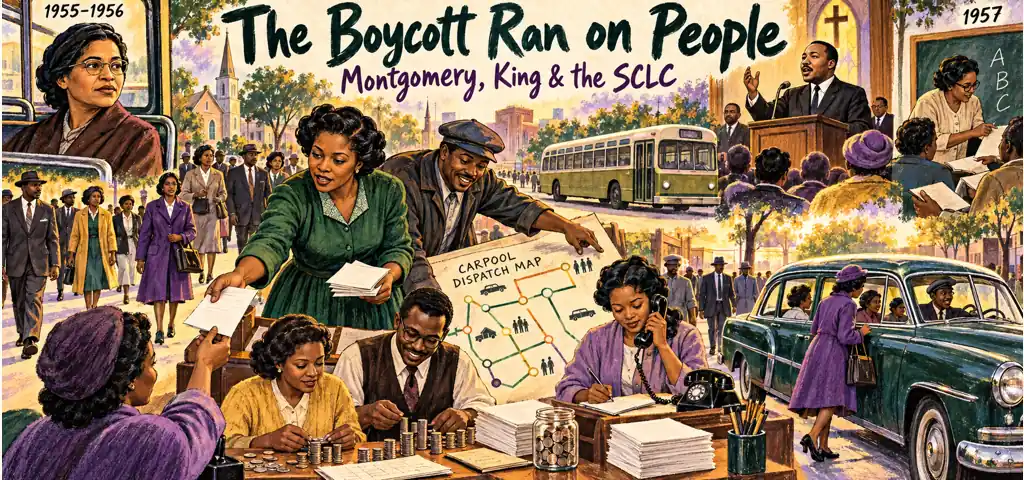
Chapter 13 of the CLEP History of the United States II study guide on Effortless Math covers Montgomery, King, and the SCLC: the key terms, the core ideas, and worked examples showing how this topic is tested on the exam.
CLEP History of the United States II, Chapter 13
The Montgomery boycott grew from prepared people, not a spontaneous moment
Rosa Parks's arrest on December 1, 1955, supplied the immediate trigger, but Parks had served for years as secretary of the Montgomery NAACP and had investigated racial violence, including the assault on Recy Taylor. E. D. Nixon, Jo Ann Robinson, the Women's Political Council, church networks, and local lawyers already knew one another. Their work explains how thousands of leaflets appeared quickly and why a one-day protest became a sustained campaign.
Emmett Till's murder had made racial violence newly visible
Three months before Parks's arrest, fourteen-year-old Emmett Till was murdered in Mississippi. His mother, Mamie Till-Mobley, chose an open-casket funeral and permitted photographs of his body to circulate in the Black press. The images connected southern violence to a national audience and moved many people toward action. Publicity did not itself organize Montgomery, but it changed the emotional and political setting in which local organizers assessed the cost of silence.
A transportation system kept the boycott alive for more than a year
Most Black riders did not own cars, so abstaining from buses required daily coordination. Volunteer drivers, dispatch stations, pickup points, church collections, and outside donations created an organized carpool. Some people walked long distances; Black taxi drivers also helped until officials restricted their fares. The Supreme Court ultimately affirmed the federal ruling against bus segregation. Legal victory and logistical endurance were complementary: neither alone explains the boycott's success.
King joined Christian ethics to Gandhian strategy
Martin Luther King, Jr., a young Montgomery pastor, became the boycott's most visible spokesman. His account of nonviolence drew on the Black church's teaching of redemptive love and on Mohandas Gandhi's campaigns in India. Nonviolence was not passive waiting. It organized disciplined refusal, accepted suffering without retaliatory violence, and sought to expose injustice before a wider public. The method also demanded training, planning, and material support from people whose names rarely reached national newspapers.
The SCLC federated churches and local movements
Leaders formed the Southern Christian Leadership Conference in 1957. Unlike an organization built primarily from individual dues-paying members, SCLC relied on affiliated churches, ministers, and local protest groups. That base provided meeting places, trusted speakers, collections, transportation, and a moral language with deep community reach. It also shaped limits: ministerial leadership could marginalize women who performed essential organizing, and a national campaign still depended on local activists who understood their town.
Citizenship schools tied literacy to political action
Septima Clark, Bernice Robinson, and Esau Jenkins developed citizenship education on the South Carolina Sea Islands through the Highlander Folk School; SCLC later expanded the program. Adults learned reading and writing through voter-registration forms, driver's-license tests, the state constitution, and practical problems. The immediate objective was not an abstract credential. It was to defeat registrars' literacy barriers and strengthen local leadership. Students often became teachers, multiplying capacity across rural communities.
Malcolm X challenged integration and nonviolence from a different position
Before leaving the Nation of Islam in 1964, Malcolm X rejected integration as the central goal, criticized dependence on white approval, and defended Black self-defense. King and SCLC sought interracial democracy through nonviolent mass action. The contrast should not be flattened into violence versus peace: Malcolm distinguished self-defense from initiating violence, while SCLC's campaigns deliberately created confrontation. Both addressed dignity and power, but they proposed different communities, alliances, and means.
Operation Breadbasket carried movement pressure into northern employment
Under Jesse Jackson's leadership in Chicago after 1966, SCLC's Operation Breadbasket asked dairies, bakeries, and supermarket chains how many Black workers they hired and in what jobs. Selective-buying campaigns targeted firms that profited from Black customers while excluding Black employees. The tactic resembled a boycott but focused on hiring and purchasing agreements rather than bus seating or voter registration. Economic pressure remained part of civil rights after headline southern campaigns.
Labor struggles tested whether civil rights included power at work
In 1969 Black women hospital workers in Charleston struck for union recognition, better pay, and a grievance procedure. Local 1199 and SCLC supported them. The dispute joined race, gender, public authority, and workplace organization: employees demanded a voice in discipline as well as higher wages. The campaign complicates any story that ends with a voting or accommodations statute. Formal civil rights could coexist with low pay and arbitrary supervision.
distinguish a trigger from the capacity behind it
A newspaper timeline begins with Parks's arrest and ends with desegregated buses.
SCLC's history is best read as an evolving repertoire
Montgomery showed the power of coordinated withdrawal from a service. Citizenship schools built voters and teachers. Later campaigns sought federal action through demonstrations; Breadbasket targeted private employment; Charleston allied civil rights with organized labor. A common misconception treats SCLC as King speaking at marches. His leadership mattered, but churches, women organizers, teachers, drivers, workers, and local affiliates supplied the institutional reach that made national leadership possible.
Watch the history in motion
This short lesson adds voices, images, and chronology to the ideas you just studied.
Video: Martin Luther King, Jr: Crash Course Black American History #36, CrashCourse.
Try four CLEP-style questions
- Which institution gave SCLC its most distinctive organizational base at its founding?
- A federation of industrial-union locals operating across southern workplaces
- A network of affiliated Black churches and local protest groups
- A legal-defense staff organized around constitutional cases in federal courts
- A coalition of Democratic Party committees from the southern states
- A university association composed chiefly of independent student chapters
- Why is a carpool map especially useful evidence for explaining the Montgomery boycott?
- It shows how a legal brief persuaded the Supreme Court to hear the case.
- It reveals the daily organization that let riders sustain economic withdrawal.
- It records the church sermons that first taught King about Gandhi.
- It identifies which newspapers published photographs of Emmett Till.
- It measures voter registration produced by citizenship-school classes.
- How did citizenship schools and Operation Breadbasket differ in their immediate form of pressure?
- Schools prepared adults to pass registration barriers; Breadbasket organized consumer pressure for jobs.
- Schools petitioned registrars for group appointments; Breadbasket sought EEOC court orders against local firms.
- Schools prepared adults for employment examinations; Breadbasket withheld church deposits from city banks.
- Schools obtained federal grants for adult education; Breadbasket negotiated longer voter-registration hours.
- Schools challenged literacy tests through class actions; Breadbasket trained applicants for clerical examinations.
- Which development came first?
- SCLC's Operation Breadbasket campaign in Chicago
- The Charleston hospital workers' strike
- The expansion of federal voting examiners after Selma
- Malcolm X's departure from the Nation of Islam
- The founding of SCLC after the Montgomery boycott
Check your answers and reasoning
Independent preparation. CLEP is a registered trademark of the College Board, which does not endorse this lesson.

Related to This Article
More math articles
- Grade 3 Math: Telling Time
- Racism, Institutional Discrimination, and Privilege
- Mastering the Lagrange Error Bound for Reliable Function Approximations
- How to Solve Word Problems by Finding Two-Variable Equations?
- The Best Grade 5 ELA Practice Tests for Oregon Students
- CLEP U.S. History I 084: Manifest Destiny as Ideology and Debate
- How to Use Number Lines to Graph Decimals
- Translate every hiring number into a unit
- Biodiversity Made Simple: Richness and Evenness
- Order of Decimals, Mixed Numbers and Fractions









What people say about "Montgomery, King, and the SCLC"?
No one replied yet.