Free Wisconsin Grade 2 English Worksheets
Free Wisconsin Grade 2 English Worksheets: a free, printable set you can download and use right away, with answer keys, organized by topic so students can practice one skill at a time and teachers can assign exactly what a lesson needs.
Printable reading, grammar, and writing practice aligned to Wisconsin’s Grade 2 standards.
There’s a sound every Wisconsin parent of a second grader knows: the steady, unhurried murmur of a kid reading a chapter book to themselves. Not sounding out. Not stopping every other word. Just reading, the way you’d read a recipe or a road sign, and actually following the story while they do it.
That smoothness is the whole win of second grade. First grade was the grind of decoding, where every word took real effort. Now the words come more easily, and a child’s attention is free to land somewhere new: on meaning. They start asking why a character made a choice. They pull facts out of a science book. They write a paragraph that says what they think and gives a reason.
This page collects free Grade 2 English worksheets for that exact stretch of learning. Reading, writing, grammar, spelling, vocabulary, all of it. Every worksheet is a printable PDF, and every one has an answer key. No account to make. No email to fill in. No trial that becomes a bill. Click the title, print the page, you’re done.
Run one for ten minutes after dinner. Hand a few to a tutor. Photocopy a page for an entire class in Milwaukee or Madison. It’s free, and it stays that way.
What’s in this collection
These worksheets cover the Grade 2 English Language Arts standards Wisconsin has adopted, the reading, writing, and language skills a second grader works on across a normal school year. Stories and poems. Articles about real things. Spelling. Grammar. Choosing the right word for the moment.
Everything is grouped into eight strands, and each worksheet focuses on a single skill. That’s deliberate. A second grader learns more from twelve careful minutes on one skill than from a fat packet that brushes everything lightly. Find the skill your child needs this week, and let the rest wait their turn.
Reading: Literature
- Asking and Answering Questions About Stories, drawing who, what, and why right out of a story
- Central Message, Lesson, or Moral, naming the lesson the story is quietly teaching
- How Characters Respond to Events, when trouble shows up, what the character does next
- Rhythm and Meaning in Stories, Poems, and Songs, hearing the beat and rhyme, and why the writer used them
- The Structure of a Story, beginning, middle, end, and how they hold together
- Points of View of Characters, different characters wanting different things in one story
- Using Illustrations to Understand Stories, treating the picture as part of the storytelling
- Comparing Two Versions of the Same Story, one story told twice, and finding what’s different
Reading: Nonfiction
- Asking and Answering Questions About Nonfiction, locating real answers inside a true-facts text
- Main Topic and Focus of Paragraphs, figuring out what a section is mostly about
- Connections Between Events, Ideas, and Steps, tracing how one idea or step leads to the next
- Nonfiction Vocabulary, the science and history words that crop up in true books
- Text Features, headings, bold words, captions, and what they’re each for
- The Author’s Main Purpose, whether the writer meant to teach, explain, or persuade
- How Images Help a Text, when a photo or diagram makes the words clearer
- How Reasons Support the Author’s Points, the because sitting behind an author’s claim
- Comparing Two Texts on the Same Topic, two books, one subject, and what each one offers
Foundational Reading Skills
- Long and Short Vowels, the difference that separates cap from cape
- Vowel Teams, two vowels teaming up, as in ea and oa
- Decoding Two-Syllable Words, breaking longer words into readable pieces
- Prefixes and Suffixes, small add-ons like un- and -ful that reshape a word
- Words with Tricky Spelling Patterns, the spellings that don’t quite follow the rules
- Irregularly Spelled Words (Sight Words), words like was and come you learn by sight
- Reading Fluency: Accuracy, Rate, and Expression, reading smoothly, at a good pace, with expression
- Self-Correcting While You Read, noticing when a sentence breaks down, and fixing it
Writing
- Opinion Writing, stating what you think and giving a reason for it
- Informative and Explanatory Writing, teaching a reader something that’s true
- Narrative Writing, telling a story in order, with details that bring it alive
- Revising and Editing, circling back through a draft to make it stronger
- Shared Research Projects, exploring a topic together and writing down what you learn
- Gathering Information to Answer a Question, tracking down facts that truly answer the question
Speaking and Listening
- Recounting Ideas from a Read-Aloud, listening well, then retelling the important parts
- Asking and Answering Questions About a Speaker, the right questions to raise when someone is presenting
- Telling a Story or Sharing an Experience, speaking clearly so a listener can keep up
Grammar
- Collective Nouns, words that name groups, like team, flock, and bunch
- Irregular Plural Nouns, when mouse becomes mice, not mouses
- Reflexive Pronouns, myself, yourself, himself, and where they go
- Past Tense of Irregular Verbs, went, ate, ran, verbs that skip the -ed
- Adjectives and Adverbs, words that describe things, words that describe actions
- Expanding and Rearranging Sentences, growing a short sentence into a fuller, clearer one
Capitalization, Punctuation, and Spelling
- Capitalizing Holidays, Products, and Place Names, which words deserve a capital, and why
- Commas in Greetings and Closings of Letters, where the comma sits in Dear Aunt Lily,
- Apostrophes: Contractions and Possessives, isn’t and Ben’s, two jobs for one mark
- Spelling Patterns, the patterns that make new words easier to spell
- Using Reference Materials to Check Spelling, looking a word up rather than guessing
Vocabulary and Word Study
- Formal and Informal English, how you talk to a friend vs. How you write to a teacher
- Context Clues, using the rest of the sentence to work out a new word
- Prefixes, how re- and un- turn a word’s meaning around
- Root Words and Word Endings, spotting the base word inside a longer one
- Compound Words, two words joining into one, like sunflower
- Using Glossaries and Dictionaries, finding a word’s meaning the grown-up way
- Real-Life Word Connections, linking new words to things a kid already knows
- Shades of Meaning, the gap between warm, hot, and boiling
- Using Describing Words and New Vocabulary, putting fresh words to use in writing and speech
Making these worth the effort
Here’s the honest truth about free worksheets: a tall printed stack feels like progress, but a stack doesn’t teach a child anything. This small plan does.
One worksheet at a time. One skill, one sitting. A page done slowly, with a real chat about the tricky parts, beats six rushed through and forgotten by bedtime.
Read the Quick Review box together. That box at the top of each worksheet is the lesson itself, not filler. Read it aloud, try the sample together, then your child takes the pencil.
Go through the answer key side by side. Don’t just count rights and wrongs. Sit close and read why each answer works. That’s the part of the worksheet that keeps teaching.
Revisit the weak spots in a week. If your child stumbles on Opinion Writing today, don’t drill it again tonight. Wait six or seven days, then try a different worksheet on the same skill. Spaced practice sticks better than cramming.
A word about the Forward Exam
If you’re a Wisconsin parent, you’ve probably heard of the Forward Exam, the state’s assessment for English language arts and math. Here’s the part that takes the pressure off: Wisconsin students don’t take the Forward Exam English language arts test in second grade. It starts in third grade.
That makes second grade the foundation year, not a testing year. It’s the stretch when a child builds the reading and writing skills the Forward Exam will eventually check on. A second grader who reads smoothly, finds the main idea, and writes a sentence that makes sense is already on solid ground. No test prep, no pressure, just steady, friendly practice, one skill at a time.
If you want a place to begin, Main Topic and Focus of Paragraphs and Context Clues quietly hold up almost everything else. They’re a smart first choice.
Questions Wisconsin families ask
Will these match what’s happening in my child’s classroom? They should fit closely. Each worksheet targets the Grade 2 English Language Arts standards Wisconsin has adopted, the same skills behind classroom lessons across the state.
Is everything really free? Yes. No account, no email, no trial that turns into a charge. The PDF opens, you print it, and the answer key comes with it.
My second grader gets restless during seatwork. What helps? Keep sessions short and do them together. Sitting beside your child changes the whole feeling of it. Ten focused minutes is plenty, and letting them choose the topic helps too.
Are these good for homeschooling? Very. They work as the core practice for a skill or as a quick check after a longer lesson. Wisconsin homeschool families use them at the kitchen table all the time.
My child reads fine but freezes when asked to write. Where do I start? Try Narrative Writing. Telling a story is something most second graders already do out loud all day. This worksheet just helps them get that same energy onto paper.
What if my child is reading below grade level right now? Begin with the foundations. Long and Short Vowels and Vowel Teams rebuild confidence fast, and once decoding is steadier, the rest gets noticeably easier.
One last note
If you print a worksheet tonight and find it half-finished and slightly crumpled in the morning, don’t worry. That’s just second grade. Try a shorter page tomorrow. Try the same skill again next week. A perfect worksheet was never the goal, a kid who keeps practicing and keeps getting steadier is. Come back any time you need the next one.
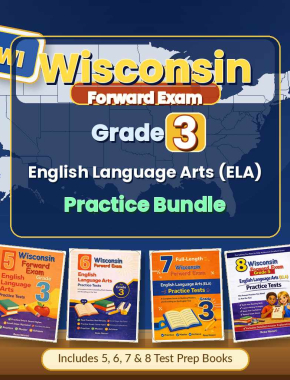
Ready for Grade 3 English? The Wisconsin Forward Grade 3 English Bundle
Second grade is the build-up year, and when your child is ready for what comes next, this bundle makes the jump to Grade 3 English feel easy. It includes four full practice-test books (5 + 6 + 7 + 8 tests) covering the Grade 3 reading, writing, and language skills just ahead, with explained answer keys and an instant PDF download.
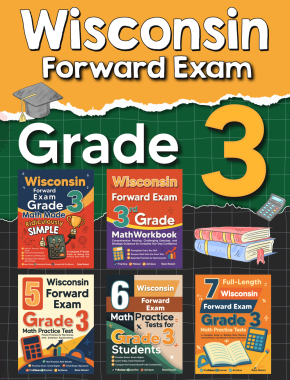
Getting Ready for Grade 3 Math, Too? The Wisconsin Forward Grade 3 Math Bundle
The same jump to Grade 3 happens in math. If your second grader could use a head start there as well, this Wisconsin Forward Grade 3 Math bundle is the shortest path, workbook, study guide, and full practice tests in one instant download, with answer keys throughout.

Related to This Article
More math articles
- The Ultimate GACE Elementary Education Math Course
- Solving One-Step Equations Worksheet with Answers
- The Ultimate PEAKS Algebra 1 Course (+FREE Worksheets)
- Rational and Irrational Numbers: Complete Guide with Video and Examples
- DAT Quantitative Reasoning Math Practice Test Questions
- Unit Converter (Length, Mass, Volume, Temperature & More)
- How to Develop a Love of Math in Your Child!
- Congressional Reconstruction and Johnson’s Impeachment
- What is a Perfect SAT Score?
- FREE 6th Grade MCAS Math Practice Test




What people say about "Wisconsin Grade 2 English Worksheets: Free PDFs"?
No one replied yet.