The Slot Bonus Buy Trap: Math Behind Paying for the Feature
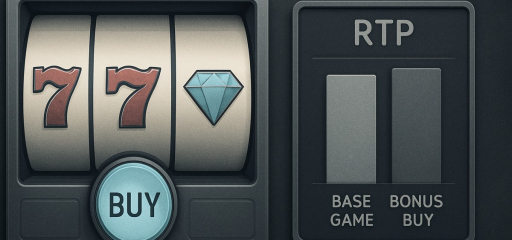
The first time I clicked a “Buy Feature” button on an online slot, I felt the same little dopamine hit I used to get from buying a continue on a 1990s arcade machine. Skip the grind, pay the toll, jump straight to the good part. The marketing language sells exactly that fantasy, no more spinning for ten minutes waiting for three scatters, just pay 100x your bet and the bonus round starts now. I’ve taught probability long enough to know when something feels too convenient, and bonus buys feel exactly that convenient. So let’s actually do the math on bonus buy slots math and figure out what you’re really paying for when you press that shiny button.
What a Bonus Buy Actually Is
On most modern video slots, the “bonus” is a free spins round, a pick-em screen, or a sticky-symbol feature where the bigger wins live. Naturally, that bonus is rare. Triggering it the old-fashioned way, landing three or more scatters, usually happens somewhere between once every 150 spins and once every 500 spins, depending on the game. That’s a long, expensive wait if you’re stake-hunting.
A bonus buy lets you skip the wait. You pay a multiplier of your base stake, often 100x, but it ranges from roughly 50x to 500x, and the game drops you straight into the feature. On a $1 base bet that’s a $100 click. On a $5 base bet that’s $500 per click. The math doesn’t care that the button is small and round. Each press is a high-stakes session compressed into about thirty seconds.
Some games offer multiple buy tiers, a “regular” buy for the standard bonus, an “improved” buy that guarantees better starting modifiers, and a “super” buy at 500x with a fatter top end. The RTP and volatility shift at each tier, and not always in the direction you’d expect.
Why the RTP Numbers Look Like a Sales Pitch
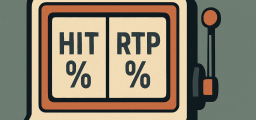
Open the info screen on most bonus-buy slots and you’ll see two RTP figures side by side. The base game might be advertised at 96.5%, while the feature buy sits at 97.0% or even 97.5%. That bump is real, and it’s intentional. Studios know players read those numbers. Selling a higher RTP on the buy makes the button feel like a smart-money play.
Here’s the catch, RTP is a percentage of money wagered, not money you walked in with. A 0.5% bump on a 100x stake doesn’t just give you back more money. It also changes what you’re risking per click, and that’s where the wheels come off. I’ll show you the arithmetic in a minute. First, some real numbers from games people actually play.
Real Slots, Real Numbers
Studios publish RTP information in the game’s paytable or info page. Values shift across jurisdictions and operator configurations, UK-licensed sites no longer see these buttons at all, more on that below, but the table below uses commonly cited figures from the developers’ documentation. Treat them as ballpark; the relative gaps are what matter.
| Slot | Studio | Base Game RTP | Bonus Buy Cost | Bonus Buy RTP |
|---|---|---|---|---|
| Money Train 2 | Relax Gaming | 96.40% | 100x stake | 98.00% |
| Sweet Bonanza | Pragmatic Play | 96.51% | 100x stake | 96.48% |
| San Quentin xWays | Nolimit City | 96.03% | 83x / 295x / 500x | 96.03% / 96.13% / 96.51% |
| Wanted Dead or a Wild | Hacksaw Gaming | 96.38% | 100x stake | 96.45% |
| The Dog House Megaways | Pragmatic Play | 96.55% | 100x stake | 96.51% |
| Tombstone R.I.P. | Nolimit City | 96.07% | 200x / 500x | 96.18% / 96.16% |
Notice something? The RTP shifts are tiny in either direction, fractions of a percent, and on several titles the buy is actually slightly worse than the base game. Sweet Bonanza and The Dog House Megaways have buys that come in a hair under the base RTP. Money Train 2’s nearly 1.6 percentage-point bump on the buy is the loud exception, not the rule.
The Worked Example That Should Scare You
Let’s compare two players who both want to experience, say, 10 bonus rounds in a session. Player A is patient and spins the base game. Player B clicks buy.
Player A, base game grind. Stake: $1 per spin. Bonus hit rate: roughly 1 in 200 spins. To see 10 bonus rounds, expected spins ≈ 2,000. Total wagered ≈ $2,000. At 96.5% RTP, expected loss = 3.5% × $2,000 = $70.
Player B, buying the feature. Cost per buy: 100 × $1 = $100. Ten buys = $1,000 wagered. At a generous 97.0% RTP, expected loss = 3.0% × $1,000 = $30.
On paper Player B looks like the genius. But that’s only true if Player B actually stops at ten buys, treats $100 a click like a real $100, and doesn’t increase the base stake. In practice, the people who buy features at $1 base usually have a bigger bankroll and a bigger appetite. They’re not playing $1; they’re playing $2 or $5. So let’s redo Player B at a $5 base, which is where this gets ugly.
At $5 base, each buy costs $500. Ten buys = $5,000 wagered. Even at 97% RTP, expected loss = $150. Same ten bonus rounds, more than double the loss of the patient $1-spinner. And we haven’t even talked about how long ten clicks takes versus 2,000 spins, maybe five minutes against three hours. Your hourly expected loss isn’t 30 bucks anymore; it’s closer to $1,800/hour of theoretical burn. That’s the part the RTP percentage hides.
Variance Is the Real Villain Here
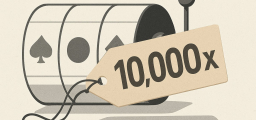
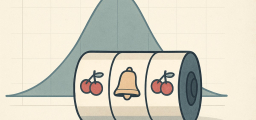
Expected loss is the boring center of the distribution. The interesting part, and the part that empties bankrolls, is the spread around it. Bonus rounds on modern slots are absurdly high-variance events. The bonus on Money Train 2 has a maximum win of 50,000x your bet. The vast majority of bonuses pay back somewhere between 0x and 20x. A meaningful chunk pay back nothing or single digits. That long tail is what props up the headline RTP.
Now think about what bonus buys do to that variance from the player’s perspective:
- You concentrate your wagering into a tiny number of high-variance events. Ten buys, ten coin flips with skewed payouts, not 2,000 spins where outcomes smooth out.
- Your stake per “decision” is 100x larger, so your bankroll has to absorb 100x bigger swings.
- Standard deviation for a bonus-only sample of ten rounds can easily exceed 1,000x base stake. At a $1 base, that’s a $1,000 swing in either direction over a session that took ten minutes.
- The “I’m down badly, one more buy will fix it” instinct hits harder when each click is a real percentage of your bankroll.
I’ll say it plainly because I’ve watched it happen, bonus buys turn slots into a casino game that more closely resembles a single hand of high-limit blackjack than a leisurely slot session. The pacing is wrong, the stake is wrong, and your brain doesn’t have time to recalibrate between clicks. If you’re going to play them, you should at least know you’ve voluntarily multiplied your variance by an order of magnitude.
The Regulators Have Already Pushed Back
The UK Gambling Commission isn’t usually quick to ban product features, but they pulled the trigger on bonus buys. Effective from changes set out in their 2023 to 2024 reforms, UK-licensed operators can no longer offer feature-buy mechanics on slots aimed at British players. The commission’s stated reasoning, available at gamblingcommission.gov.uk, centers on harm, the buys accelerate spend rates, compress losses into shorter sessions, and remove the natural cool-down windows that base-game play provides.
Other regulators are watching. The Netherlands’ KSA has flagged similar concerns, and in the US the situation varies wildly by state. If you live somewhere the button still exists, that’s a policy choice, not a math endorsement.
When Does Buying Actually Make Mathematical Sense?
I want to be fair. There is a narrow case where bonus buys are genuinely less bad than the base game, and it usually involves these conditions:
- The published bonus-buy RTP is meaningfully higher than the base RTP (a full percentage point or more, like Money Train 2).
- You’re going to play the slot anyway and your bankroll comfortably handles the buy cost, meaning a single buy is no more than 1 to 2% of your roll.
- You can genuinely stop after a predetermined number of buys without chasing.
- The base game is grindy and boring enough that you’d otherwise quit before hitting a bonus naturally.
If all four are true, then yes, paying for the feature on the right title can be a slightly less expensive way to experience the same content. But that’s about entertainment efficiency, not profit. I’ve never seen a bonus buy that converted a negative-EV slot into a positive-EV one. The math doesn’t bend that way; the studio sets the RTP under 100% on both sides of the menu.
A Quick Sanity-Check Formula
If you want a back-of-the-napkin tool before you press the button, here’s the one I use. Compare your expected hourly burn under both strategies:
Hourly Loss ≈ (1 − RTP) × Stake × Decisions per Hour
For base-game spinning at $1 with 600 spins/hour and 96.5% RTP, that’s 0.035 × $1 × 600 = $21/hour. For bonus buys at $1 base, 100x cost, maybe 200 clicks/hour if you’re moving fast and 97% RTP, that’s 0.03 × $100 × 200 = $600/hour. Same RTP world, completely different financial reality. If you want more practice with how expected value scales, and how small percentage edges compound brutally, there’s plenty of approachable material over at EffortlessMath that covers the foundations.
FAQ
Are bonus buy slots rigged differently than the base game?
No, they’re using the same underlying random number generator and the same paytable for the feature. What changes is the published RTP, which the studio tunes by adjusting things like the distribution of starting symbols or modifier values at the feature start. It’s not “rigged”. It’s configured, and the configuration is disclosed.
Why does Sweet Bonanza’s buy have a lower RTP than its base game?
A few games are tuned that way deliberately. When the buy RTP comes in below the base, it usually means the feature has a particularly fat top end and the studio is balancing that by skimming a sliver off the average. Players pay a small premium for the guaranteed access to the high-variance event.
Is there a strategy that beats the bonus buy?
Not in any mathematical sense. The buy has a fixed, disclosed RTP under 100%, so over a large sample you lose. The only “strategy” is bankroll management, capping how many buys per session, using a base stake that matches your roll, and quitting on a predetermined stop-loss. None of that changes the expected value; it just controls how fast you arrive at it.
Why did the UK ban them but not other countries?
The UKGC’s harm framework weighs speed of loss and dissociation from money pretty heavily, and bonus buys score badly on both. Other regulators use different harm frameworks, some are slower to act, some don’t see a problem, some are still studying it. Expect more jurisdictions to restrict the feature over the next few years.
If I’m going to play anyway, what’s the safest way to use bonus buys?
Set a buy budget before you start, for instance, “I’ll do five buys at $5 base and stop, win or lose.” Use a base stake where a single buy is genuinely affordable. Avoid the super-buy tiers; the marginal RTP gain rarely compensates for the bankroll hit. And don’t combine buys with chasing, once you’ve used your budget, you’re done.
Closing Thought
Bonus buys aren’t evil and they’re not magic. They’re a piece of product design that compresses an already negative-EV game into a faster, sharper, more emotionally intense form of the same activity. The published RTP makes them look almost generous, and on a couple of titles the buy genuinely is a hair better than grinding the base. But the moment you do the hourly-burn calculation, the friendliness of those decimal points evaporates. I’ve pressed the button enough times to know how it feels, like skipping the boring level of a video game, and I’ve done the math enough times to know what that shortcut actually costs. If you’re going to play, play the buys with both numbers in front of you. The studio already knows them. You should too.

Related to This Article
More math articles
- Social-Science Evidence: Psychology, Sociology, Anthropology, and Case Studies
- Cartels face an incentive to cheat
- Best Scientific Calculators for Students
- The Ultimate 7th Grade K-PREP Math Course (+FREE Worksheets)
- The Best Grade 7 Math Book for Washington Students
- Black Codes and the Civil Rights Act of 1866
- The Best Grade 5 Math Book for Minnesota Students
- Patterns of Intergroup Relations
- Montana Algebra 1 Free Worksheets: Free Printable Algebra 1 PDF Worksheets with Full Solutions
- PSAT 10 Math Practice: 10 Free Questions with Answers





What people say about "The Slot Bonus Buy Trap: Math Behind Paying for the Feature - Effortless Math"?
No one replied yet.