The Ultimate ISEE Lower Level Math Formula Cheat Sheet
TL;DR: If your child is applying to private school for grade 5 or 6, the ISEE Lower Level Math sections are Quantitative Reasoning (38 questions in 35 minutes) and Mathematics Achievement (30 questions in 30 minutes), with no calculator and no reference sheet. Every formula on this page needs to be cold before test day. Walk through them together, a few at a time, and the real test becomes much less of a memory game.
Key takeaways:
- ISEE Lower Level has two math sections: Quantitative Reasoning and Mathematics Achievement.
- Quantitative Reasoning: 38 questions in 35 minutes.
- Mathematics Achievement: 30 questions in 30 minutes.
- No calculator allowed and no formula reference sheet.
- Designed for students applying to grades 5 or 6 (currently in grade 4).
Mixed Numbers
A number is composed of a whole number and a fraction. Example: \(2 \frac{2}{ 3}\) Converting between improper fractions and mixed numbers: \(a \frac{c}{b}=a+\frac{c}{b}= \frac{ab+ c}{b}\)
Factoring Numbers
Factor a number means breaking it up into numbers that can be multiplied together to get the original number. Example:\(12=2×2×3\)
Integers
\( \{…,-3,-2,-1,0,1,2,3,…\} \)
Includes: zero, counting numbers, and the negative of the counting numbers
Order of Operations
PEMDAS
(parentheses/ exponents/ multiply/ divide/ add/ subtract)
Ratios
A ratio is a comparison of two numbers by division.
Example: \(3: 5\), or \(\frac{3}{5}\)
Percentages
Use the following formula to find part, whole, or percent
part \(=\frac{percent}{100}×whole\)
Proportional Ratios
A proportion means that two ratios are equal. It can be written in two ways:
\(\frac{a}{b}=\frac{c}{d}\), \(a: b = c: d \)
Percent of Change
\(\frac{New \ Value \ – \ Old \ Value}{Old Value}×100\%\)
Expressions and Variables
A variable is a letter that represents unspecified numbers. One may use a variable in the same manner as all other numbers: Addition: \(2+a\): \(2\) plus a
Subtraction: \(y-3\) : \(y\) minus \(3\)
Division: \(\frac{4}{x}\) : 4 divided by x
Multiplication: \(5a\) : \(5\) times a
Distributive Property
\(a(b+c)=ab+ac\)
Equations
The values of the two mathematical expressions are equal.
\(ax+b=c\)
Parallel and Perpendicular lines:
Have equal slopes. Perpendicular lines (i.e., those that make a \(90^° \) angle where they intersect) have negative reciprocal slopes: \(m_{1}\).\(m_{2}=-1\).
Parallel Lines (l \(\parallel\) m)
Triangles
Area: \(A=\frac{1}{2}bh\) where \(b\) is the base and \(h\) is the height.
Perimeter: \(P=a+b+c\) (sum of all three sides).
Pythagorean Theorem (right triangles): \(a^2+b^2=c^2\) where \(c\) is the hypotenuse.
Sum of interior angles: \(180°\)
Equilateral:
These triangles have three equal sides, and all three angles are \(60^\circ\).
Isosceles:
An isosceles triangle has two equal sides. The “base” angles (the ones opposite the two sides) are equal (see the \(45^\circ\) triangle above).
Rectangles
A rectangle has four right angles and opposite sides of equal length.
Area: \(A=l\times w\)
Perimeter: \(P=2l+2w=2(l+w)\)
Diagonal: \(d=\sqrt{l^2+w^2}\)
Both pairs of opposite sides are parallel.
Parallelogram
(Rhombus if l=w)
Area=lh
Regular polygons are n-sided figures with all sides equal and all angles equal.
The sum of the inside angles of an n-sided regular polygon is
\((n-2).180^\circ\).
mean:
mean: \(\frac{sum \ of \ the \ data}{of \ data \ entires}\)
mode:
value in the list that appears most often
Average
\( \frac{sum \ of \ terms}{number \ of \ terms}\)
The Best Books to Ace the ISEE Lower Level Math Test
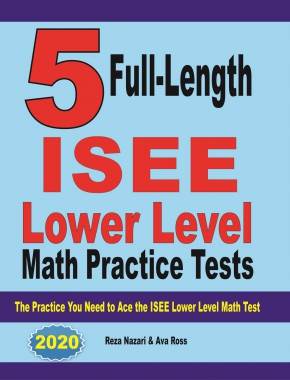

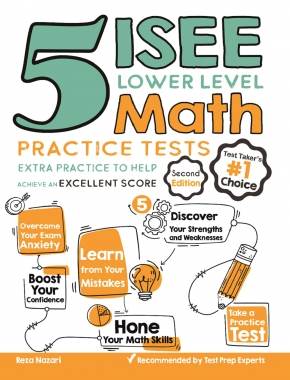
Recommended EffortlessMath Books
For a workbook your child can use alongside this cheat sheet, the ISEE Lower Level Math for Beginners walks through every topic at the right level with worked examples. For complete admissions prep with multiple full-length practice tests, see the ISEE Lower Level Math Test Prep Bundle.
Frequently Asked Questions
Does the ISEE give you a formula sheet?
No. The ISEE provides no formula reference on any section, and no calculator is allowed either. For the Lower Level (grades 4-5 applicants), the content stays within elementary arithmetic and basic geometry, so the formula list is shorter than for higher levels — but everything still has to be memorized.
What formulas should my child memorize for the ISEE Lower Level?
Area of rectangle (\(lw\)) and square (\(s^2\)). Perimeter of rectangle (\(2l+2w\)) and square (\(4s\)). Volume of rectangular prism (\(lwh\)) and cube (\(s^3\)). Basic time conversions (60 sec = 1 min, 60 min = 1 hr). Basic statistics: mean (average), median, mode, range. Simple probability.
What grades take the ISEE Lower Level?
Students currently in grade 4 applying for admission to grade 5 or 6. Younger applicants take the Primary Level (apply to grades 2-4); older applicants take the Middle Level (apply to grades 7-8) or Upper Level (apply to grades 9-12).
What math topics are on the ISEE Lower Level?
Whole-number arithmetic (addition, subtraction, multiplication, division), fractions and basic decimals, simple word problems, time and money, measurement (length, weight, capacity), basic geometry (perimeter, area, shapes), and data analysis (reading bar graphs and pictographs, finding the mean and median of small data sets).
What’s the area of a rectangle?
\(A=lw\), where \(l\) is the length and \(w\) is the width. For a square, since all sides are equal, area is \(s^2\), where \(s\) is the side length. Example: a rectangle that’s 6 by 4 has area \(6\times 4=24\) square units. A square with side 5 has area \(5^2=25\) square units.
What’s the perimeter formula?
Perimeter is the total distance around a shape — add up all the sides. For a rectangle: \(P=2l+2w\) or equivalently \(P=2(l+w)\). For a square: \(P=4s\). For a triangle: just add the three side lengths.
What statistics do my child need?
Mean (add the numbers, divide by how many there are). Median (line them up smallest to largest and take the middle number — if two middle numbers, average them). Mode (the number that appears most often). Range (largest minus smallest). All four show up on Lower Level data questions.
Does the ISEE Lower Level penalize guessing?
No. There’s no penalty for wrong answers. Your child should answer every single question — even a random guess has a 20-25% chance of being right depending on the item, and blanks always count as wrong.
How is the ISEE Lower Level scored?
Each section gets a scaled score (760-940) and a stanine (1-9). The stanine compares your child’s performance against other Lower Level test-takers in the same grade. Most competitive schools focus heavily on stanine because it’s normalized for the grade-level skill curve.
How should we use this cheat sheet?
Sit with your child and go through it once together. Make sure they recognize each formula. For any formula they don’t know, work 5-10 practice problems on it. Then have them take a timed ISEE Lower Level Math practice test to confirm the formulas come back when the timer is running.
Related EffortlessMath Lessons
If a topic on this page feels rusty, these short lessons go deeper:

Related to This Article
More math articles
- What Kind of Math Is on the PSAT/NMSQT Test?
- Pennsylvania PSSA Grade 5 Math Worksheets — 49 Free Printable Single-Skill PDFs
- Matching a Model with a Ratio
- Top 10 Free Websites for ALEKS Math Preparation
- How to Master the Concept of Continuity over an Interval
- The Best Grade 3 Math Book for North Carolina Students
- How to Determine Functions?
- The Ultimate AZMerit Algebra 1 Course (+FREE Worksheets)
- The Best Grade 4 Math Book for Maryland Students
- 5th Grade NDSA Math Worksheets: FREE & Printable

What people say about "The Ultimate ISEE Lower Level Math Formula Cheat Sheet - Effortless Math: We Help Students Learn to LOVE Mathematics"?
No one replied yet.