How Body Systems Work Together
Students often see how body systems work together as a cluster of new terms. A steadier route is to connect Respiratory and cardiovascular with Digestive and cardiovascular, then place Nervous and muscular and Endocrine and urinary into the same working picture.
Definition: No body system works alone. Homeostasis depends on coordinated transport, exchange, control, movement, protection, and waste removal. A useful way to solve interaction questions is to trace a material or signal from its source, through the systems that move it, to the cells that use it.
What do you need to know about how body systems work together?
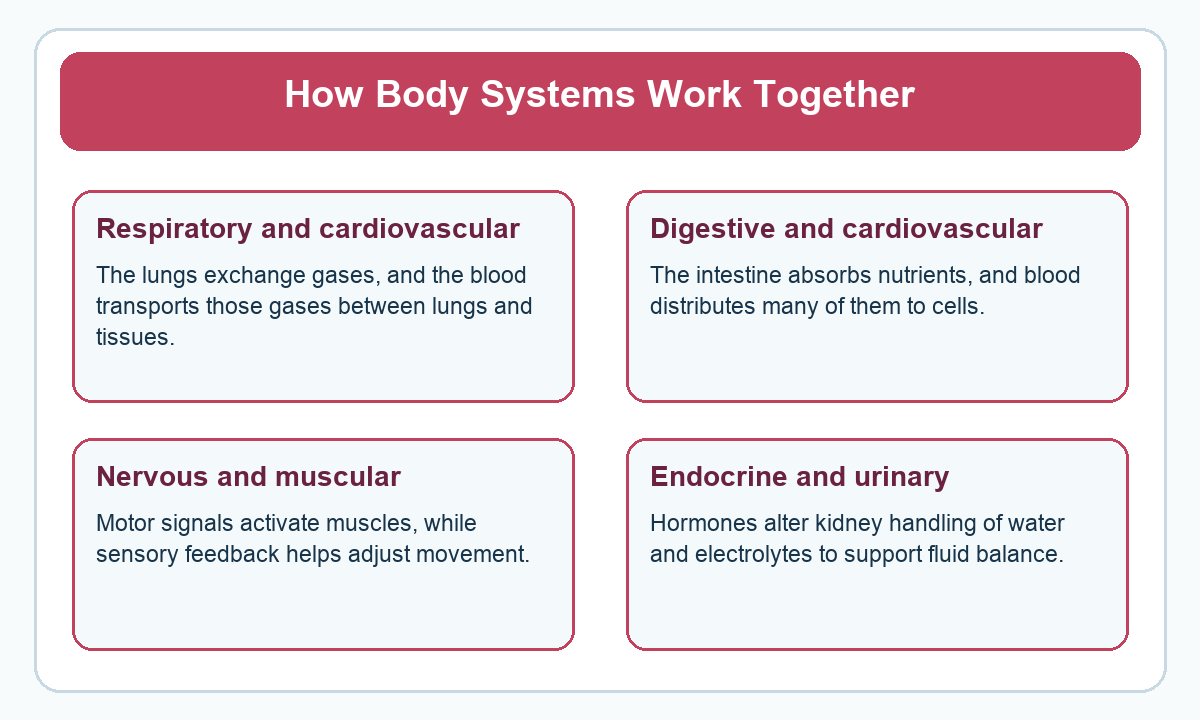
Use the visual as a recall tool: read the Respiratory and cardiovascular box, cover it, and explain it from memory. Repeat that move for Digestive and cardiovascular, Nervous and muscular, and Endocrine and urinary; then explain how the four ideas connect.
What should you remember about how body systems work together?
| Idea | What it means |
|---|---|
| Respiratory and cardiovascular | The lungs exchange gases, and the blood transports those gases between lungs and tissues. |
| Digestive and cardiovascular | The intestine absorbs nutrients, and blood distributes many of them to cells. |
| Nervous and muscular | Motor signals activate muscles, while sensory feedback helps adjust movement. |
| Endocrine and urinary | Hormones alter kidney handling of water and electrolytes to support fluid balance. |
How can each anchor help you answer a question?
Respiratory and cardiovascular as a question clue
The lungs exchange gases, and the blood transports those gases between lungs and tissues. A useful contrast is digestive and cardiovascular: the intestine absorbs nutrients, and blood distributes many of them to cells.
Digestive and cardiovascular as a question clue
The intestine absorbs nutrients, and blood distributes many of them to cells. A useful contrast is nervous and muscular: motor signals activate muscles, while sensory feedback helps adjust movement.
Nervous and muscular as a question clue
Motor signals activate muscles, while sensory feedback helps adjust movement. A useful contrast is endocrine and urinary: hormones alter kidney handling of water and electrolytes to support fluid balance.
Endocrine and urinary as a question clue
Hormones alter kidney handling of water and electrolytes to support fluid balance. A useful contrast is respiratory and cardiovascular: the lungs exchange gases, and the blood transports those gases between lungs and tissues.
What else helps this topic make sense?
A material-tracing question often has three stages: entry or production, transport, and use or removal. Oxygen enters through the respiratory system, moves in the cardiovascular system, and participates in cellular respiration. Nutrients enter through digestion, travel in blood or lymph, and reach cells for energy or building material. Carbon dioxide moves in the opposite direction toward the lungs. Naming each handoff makes multi-system questions much less abstract.
How does this idea work in a real question?
During exercise, breathing rate and heart rate rise, blood flow shifts toward working muscles, and sweating increases. The nervous and endocrine systems coordinate these changes while the respiratory, cardiovascular, muscular, and integumentary systems carry them out.
For this example, first identify which of the four anchors is changing or acting. Follow its effect through the situation and name the result before comparing choices. This keeps your reasoning tied to evidence rather than to a familiar-looking term.
What is a reliable way to reason through it?
- Decide whether the question is mainly about Respiratory and cardiovascular, Digestive and cardiovascular, Nervous and muscular, or Endocrine and urinary.
- Restate the job of the named idea before reading the answer choices.
- Use the Respiratory and cardiovascular, Endocrine and urinary map above to trace direction, cause, evidence, or outcome in the order supplied.
- Test the remaining choice against this specific warning: Avoid naming two systems without explaining the connection. State what substance, signal, or action passes from one system's job to the other's.
What mistake should you watch for?
Avoid naming two systems without explaining the connection. State what substance, signal, or action passes from one system's job to the other's.
If two choices survive, ask which one preserves the stated relationship between Respiratory and cardiovascular and Digestive and cardiovascular. Then check it against Nervous and muscular or Endocrine and urinary if either appears in the prompt.
Watch a short lesson
The human-body-systems video provides the whole-body map needed to see how specialized organs contribute to shared goals. Pause the lesson when a diagram or process appears and connect it with the four anchors in this page’s visual.
Can you check your understanding?
Try these six checks from memory. Open an answer only after you have said or written your own response.
-
In your own words, what is the central idea in this lesson?
Check the answer
No body system works alone. Homeostasis depends on coordinated transport, exchange, control, movement, protection, and waste removal. A useful way to solve interaction questions is to trace a material or signal from its source, through the systems that move it, to the cells that use it.
-
What should you remember about respiratory and cardiovascular?
Check the answer
The lungs exchange gases, and the blood transports those gases between lungs and tissues.
-
What should you remember about digestive and cardiovascular?
Check the answer
The intestine absorbs nutrients, and blood distributes many of them to cells.
-
What should you remember about nervous and muscular?
Check the answer
Motor signals activate muscles, while sensory feedback helps adjust movement.
-
What should you remember about endocrine and urinary?
Check the answer
Hormones alter kidney handling of water and electrolytes to support fluid balance.
-
What final check is most useful for a question about how body systems work together?
Check the answer
Compare the choice with the relationship among Respiratory and cardiovascular, Digestive and cardiovascular, Nervous and muscular, and Endocrine and urinary. Then apply this warning: Avoid naming two systems without explaining the connection. State what substance, signal, or action passes from one system's job to the other's.
Where does this fit in your science review?
The ATI TEAS Science Study Hub places this lesson inside the larger anatomy and physiology review. Continue with these connected lessons:
Recommended ATI TEAS resources

Related to This Article
More math articles
- Modern Liberalism, Its Achievements, and Its Critics
- GED Math – Test Day Tips
- Free Grade 2 English Worksheets for Michigan Second Graders
- Crypto Casinos vs. Traditional Online Casinos: The Math Differences
- The Best Grade 4 ELA Practice Tests for North Carolina Students
- Literal Equations Worksheet with Answers PDF
- SBAC Algebra 1 Free Worksheets: Free Printable Smarter Balanced Algebra 1 Practice with Keys
- Algebra Puzzle – Challenge 50
- How to Evaluate Decimal Distances on the Map
- Different Question Types on the ACT Math Test




















What people say about "ATI TEAS 7: How Body Systems Work Together"?
No one replied yet.