The Urinary System

Students often see the urinary system as a cluster of new terms. A steadier route is to connect Kidney with Nephron, then place Ureter and Urethra into the same working picture.
Definition: The urinary system filters blood, removes nitrogen-containing wastes, and adjusts water, electrolyte, and acid-base balance. Kidneys form urine through filtration, selective reabsorption, and secretion. Ureters carry urine to the bladder, and the urethra carries it out of the body.
What do you need to know about the urinary system?
Use the visual as a recall tool: read the Kidney box, cover it, and explain it from memory. Repeat that move for Nephron, Ureter, and Urethra; then explain how the four ideas connect.
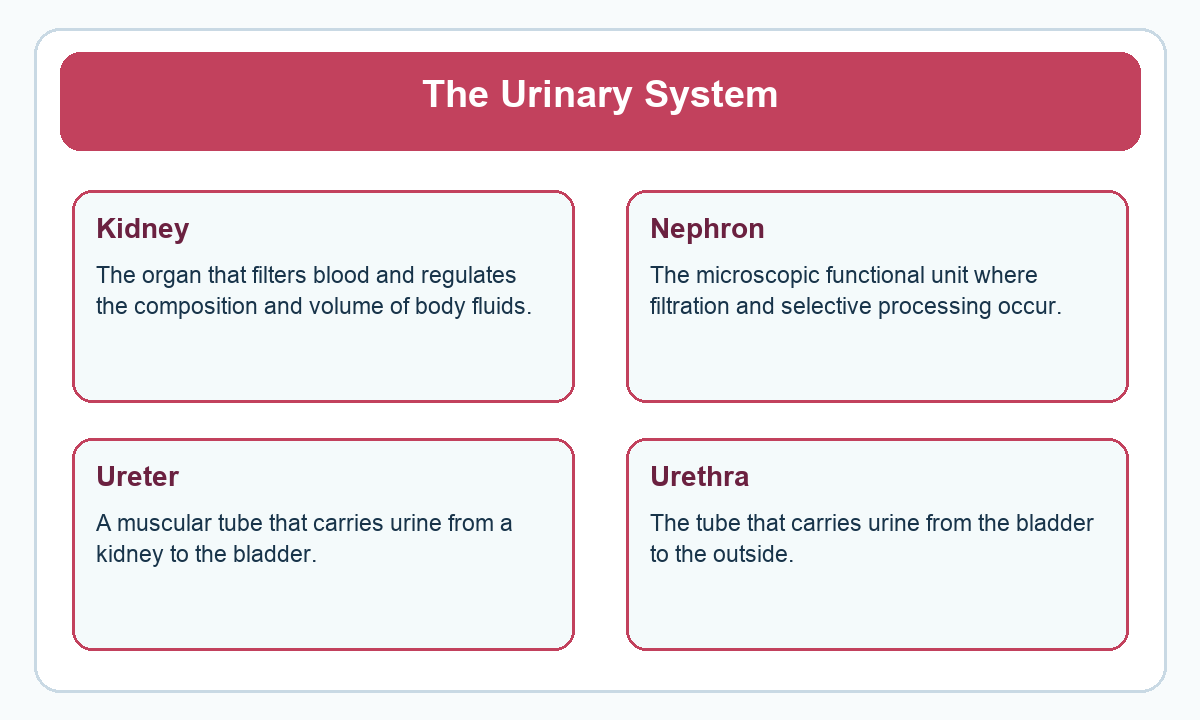
What should you remember about the urinary system?
| Idea | What it means |
|---|---|
| Kidney | The organ that filters blood and regulates the composition and volume of body fluids. |
| Nephron | The microscopic functional unit where filtration and selective processing occur. |
| Ureter | A muscular tube that carries urine from a kidney to the bladder. |
| Urethra | The tube that carries urine from the bladder to the outside. |
How can each anchor help you answer a question?
Kidney as a question clue
The organ that filters blood and regulates the composition and volume of body fluids. A useful contrast is nephron: the microscopic functional unit where filtration and selective processing occur.
Nephron as a question clue
The microscopic functional unit where filtration and selective processing occur. A useful contrast is ureter: a muscular tube that carries urine from a kidney to the bladder.
Ureter as a question clue
A muscular tube that carries urine from a kidney to the bladder. A useful contrast is urethra: the tube that carries urine from the bladder to the outside.
Urethra as a question clue
The tube that carries urine from the bladder to the outside. A useful contrast is kidney: the organ that filters blood and regulates the composition and volume of body fluids.
What else helps this topic make sense?
Kidneys influence blood pressure as well as urine composition. When blood volume or kidney perfusion falls, hormonal pathways can increase sodium retention, water retention, and vessel constriction. Other hormones adjust how much water or sodium the nephron returns to blood. A change in urine volume may therefore reflect the body's attempt to protect circulation, not simply the amount of fluid recently consumed. Follow the regulatory signal before predicting the kidney response.
How does this idea work in a real question?
Useful water and glucose enter the nephron filtrate along with wastes. The nephron reabsorbs needed substances back into the blood while leaving or adding wastes to the forming urine. Filtration alone would remove too much useful material.
For this example, first identify which of the four anchors is changing or acting. Follow its effect through the situation and name the result before comparing choices. This keeps your reasoning tied to evidence rather than to a familiar-looking term.
What is a reliable way to reason through it?
- Decide whether the question is mainly about Kidney, Nephron, Ureter, or Urethra.
- Restate the job of the named idea before reading the answer choices.
- Use the Kidney, Urethra map above to trace direction, cause, evidence, or outcome in the order supplied.
- Test the remaining choice against this specific warning: Do not confuse ureter with urethra. There are two ureters leading to the bladder and one urethra leading away from it.
What mistake should you watch for?
Do not confuse ureter with urethra. There are two ureters leading to the bladder and one urethra leading away from it.
If two choices survive, ask which one preserves the stated relationship between Kidney and Nephron. Then check it against Ureter or Urethra if either appears in the prompt.
Watch a short lesson
The urinary-system-and-skin video reviews waste removal and body-fluid balance, matching the system-level goals of the lesson. Pause the lesson when a diagram or process appears and connect it with the four anchors in this page’s visual.
Can you check your understanding?
Try these six checks from memory. Open an answer only after you have said or written your own response.
-
In your own words, what is the central idea in this lesson?
Check the answer
The urinary system filters blood, removes nitrogen-containing wastes, and adjusts water, electrolyte, and acid-base balance. Kidneys form urine through filtration, selective reabsorption, and secretion. Ureters carry urine to the bladder, and the urethra carries it out of the body.
-
What should you remember about kidney?
Check the answer
The organ that filters blood and regulates the composition and volume of body fluids.
-
What should you remember about nephron?
Check the answer
The microscopic functional unit where filtration and selective processing occur.
-
What should you remember about ureter?
Check the answer
A muscular tube that carries urine from a kidney to the bladder.
-
What should you remember about urethra?
Check the answer
The tube that carries urine from the bladder to the outside.
-
What final check is most useful for a question about the urinary system?
Check the answer
Compare the choice with the relationship among Kidney, Nephron, Ureter, and Urethra. Then apply this warning: Do not confuse ureter with urethra. There are two ureters leading to the bladder and one urethra leading away from it.
Where does this fit in your science review?
The ATI TEAS Science Study Hub places this lesson inside the larger anatomy and physiology review. Continue with these connected lessons:
- The Digestive System
- The Immune and Lymphatic Systems
- The Respiratory System
- The Reproductive Systems
Recommended ATI TEAS resources

Related to This Article
More math articles
- GED Testing Accommodations and Support for Students with Disabilities
- GED Math Practice Test & Sample [Updated for 2026]
- Entry determines whether profit persists
- 6th Grade AZMerit Math Worksheets: FREE & Printable
- Felony disenfranchisement
- How to Graphing the Floor Function
- Free Grade 6 English Worksheets for Nevada Students
- 3rd Grade WY-TOPP Math Worksheets: FREE & Printable
- Table Tales: How to Finding the Rule in Word Problems
- 8th Grade Mathematics Worksheets: FREE & Printable



















What people say about "ATI TEAS 7: The Urinary System"?
No one replied yet.