Populations, Communities, and Biomes
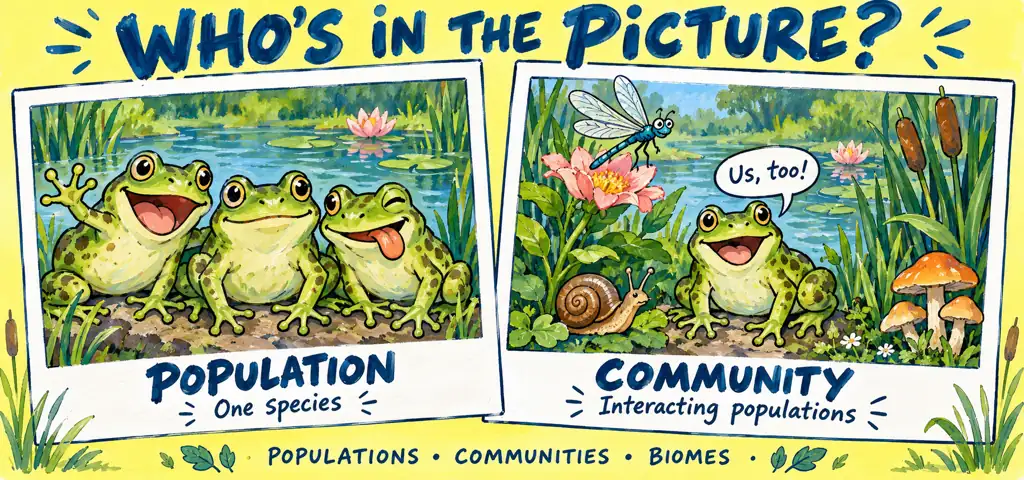
Count the rabbits in a meadow. You are measuring a population. Include the grasses, foxes, fungi, and their interactions, and your question now concerns a community of organisms. Before interpreting a graph or census, establish which living groups and environmental conditions the study includes.
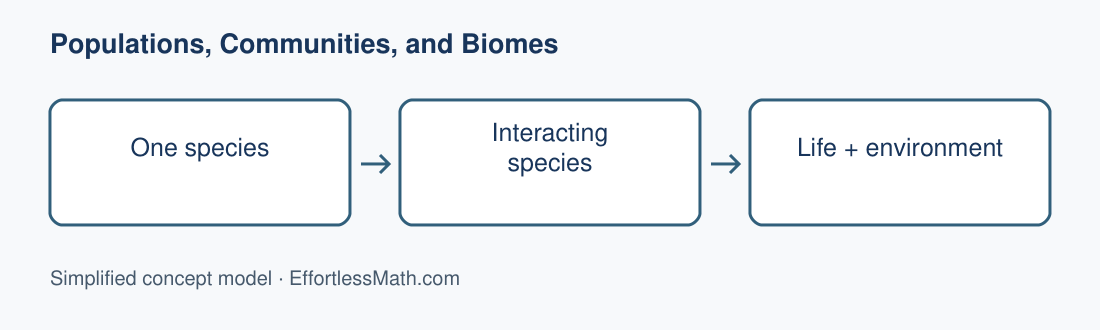
A population consists of organisms of one species in a defined place and time. A community includes the interacting populations in an area. A biome is a broad ecological region characterized by environmental conditions and characteristic life, especially vegetation on land. These levels organize questions about abundance, interactions, and environmental limits.
What changes population size?
Births and immigration add individuals. Deaths and emigration remove them. Population density also depends on the area or volume being considered. A large population spread across a huge area may have a lower density than a smaller population in a small patch. Always check the sampling boundary and interval.
Is carrying capacity a permanent number?
Carrying capacity describes the population an environment can sustain under particular conditions. Food, water, nesting space, disease, and other factors can change those conditions. Logistic growth is a useful simplified model, but real populations may fluctuate, overshoot, migrate, or encounter sudden disturbances rather than settle neatly on a horizontal line.
How do communities differ from biomes?
Community ecology examines interactions such as competition, predation, mutualism, and parasitism. A biome describes a much broader environmental pattern. Temperature and precipitation help distinguish terrestrial biomes, while aquatic systems require factors such as salinity, light, depth, and water movement. Conditions change across biome boundaries, with transition zones between neighboring regions.
Which process does each term describe?
| Term | Meaning in this lesson |
|---|---|
| Population | One species within a defined boundary |
| Community | Multiple interacting populations |
| Ecosystem | Community plus its physical environment |
| Biome | Broad region with characteristic environmental and biological patterns |
How can you reason through an example?
In a hypothetical one-year census, a pond starts with 120 frogs. There are 30 births, 18 deaths, 9 arrivals, and 5 departures. Adding births and arrivals gives 159. Subtracting deaths and departures leaves 136. That is a net increase of 16 frogs. It does not establish the pond’s carrying capacity, which cannot be inferred from a single census change.
- Identify the species, boundary, and time interval.
- Keep abundance separate from density.
- Look for evidence about mechanisms before assigning a cause to a population change.
Can you apply the ideas?
Answer these six questions before opening the explanations.
- Are all the oak trees of one species in a park a population or community?
- Does immigration increase or decrease population size?
- Can carrying capacity change after a drought?
- What distinguishes a community from an ecosystem?
- Does a population’s decline prove predation caused it?
- Which two climate factors commonly help describe terrestrial biomes?
Check the six answers and explanations
- A population, with the park and time interval defining the boundary.
- It increases size by adding arriving individuals.
- Yes. Changed water or food supplies can change what the habitat supports.
- An ecosystem explicitly includes the physical environment as well as the community.
- No. Births, deaths, movement, sampling, and several possible causes must be examined.
- Temperature and precipitation, including their seasonal patterns.
What does the video explain?
Watch Population Ecology: How We Saved the Bald Eagle: Crash Course Biology #7 by CrashCourse. Use the bald-eagle example to connect a population change to its causes. Distinguish the evidence about reproduction from a simple count of adults.
Where does this lesson fit?
Use the Biology Learning Hub to choose your next topic. Related lessons explain testing a biological explanation, how DNA instructions become proteins, organisms in ecosystems.
Further reading: OpenStax Biology 2e topic reference. Lesson text and diagrams are original educational material. Examples marked hypothetical are teaching scenarios.
Recommended study resources
The algebra bundle below supports quantitative skills used in science, including reading relationships, working with units, and solving for unknown quantities.

For the AP course sequence and practice tests, use the AP Biology study hub.

Related to This Article
More math articles
- Rounding Numbers for 5th Grade: Nearest Ten, Hundred, and Thousand
- Top 10 Free Websites for SAT Math Preparation
- The Ultimate 7th Grade NDSA Math Course (+FREE Worksheets)
- Understanding Betting Odds
- Economic Crises and Economic Freedom
- Hawaii Algebra 1 Free Worksheets: Printable Algebra 1 Practice Worksheets with Worked Solutions
- FTCE General Knowledge Math Flashcards
- Federal and state court systems
- GCF & LCM Practice — Free Step-by-Step Drills
- The Best Grade 2 English Worksheets for Wyoming Students













What people say about "Populations, Communities, and Biomes"?
No one replied yet.