Life Course, New Roles, and Resocialization
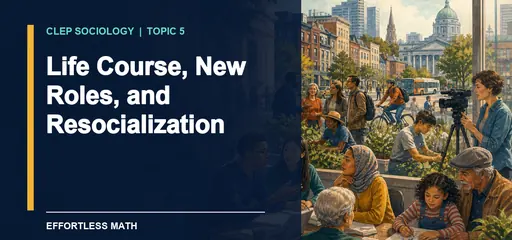
Chapter 5 of the CLEP Sociology study guide on Effortless Math covers Life Course, New Roles, and Resocialization: the key terms, the core ideas, and worked examples showing how this topic is tested on the exam.

CLEP Sociology – Chapter 5
Life Course, New Roles, and Resocialization
CLEP Introductory Sociology · Chapter 5
The life course is the socially organized sequence of roles, transitions, and trajectories across life. A transition is a change of state or role, such as entering college. A trajectory is the longer path through education, work, family, or health in which transitions occur. A turning point redirects that longer path. Linked lives means that one person’s transition changes the options and timing of people connected to that person. Biological aging matters, but societies give ages different boundaries and expectations.
Anticipatory socialization occurs when someone rehearses a role before entering it. A high school student shadows an emergency-room nurse, learns clinical vocabulary, and observes professional dress before applying to nursing school. The rehearsal may prove inaccurate, but its timing and purpose still make it anticipatory.
Resocialization substantially reorganizes an earlier routine, identity, or way of interpreting a role. Immigration, military training, incarceration, recovery programs, religious conversion, retirement, and demanding occupational entry can involve resocialization. The concept does not require erasing every prior identity. It identifies significant replacement tied to a changed setting.
Ordinary secondary socialization and resocialization differ by degree. Lina’s father learns a new hospital’s charting software and break schedule. That is secondary role learning. If a training program removes his earlier professional routines, imposes a new status, controls daily conduct, and demands a different account of who he is, resocialization becomes the stronger concept.
A total institution, a concept associated with Erving Goffman, places most activities in one residential setting under a single authority. Sleep, work, meals, movement, dress, and contact with outsiders follow an encompassing schedule. Prisons, some military boot camps, and older residential asylums are standard examples. A strict school or office is not automatically total because people usually leave and retain separate spheres of life.
Entry may include a degradation ceremony that publicly strips signs of an earlier status. Staff may remove personal clothing, assign a number, cut hair, take possessions, or require a ritual confession. The process marks a lowered or replaced identity within the institution. A demanding orientation becomes a degradation ceremony only when it symbolically dismantles the prior status.
Power shapes resocialization. A volunteer preparing for a profession can leave more easily than a prisoner under confinement. Both may learn new routines, but the authority, surveillance, and stakes differ. Researchers therefore examine consent, control over time and space, contact with outsiders, and the consequences of refusal.
Life-course timing also matters. A first job during a recession, parenthood after a new leave policy, or retirement during a public-health crisis creates a different trajectory from the same transition in another period. Cohort members share exposure to history at similar ages, which can shape later opportunity and identity.
Role exit adds another pathway. A person may begin doubting a role, search for alternatives, leave, and then manage a former identity that other people still recognize. A retired judge or former athlete may continue receiving treatment tied to the old status. Leaving the formal position does not instantly end its social meaning.
Follow Noor across a decade. Entering a fire academy is a transition within an occupational trajectory. A regional recession delays her entry and sends many people in her cohort toward public-service training at the same historical moment. When her mother becomes ill, Noor reduces hours to provide care. The mother’s health transition changes Noor’s work path, which shows linked lives. Later, a wildfire gives Noor unusual leadership experience and redirects her toward emergency management. That redirection can become a turning point if the new path persists.
The terms require evidence across time. One promotion is a transition. A series of positions with increasing authority forms a trajectory. Calling the wildfire a turning point requires later records showing that her direction changed rather than briefly paused. Cohort refers to people born or entering a role in a similar period, while a period event such as a recession can affect several age groups at once. CLEP questions often describe one event vividly. Ask what came before, what followed, whose life was linked, and whether history changed the timing.
Chapter the related chapter extends this life-course foundation by separating age, cohort, and period effects and by examining how linked lives and accumulated opportunity shape later life.
Quick review: A transition is one role change, a trajectory is the longer path, and a turning point redirects that path. Linked lives connect one person’s timing to another’s. Anticipatory socialization rehearses a future role, while resocialization substantially reorganizes an existing routine or identity.
Watch the chapter connection
Socialization gives you a second explanation of the chapter ideas surrounding this lesson. As you watch, pause when the lesson concept appears and explain how the example fits.
Use this lesson for CLEP practice
Write one original example, one close nonexample, and one observation that would help you choose between them. This turns vocabulary recognition into the kind of applied reasoning the exam expects.

Related to This Article
More math articles
- Begin a Captivating Journey with “ATI TEAS 7 Math for Beginners”: The Ultimate Guide and Solutions Handbook
- Capitalism, Socialism, Mixed Economies, and Postindustrial Change
- Full-Length ISEE Lower Level Math Practice Test-Answers and Explanations
- Discovering the Magic of SSS and SAS Congruence in Triangles
- The Role Played by Infinity in Limits
- 10 Most Common DAT Quantitative Reasoning Math Questions
- How to Motivating Disengaged Learners to Enjoy Learning Math
- FREE 3rd Grade MAP Math Practice Test
- The Ultimate 7th Grade NSCAS Math Course (+FREE Worksheets)
- Device Parts, Materials, Joints, and Lumens

















What people say about "Life Course, New Roles, and Resocialization | CLEP Sociology"?
No one replied yet.