How to Find the Volume of Cylinders, Cones, and Spheres? (+FREE Worksheet!)
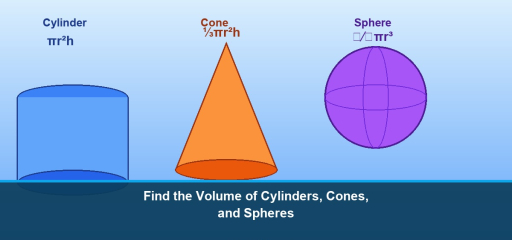
TL;DR: Three shapes, three short formulas. That is the whole story of volume in 8th grade. A cylinder holds pi times r-squared times its height. A cone, with the same base and height, holds exactly one-third as much. A sphere of radius r holds four-thirds pi r-cubed. Get those three down and the test problems are mostly plug-and-go.
Key takeaways:
- Cylinder volume: V = pi r^2 h.
- Cone volume: V = (1/3) pi r^2 h, exactly one-third the cylinder with the same base and height.
- Sphere volume: V = (4/3) pi r^3.
- Always use the radius (not diameter) in these formulas, and cube it for spheres.
- Use pi ≈ 3.14 unless the problem asks for an exact answer in terms of pi.
Three-dimensional shapes are everywhere, cans in your kitchen, traffic cones on the road, and soccer balls on the field. In 8th-grade math you learn the formulas for calculating the volume of three essential solids: cylinders, cones, and spheres. Once you memorize the three formulas and understand how they relate to each other, you can solve any volume problem that comes your way.
This guide walks you through each formula, explains where it comes from, provides worked examples, and gives you plenty of practice with full solutions.
The Three Volume Formulas
| Shape | Formula | Key Variables |
|---|---|---|
| Cylinder | \(V = \pi r^{2} h\) | \(r\) = radius, \(h\) = height |
| Cone | \(V = \dfrac{1}{3}\pi r^{2} h\) | \(r\) = radius, \(h\) = height |
| Sphere | \(V = \dfrac{4}{3}\pi r^{3}\) | \(r\) = radius |
Bonus, Hemisphere: \(V = \dfrac{2}{3}\pi r^{3}\) (exactly half of a sphere).
Understanding the Relationships
Notice how the formulas connect:
- A cone is exactly \(\frac{1}{3}\) the volume of a cylinder with the same radius and height. It takes 3 cones to fill the cylinder.
- A sphere with radius \(r\) has the same volume as a cylinder with radius \(r\) and height \(\frac{4}{3}r\). Alternatively, a sphere fits inside a cylinder of height \(2r\), and the sphere fills exactly \(\frac{2}{3}\) of that cylinder.
Step-by-Step Guide
- Identify the shape (cylinder, cone, or sphere).
- Write the correct formula.
- Identify \(r\) and \(h\) from the problem. If you are given the diameter, divide by 2 to get the radius.
- Substitute the values into the formula.
- Compute. Leave the answer in terms of \(\pi\) or use \(\pi \approx 3.14\) as directed.
- Include units (cubic inches, cubic cm, etc.).
Worked Examples
Example 1, Cylinder
Find the volume of a cylinder with radius 5 cm and height 10 cm.
\(V = \pi r^{2} h = \pi (5)^{2}(10) = \pi (25)(10) = 250\pi \approx 785 \text{ cm}^{3}\)
Example 2, Cone
Find the volume of a cone with radius 3 in and height 7 in.
\(V = \dfrac{1}{3}\pi r^{2} h = \dfrac{1}{3}\pi (3)^{2}(7) = \dfrac{1}{3}\pi (9)(7) = \dfrac{63\pi}{3} = 21\pi \approx 65.97 \text{ in}^{3}\)
Example 3, Sphere
Find the volume of a sphere with radius 6 m.
\(V = \dfrac{4}{3}\pi r^{3} = \dfrac{4}{3}\pi (6)^{3} = \dfrac{4}{3}\pi (216) = 288\pi \approx 904.78 \text{ m}^{3}\)
Example 4, Hemisphere
Find the volume of a hemisphere with diameter 12 ft.
Radius \(= 6\) ft.
\(V = \dfrac{2}{3}\pi r^{3} = \dfrac{2}{3}\pi (6)^{3} = \dfrac{2}{3}\pi (216) = 144\pi \approx 452.39 \text{ ft}^{3}\)
Example 5, Given Diameter
A cylindrical can has a diameter of 8 cm and height of 12 cm. Find the volume.
Radius \(= \frac{8}{2} = 4\) cm.
\(V = \pi (4)^{2}(12) = 192\pi \approx 603.19 \text{ cm}^{3}\)
Video Lesson
Watch this video for additional examples and a step-by-step walkthrough:
Solving for a Missing Dimension
Sometimes the volume is given and you need to find the radius or height.
Example 6, Find the height of a cylinder
A cylinder has volume \(100\pi\) cm³ and radius 5 cm. Find \(h\).
\(100\pi = \pi (5)^{2} h \Rightarrow 100\pi = 25\pi h \Rightarrow h = 4 \text{ cm}\)
Example 7, Find the radius of a sphere
A sphere has volume \(36\pi\) in³. Find \(r\).
\(36\pi = \dfrac{4}{3}\pi r^{3} \Rightarrow 36 = \dfrac{4}{3}r^{3} \Rightarrow 27 = r^{3} \Rightarrow r = 3 \text{ in}\)
Practice Problems
- Find the volume of a cylinder: \(r = 4\) cm, \(h = 9\) cm.
- Find the volume of a cone: \(r = 6\) in, \(h = 10\) in.
- Find the volume of a sphere: \(r = 3\) m.
- A hemisphere has radius 8 cm. Find its volume.
- A cylinder has diameter 10 ft and height 7 ft. Find the volume.
- A cone has diameter 12 cm and height 15 cm. Find the volume.
- A sphere has diameter 14 in. Find its volume.
- A cylinder has volume \(200\pi\) cm³ and radius 5 cm. Find the height.
- A cone has volume \(48\pi\) in³ and height 9 in. Find the radius.
- Compare: a cone and a cylinder both have \(r = 4\) and \(h = 6\). How many times larger is the cylinder?
- A tennis ball has a radius of about 3.3 cm. What is the volume of one ball?
- An ice cream cone (cone shape) has \(r = 2\) in and \(h = 5\) in, topped with a hemisphere of ice cream (\(r = 2\) in). What is the total volume?
Solutions
- \(V = \pi(4)^{2}(9) = 144\pi \approx 452.39\) cm³
- \(V = \frac{1}{3}\pi(6)^{2}(10) = 120\pi \approx 376.99\) in³
- \(V = \frac{4}{3}\pi(3)^{3} = 36\pi \approx 113.10\) m³
- \(V = \frac{2}{3}\pi(8)^{3} = \frac{1024\pi}{3} \approx 1072.33\) cm³
- \(r = 5\). \(V = \pi(5)^{2}(7) = 175\pi \approx 549.78\) ft³
- \(r = 6\). \(V = \frac{1}{3}\pi(6)^{2}(15) = 180\pi \approx 565.49\) cm³
- \(r = 7\). \(V = \frac{4}{3}\pi(7)^{3} = \frac{1372\pi}{3} \approx 1436.76\) in³
- \(200\pi = \pi(25)h \Rightarrow h = 8\) cm
- \(48\pi = \frac{1}{3}\pi r^{2}(9) = 3\pi r^{2} \Rightarrow r^{2} = 16 \Rightarrow r = 4\) in
- Cylinder: \(\pi(16)(6) = 96\pi\). Cone: \(\frac{1}{3}(96\pi) = 32\pi\). The cylinder is 3 times larger.
- \(V = \frac{4}{3}\pi(3.3)^{3} \approx \frac{4}{3}\pi(35.937) \approx 150.53\) cm³
- Cone: \(\frac{1}{3}\pi(4)(5) = \frac{20\pi}{3}\). Hemisphere: \(\frac{2}{3}\pi(8) = \frac{16\pi}{3}\). Total: \(\frac{36\pi}{3} = 12\pi \approx 37.70\) in³
Real-World Applications
- Packaging: Companies calculate cylinder volume to determine how much soup, soda, or paint fits in a can.
- Construction: Traffic cones, grain silos (cylinders), and dome roofs (hemispheres) all require volume calculations for materials and capacity.
- Sports: Knowing the volume of a basketball (\(V = \frac{4}{3}\pi r^{3}\)) helps manufacturers determine how much air it holds.
Common Mistakes to Avoid
- Using diameter instead of radius. Always divide the diameter by 2 before substituting into a formula.
- Forgetting \(\frac{1}{3}\) for the cone. A cone is one-third of a cylinder, not the same.
- Cubing vs. Squaring the radius. Cylinder and cone formulas use \(r^{2}\); the sphere formula uses \(r^{3}\). Don’t mix them up.
- Dropping the units. Volume is always in cubic units (cm³, in³, m³).
Frequently Asked Questions
What is the volume of a cylinder?
V = pi r^2 h, where r is the radius of the circular base and h is the height. With r = 4 and h = 10: V = pi(16)(10) = 160 pi, about 502.7 cubic units.
What is the volume of a cone?
V = (1/3) pi r^2 h. A cone with r = 3 and h = 5 has V = (1/3) pi (9)(5) = 15 pi ≈ 47.1 cubic units. The 1/3 is critical.
Why is a cone exactly one-third of a cylinder with the same base and height?
Calculus proves it: integrating the area of the cross-section from the apex to the base gives one-third the cylinder. Geometrically, three cones with the same base and height pack into a cylinder.
What is the volume of a sphere?
V = (4/3) pi r^3. A sphere with r = 6 has V = (4/3) pi (216) = 288 pi, about 904.8 cubic units. The 4/3 coefficient is the part students forget most often.
How does the volume change if I double the radius?
Cube of 2 is 8, so volume becomes 8 times larger. For a sphere or cone, doubling r raises the volume eightfold. For a cylinder doubling r and keeping h, the volume is 4 times bigger (r is squared).
What if I am given the diameter instead of the radius?
Divide by 2 first. D = 10 means r = 5; THEN plug r = 5 into the formula. Forgetting this step is the most common error in volume problems.
How do I use these formulas in real life?
Calculating soup-can capacity (cylinder), ice-cream cone volume (cone), basketball volume (sphere), and any container measurement. Pharmaceutical doses, water tank design, fuel tank capacities all use these formulas.
What is the unit of volume?
Cubic units, cubic centimeters, cubic inches, cubic feet, cubic meters. Always cube the unit because volume measures three dimensions.
Why is pi in every formula?
Because each shape involves a circle. Pi (≈ 3.14159) is the constant ratio of any circle’s circumference to its diameter, and it appears in the area of a circle (pi r^2) which forms the base of cylinders/cones and the surface of spheres.
What grade level is this material?
Volumes of cylinders, cones, and spheres are 8th grade Common Core (8.G.C.9). Cylinders and rectangular prisms are introduced earlier.
Related Lessons You May Like
- How to solve multi-step equations
- How to find the slope of a line
- How to graph linear equations
- How to use the Pythagorean Theorem
- How to find the volume of cylinders and spheres
If you want a workbook for these questions, Mastering Grade 8 Math (resource currently unavailable) covers every standard. Pre-Algebra for Beginners covers prerequisites.

Related to This Article
More math articles
- Big Number Brainwork: How to Solve Word Problems with Large Whole Number Operations
- A Comprehensive Collection of Free Praxis Math Practice Tests
- DAT Quantitative Reasoning Math Practice Test Questions
- Kansas Algebra 1 Free Worksheets: 68 Free Printable Algebra 1 Worksheets with Step-by-Step Keys
- Connecting Limits at Infinity and Horizontal Asymptotes
- 10 Most Common 5th Grade Georgia Milestones Assessment System Math Questions
- Early voting
- Free Grade 4 English Worksheets for Oregon Students
- Full-Length 8th Grade Common Core Math Practice Test-Answers and Explanations
- Intermediate scrutiny
What people say about "Volume of Cylinders, Cones, and Spheres"?
No one replied yet.