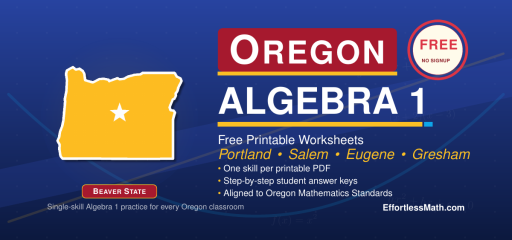
Oregon Algebra 1 Free Worksheets: Printable Algebra 1 Practice with Answer Keys
Algebra I is the first course where being clever with arithmetic is no longer enough. A student can be quick at multiplication, comfortable with fractions, and good at mental estimation and still find themselves stuck halfway through a unit on systems of equations or quadratic factoring. The reason is not that the new math is harder. It is that the new math is structured in a way that arithmetic was not. Algebra asks a student to track relationships, to keep a variable balanced across an equals sign, to read a graph as a description of behavior over time. Those are different muscles, and like any new muscle they are built by short, repeated, focused effort rather than by long stretches of hopeful review.
The students working through Algebra I in Oregon come from very different rooms. A Portland ninth grader on a public transit ride home, a Salem student fitting study time around marching band, a Eugene teenager working at a kitchen table near campus, a Gresham student catching up after a missed unit, different mornings, same math. Linear equations and inequalities. Slope and lines. Linear and exponential functions. Systems. Exponents and radicals. Factoring. Quadratic equations and functions. Each of those topics has a small handful of underlying skills, and each of those skills fits cleanly on a single page.
That is what this collection is, sixty-two pages, sixty-two small, completable jobs.
What’s on this page
Sixty-two single-skill PDFs, each aligned to the Oregon Algebra 1 standards. The set covers the recognized backbone of the course but breaks each topic finer than a textbook chapter does. Solving two-step equations and solving multi-step equations are separate worksheets. Slope and slope-intercept form are separate worksheets. Factoring trinomials and solving quadratic equations by factoring are separate worksheets. That granularity is intentional. It is what allows a student to identify exactly which underlying piece is the actual sticking point, rather than re-doing a whole unit hoping the right skill lands by accident.
Each worksheet begins with a one-page Quick Review. The skill is stated in plain English, and one worked example is carried through with every step of the reasoning visible. Twelve practice problems follow, sequenced from gentle to genuinely challenging. The final page is a student-facing answer key written in a tutoring tone, short, friendly, and complete enough for an Oregon ninth or tenth grader to read on their own and learn from without an adult standing nearby.
Foundations of Algebra
The first unit swaps pure arithmetic for variables, building expressions, evaluating them carefully, and applying the basic properties of operations. Across Oregon, this is one of the skills that rewards regular reps.
- Variables, Expressions, and Properties
- Order of Operations and Evaluating Expressions
- Simplifying Algebraic Expressions
- Introduction to Equations and Solutions
- Personal Financial Literacy
Solving Linear Equations
Students learn to undo operations in the right order, building from simple equations up to literal equations solved for any letter. It is worth the extra reps for Oregon learners aiming for a strong score on the Oregon Algebra 1 course.
- Solving One-Step Equations
- Solving Two-Step Equations
- Solving Multi-Step Equations
- Equations with Variables on Both Sides
- Literal Equations and Formulas
Inequalities and Absolute Value
The chapter covers one- and multi-step inequalities, compound statements, and absolute-value equations and inequalities. Portland families can use these pages to lock the skill in before it’s tested.
- Solving One-Step Inequalities
- Solving Multi-Step Inequalities
- Compound Inequalities
- Absolute Value Equations
Relations, Functions, and Sequences
Relations give way to functions here, and sequences show how a single rule can generate a whole list of values. In Portland classrooms it tends to separate confident students from hesitant ones.
- Relations and Functions
- Function Notation and Evaluating Functions
- Domain and Range
- Graphing Functions and Transformations
- Arithmetic Sequences as Linear Functions
- Geometric Sequences
- Comparing Functions
- Piecewise Functions
- Combining Functions
- Inverse Functions
Linear Functions and Their Graphs
Straight lines in full: slope and rate of change, the major equation forms, parallel and perpendicular lines, and variation. Steady practice now makes the Oregon Algebra 1 course feel far more manageable later.
- Slope and Rate of Change
- Slope-Intercept Form
- Point-Slope Form
- Standard Form of a Linear Equation
- Writing Linear Equations from Graphs and Tables
- Parallel and Perpendicular Lines
- Inverse Variation
- Understanding Graphs as Solution Sets
Systems of Equations and Inequalities
Students juggle multiple equations, choosing among graphing, substitution, and elimination, and apply systems to real situations. Master it early and the rest of the Oregon course leans on it with ease.
- Solving Systems by Graphing
- Solving Systems by Substitution
- Solving Systems by Elimination
- Applications of Systems of Equations
- Systems of Linear Inequalities
- Solving Linear-Quadratic Systems
Exponents, Polynomials, and Real Numbers
This chapter handles exponents, polynomial arithmetic, special products, and the structure of the real numbers. It’s a frequent early hurdle for learners in Portland and across the state.
Factoring
Factoring techniques take center stage, from greatest common factor to trinomials and difference-of-squares patterns. These worksheets give Oregon students focused, low-pressure practice.
- Greatest Common Factor and GCF Factoring
- Factoring Trinomials: \(x^2 + bx + c\)
- Factoring Trinomials: \(ax^2 + bx + c\)
- Factoring Special Products
Quadratic Functions and Equations
From parabola shapes to the quadratic formula, students learn to handle second-degree equations end to end. For Oregon students, fluency here shows up directly on the Oregon Algebra 1 course.
- Graphing Quadratic Functions
- Characteristics of Quadratic Functions
- Solving Quadratics by Factoring
- Solving Quadratics by Completing the Square
Statistics and Probability
Making sense of data: center and spread, histograms and box plots, two-way tables, scatter plots, and basic probability. Getting comfortable here pays off all the way through the Oregon Algebra 1 course.
Exponential Functions and Modeling
Students model exponential change, graph it, and weigh it against linear and quadratic behavior. Time spent here is time saved when the Oregon Algebra 1 course rolls around.
More Topics
- Absolute Value Inequalities
- Direct Variation
- Displaying Data with Box Plots
- Displaying Data with Histograms
- Exponential Decay
- Graphing Cube Root Functions
- Graphing Square Root Functions
How to use these worksheets at home
Choose pairs that share a prerequisite, and the work feels half as heavy as it would alone. Algebra I is full of natural two-step sequences. Print “Solving Two-Step Equations” the day before “Solving Multi-Step Equations”, the second sheet is the first with one more move stacked on top. Run “Slope and Rate of Change” right before “Slope-Intercept Form,” and the slope a student has just computed walks straight into the m of y = mx + b. Set “Factoring Trinomials” the night before “Solving Quadratics by Factoring,” and the second worksheet feels like the first one completed. Pairing this way is the difference between learning two things and learning the relationship between them.
Length-wise, twenty unbroken minutes on one page is the sweet spot for this age. Set the worksheet on the table, hand over a pencil, and walk away. Oregon teenagers, like teenagers anywhere, will commit to focused work when they know the work has a clear end and is theirs to finish. They will not commit to vague “math time,” and they should not be expected to.
Close with the answer key. Hand it over and let your student grade themselves. The skill of noticing where your own reasoning split from the model, naming it in a sentence, and rewriting the corrected step on a clean sheet is part of the math content at this age, and it is the habit that distinguishes students who reach the end of the year with the course built up underneath them from students who arrive at spring unsure where the gaps are. It is also, conveniently, the habit that makes Geometry and Algebra II noticeably less stressful when they come around.
A note about Algebra 1 in Oregon
Oregon high schools teach Algebra 1 under the state’s Algebra 1 standards, which align with the Common Core framework for high school mathematics. The course is generally completed in the spring with a cumulative assessment, administered as part of the state’s testing program or as a district end-of-course exam, and whatever form that final assessment takes, the underlying skill list is consistent across districts. Solve linear equations and inequalities. Graph and interpret lines. Work fluently with linear and exponential functions. Solve systems by graphing, substitution, and elimination. Manipulate expressions, including those with exponents and radicals. Factor and solve quadratic equations. Reason about real-world data and the key features of functions.
Because each PDF here is mapped to a single standard, the set works neatly as a personal pre-test checklist. Print a sheet, see how the page goes, and let the result decide what to do next. A clean answer key is permission to move forward; a stumble is a quiet pointer to the prerequisite skill that needs another twenty minutes. That kind of targeted study is significantly faster than reviewing a whole textbook, and it leaves a visible record, a small stack of finished pages, that shows how much of the course has actually been learned.
A short closing
Algebra I gets built one quiet finished page at a time, and the only thing standing between most students and a strong spring is the steady habit of printing the next one. Bookmark this page, print a single PDF tonight, and let your Oregon student begin where the page looks easiest. The course unfolds more gently from one finished page than from any single weekend of effort.
New to Algebra? Start with the basics


Related to This Article
More math articles
- Everything You Need to Know to Choose the Right Laptop
- Fifth Amendment
- Press freedom
- ACCUPLACER Math Practice Test PDF with Answers
- Free Grade 5 English Worksheets for Alabama Students
- Suffixes and Word Families: How Endings Change Meaning
- The 10,000x Max Win: How Often It Actually Hits
- Kentucky KSA Grade 7 Math Worksheets: 95 Free Printable PDFs with Answer Keys
- How to Multiply Radical Expressions? (+FREE Worksheet!)
- How to Do Division Using Partial Quotients











What people say about "Oregon Algebra 1: Free Worksheets"?
No one replied yet.