Inside the Math Gap Between Online Baccarat and the Pit-Boss Version
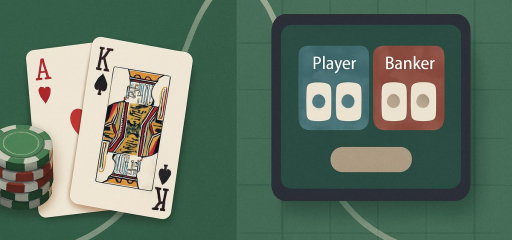
Online baccarat looks different. That’s obvious. The table might be a livestream, a mobile interface, a digital shoe, or a brisk RNG simulation. Virtual chips replace the heavy stacks. The scoreboard updates in real time. You’re sitting at home instead of standing in a high-limit pit, watching someone else’s money rise and fall.
But here’s the real question: does the online version change the actual odds? Not always. Sometimes yes, sometimes no. It depends on what rules the site’s using. The core math of baccarat comes down to three things: the drawing rules, the deck count, and the payouts. If an online game mirrors those same elements as a casino table, the mathematical skeleton is basically identical. If it introduces different commission rates, side bets, crazy-fast speed, bonuses, or RNG mechanics, then sure, the experience shifts, and so does your risk. The names stay the same (Banker, Player, Tie), but the underneath can be very different.
The smart question isn’t “Which version is more fun?” It’s “Which rules, payouts, speed, and safeguards actually change your expected value?” This is about math and reading the fine print, not a pitch to gamble. Real-money play is for adults only where it’s legal, and if you do play, use the responsible-gambling tools.
The Game Usually Follows the Same Rules
Standard baccarat boils down to this: you pick Banker, Player, or Tie. The cards come out according to fixed drawing rules. You don’t decide if the Banker draws a third card. You don’t play the Player hand. Once you’ve placed your bet, the shoe follows its algorithm.

Whether those cards hit a Las Vegas table or stream from an online studio, the underlying process is the same. If the site uses live dealers with a real shoe, you’re still watching cards dealt under baccarat rules. If it’s RNG-based, the software is generating an outcome that’s supposed to match the approved rules. Either way, the math starts with one question: what’s the probability of each result, and what’s each result worth?
If you want to build up the fundamentals, Effortless Math’s guide to solving probability problems covers the basic building block behind every casino calculation, favorable outcomes divided by total possible outcomes. Baccarat just wraps that concept in cards, rules, and payout schedules.
Where Online Baccarat Actually Differs
Online baccarat diverges from casino baccarat in ways that matter. Speed, first and foremost. A physical table has friction built in: buying chips, waiting for other players, watching the dealer work, dealing with table etiquette. Online? The hands can rip by. More hands per hour means more money exposed to the house edge. A 1% edge over 30 hands in an evening feels nothing like 250 hands in the same span.
The format is another big difference. Live-dealer sites show real cards on video. RNG sites generate outcomes digitally and display them as card results. New Jersey’s internet gaming rules (think NJAC 13:69O-1.2 and 13:69O-1.5) spell out server-based systems and demand approved mechanisms for outcomes, records, and player safeguards. In that framework, “online” isn’t just a screen. It’s a regulated technical ecosystem with rules for geolocation, account controls, game history, and access to responsible-play limits.
And then there are side bets. Most online baccarat interfaces throw extra wagering options at you, pairs, bonus wins, dragon bets, tie variants. They look tasty because they pay bigger, but, and this matters, higher payouts come with higher house edges. Stick to Banker and Player, and you’re taking one risk. Click every side bet button, and you’re taking a much worse one.
House Edge: The Number That Never Lies
The Wizard of Odds analysis for eight-deck baccarat gives you the baseline: roughly 1.06% house edge on Banker, 1.24% on Player, 14.36% on Tie (at 8-to-1 payout). Banker also carries a standard 5% commission on wins. These aren’t just “casino floor” numbers. They’re rule-based, payout-based numbers. If an online site runs the same deck rules and payout structure, that same math applies.
Expected value, the average outcome over many, many repetitions, is what matters. Effortless Math’s piece on expected value does a good job separating one lucky night from the long-term reality. You can win ten hands online and lose ten hands in a casino. The underlying edge is still the same if the rules match.
Here’s what to check before you trust the online baccarat math:
| What to Ask | Why This Matters |
|---|---|
| How many decks? | Even small deck differences shift the probabilities slightly. |
| Does Banker have a commission? | The commission, usually 5%, directly cuts into expected value. |
| What’s the Tie payout? | 8-to-1 versus 9-to-1 creates a huge house-edge gap. |
| Side bets available? | They typically carry brutal, double-digit house edges. |
| Is the operator regulated in your state? | Regulation means licensing, game audits, account controls, and a path to complain. |
Live Dealer Versus RNG: Which Feels Better Isn’t Which Plays Better
Live-dealer games get marketed as the “authentic” version because actual cards appear on camera. RNG games are typically faster, more automated. From a pure math angle? Neither is automatically superior. What matters is whether the game’s regulated, whether the rules are transparent, and whether the outcome mechanism actually matches what’s advertised.
A live dealer game can still destroy you mathematically. An RNG game can be perfectly fair, truly random, but still bad for your wallet because of how it’s designed to pay out. “Fair” doesn’t mean you’ll win. It means the outcome process isn’t secretly rigged beyond what the rules already bake in. The house edge is a built-in feature, not a hidden cheat.
Here’s a subtle but important lesson: a process can be random and still work against you. A lottery drawing can be completely random, but your ticket is still a bad investment. A slot machine can spin fairly and still pay back less than it takes. Baccarat, online or in the pit, operates on the same principle.
The Speed Factor Multiplies Your Cost
One thing people often overlook when comparing online baccarat math to casino baccarat: velocity. Let’s say you’re putting $20 on Banker every hand. At a 1.06% edge, you’re losing about $0.21 per hand on average. Sounds tiny. But here’s where it gets interesting: the expected cost per hour depends entirely on how many hands you actually play.

| Hands per Hour | Total Wagered at $20/hand | Expected Loss (at 1.06%) |
|---|---|---|
| 40 hands | $800 | ~$8.48 |
| 100 hands | $2,000 | ~$21.20 |
| 250 hands | $5,000 | ~$53.00 |
The percentage doesn’t budge. But your exposure explodes. That’s why online casino games feel deceptively cheap per hand while eating your bankroll over a session. A small percentage applied 250 times stops being small real fast.
Bonuses: Don’t Confuse Marketing With Math
Online casinos dangle bonuses like candy. Credits, free plays, deposit matches. They can change how a session plays out, but only if the terms aren’t buried in fine print and math-hostile. Wagering requirements, game contribution percentages, maximum cashout caps, time limits, excluded games.. They can wipe out whatever benefit the headline promised.
Mathematically, a bonus is a separate calculation. You’d need to estimate: the bonus value, the required turnover, the house edge on games you’re allowed to use, and your odds of clearing the requirement before you’re broke or hit a cap. That’s messier than basic baccarat math. And honestly? Most people treat a $100 bonus as “free money” when they should be running the expected-value numbers. One’s marketing. The other’s math.
Effortless Math’s article on using math for calculating winnings is worth reading because it grounds gambling math in probability, payout, and long-term reality instead of hope.
Regulation Isn’t Identical Everywhere
In the U.S., whether online gambling is legal depends on where you live. New Jersey has strict rules: detailed requirements under NJAC 13:69F-5.2 and related sections. The state demands player protections, responsible gaming limits, self-exclusion, account history access, geolocation controls. Other states have different frameworks. Many offshore sites aren’t legal or regulated for American players.
A math article can’t solve every person’s legal situation, but here’s the principle: don’t treat every online baccarat site the same. Licensing, regulatory oversight, game rules, payout tables, account safeguards, complaint procedures, all of it matters. The math of a bet starts with rules. The risk of playing includes the entire operator environment. For New Jersey players specifically, the Cornell Legal Information Institute maintains links to the gaming regulations (NJAC 13:69O-1.2, 13:69O-1.5) that spell out what regulators require. It’s not light reading, but it’s not optional if you’re assessing legitimacy.
Frequently Asked Questions
Does online baccarat have worse odds than the casino version?
Not necessarily. If the online site uses the same deck count and payout schedule as a regular casino baccarat table, the main-bet odds can be nearly identical. What actually hurts players more online: faster pace (more hands, more edge exposure), aggressive side-bet menus, vague rules, and unregulated operators. For the fundamentals of online baccarat math, Effortless Math’s lesson on theoretical and empirical probability separates what happens once from what happens over time.
Is live dealer baccarat more trustworthy than RNG baccarat?
Live video *feels* more transparent. But real trust comes from licensing, audits, and oversight. An RNG game in a regulated market (say, New Jersey) can be approved and monitored; a live game on an unregulated offshore site is still risky. New Jersey’s regulations on server-based gaming show how regulators handle outcome integrity and player record-keeping. That’s the kind of framework that matters, not whether you see cards on camera.
Can online baccarat bonuses actually make the game profitable?
Rarely. Promotions *can* shift the math in your favor, but only if you run the numbers carefully. You need to read the wagering requirements, the list of eligible games, the contribution rates, any maximum cashout limits, and the deadline. Many bonuses that look incredible on the surface have terms that crush the practical expected value.
What You Actually Need to Know
Online baccarat isn’t secretly different from casino baccarat. But the online setup changes practical realities. Same rules and payouts? You’re facing the same house edge. Add speed, side bets, bonuses, or nonstandard payouts? Your expected cost shifts, sometimes quickly.
The foundation is simple: study the rules before you study the screen. Online baccarat math isn’t hidden. It lives in the probabilities, the payouts, and how often you’re putting your bankroll in front of a negative-expectation bet. Know those, and you know what you’re actually facing.
Sources

Related to This Article
More math articles
- How to Use Strip Models to Add Fractions with Like Denominators
- Top 10 Tips to Create a CBEST Math Study Plan
- Praxis Core Math Flashcards (Free Online: Formulas, Terms & Concepts)
- SSAT Upper Level Math Flashcards (Free Online: Formulas, Terms & Concepts)
- Use models as maps
- Sweepstakes Casino Wagering: How Many Spins Until Redemption
- Top 10 Tips to Overcome ASTB Math Anxiety
- Free Grade 5 English Worksheets for Nevada Students
- 5th Grade MEAP Math Practice Test Questions
- Evaluating Variables and Expressions










What people say about "Inside the Math Gap Between Online Baccarat and the Pit-Boss Version - Effortless Math"?
No one replied yet.