CLEP U.S. History I 082: Expansion, Native Dispossession, and Borderlands
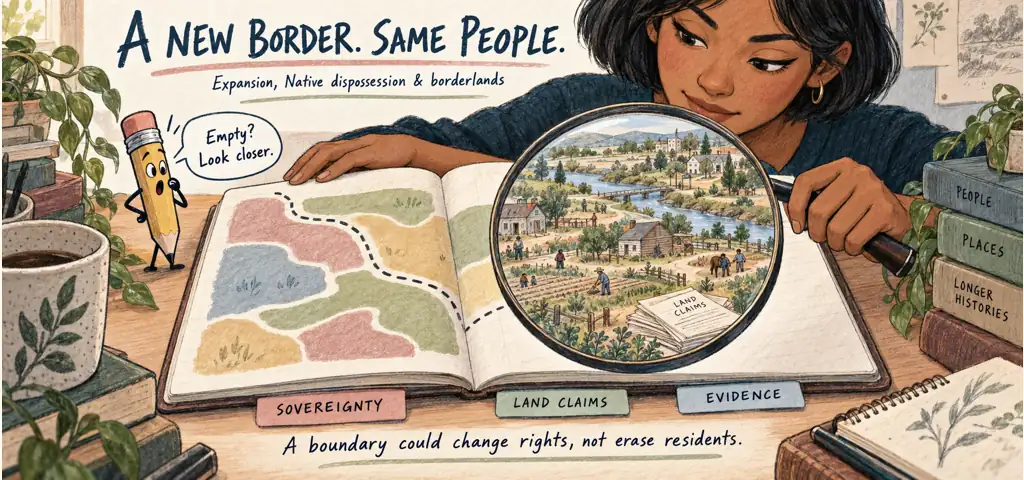
Lesson 15.4 of Chapter 15 of the U.S. History to 1877 study guide on Effortless Math covers CLEP U.S. History I 082: Expansion, Native Dispossession, and Borderlands: the key terms, the core ideas, and worked examples showing how this topic is tested on the exam.
U.S. History to 1877 | Chapter 15 | Lesson 15.4
Federal maps often turn acquired territory into a solid national color. Borderlands history asks who already lived there and which legal systems overlapped. Native nations controlled land through their own political relationships. Mexican communities held property under grants and customary use. Traders, missionaries, migrants, and military officers moved through spaces where U.S. authority was claimed before it was fully enforced.
[.9 ] images/bank-selected/us-territorial-acquisitions.png Acquisition map: useful national chronology, incomplete human geography U.S. Geological Survey, National Atlas of the United States, “Territorial Acquisitions.” For this course, focus on the original states, Louisiana Purchase, Florida, Texas, Oregon, the Mexican Cession, and the Gadsden Purchase. The modern state outlines aid orientation, but the colored blocks do not show Native sovereignty, Mexican communities, disputed control, war, or uneven enforcement.
The Treaty of Guadalupe Hidalgo promised that Mexican property would be “inviolably respected,” but the U.S. Senate removed Article X, which had specifically addressed Mexican land grants. Later confirmation procedures shifted the burden of proof onto claimants. Translation costs, missing records, taxes, litigation, squatting, and violence could turn a formal promise into practical loss. A borderlands approach therefore compares the rule written in a treaty with the institutions that implemented it.
See the history take shape
Vision Chasers offers a visual route through this topic. As you watch, compare its explanation with the source limits in the written lesson.
Video: How did Westward Expansion affect the Native Americans, Vision Chasers.
Check your understanding
- Which statement would a borderlands historian be most likely to reject?
- Diplomacy shaped where formal boundaries were drawn and recognized.
- Native nations adjusted their political strategies as conditions changed.
- Courts affected which existing property claims received legal recognition.
- Migration altered patterns of land use and local environments.
- A new boundary erased earlier peoples and legal claims at once.
- Which statement best describes Native responses to U.S. expansion?
- Some nations emphasized negotiation with federal officials.
- Some communities sought alliances against incoming settlers.
- Native nations combined varied strategies under mounting coercion.
- Some groups moved in an effort to protect their autonomy.
- Some leaders used petitions and courts to challenge land seizures.
- Select all evidence useful for testing a claim that land was “empty”:
- treaties,
- Native oral histories,
- land-use maps,
- one settler’s label alone,
- archaeological evidence.
- Explain why a change in sovereignty can alter property rights even when residents remain in place.
Write a brief response using a named fact from the lesson.
Open the answers and reasoning
Independent preparation. CLEP is a registered trademark of the College Board, which does not endorse this lesson.

Related to This Article
More math articles
- How to Find the Measures of Central Tendency? (+FREE Worksheet!)
- 10 Most Common 8th Grade STAAR Math Questions
- 6th Grade Georgia Milestones Assessment System Math Worksheets: FREE & Printable
- Building a Well-Organized Paragraph
- The Best Grade 7 Math Book for Connecticut Students
- How to Solve the Complex Plane?
- Run-Ons and Comma Splices
- The Law of Sines
- The Ultimate SIFT Math Formula Cheat Sheet
- Exterior Angle Theorem














What people say about "Expansion, Native Dispossession and Borderlands"?
No one replied yet.