Waves, Sound, and Light: A CLEP Beginner’s Guide
Waves, Sound, and Light: A CLEP Beginner’s Guide: this Effortless Math guide explains the topic in plain language, shows how it works through solved examples, and gives you free practice to try immediately, so the idea sticks instead of staying abstract.
CLEP Natural Sciences · Beginner lesson
Waves, Sound, and Light: A CLEP Beginner's Guide
Sound and light can feel like separate chapters until you see the shared wave pattern underneath them. Start with what a wave transfers, then track frequency, wavelength, speed, and what happens at a boundary.
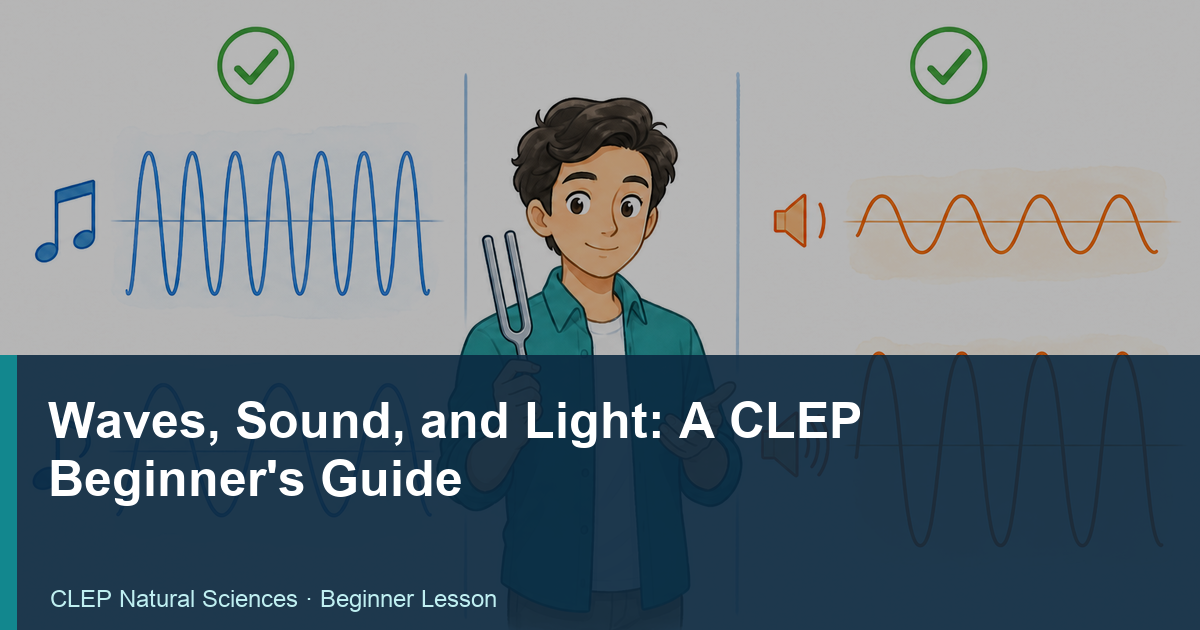
A wave is a traveling disturbance that transfers energy and information; mechanical waves such as sound need matter, while electromagnetic waves such as light can cross a vacuum.
What moves when a wave travels?
A wave transfers energy and information through a disturbance. The material in the medium usually moves back and forth around an equilibrium position instead of traveling with the wave over a long distance. A marked point on a rope rises and falls while the pulse moves along the rope.
How do wavelength, frequency, and speed fit together?
Wavelength is the distance between matching points on neighboring cycles. Frequency is the number of cycles passing a point each second. Wave speed equals frequency multiplied by wavelength. In one medium, a higher frequency therefore pairs with a shorter wavelength when speed stays constant.
| Quantity | What it describes | Common unit |
|---|---|---|
| Amplitude | Maximum displacement from equilibrium | Depends on the wave |
| Frequency | Cycles per second | Hertz |
| Wavelength | Length of one cycle | Meter |
| Speed | Distance the disturbance travels per time | Meter per second |
Why does sound need matter?
Sound is a mechanical wave. It travels through vibrations in matter, so it cannot cross a vacuum. Frequency is closely connected to pitch. Amplitude and intensity are connected to loudness, although human hearing is more complicated than a one-number rule.
How is light different from sound?
Light is an electromagnetic wave and can travel through a vacuum. All electromagnetic waves have the same speed in a vacuum but differ in frequency and wavelength. Radio waves, visible light, ultraviolet radiation, and X-rays belong to the same spectrum.
What happens at a boundary?
Reflection sends a wave back. Refraction changes its direction because its speed changes in a new medium. Absorption transfers wave energy to matter. Diffraction spreads a wave around an edge or through an opening. Interference occurs when overlapping waves combine.
Common trap: a wave’s frequency is set by its source. When light enters a new medium, speed and wavelength can change while frequency stays the same.
How do you solve a wave question?
Name the wave, identify the medium, decide which quantity changes, and use the relationship among speed, frequency, and wavelength only after the physical story is clear. A formula is most useful when each symbol already has a meaning.
Watch the idea take shape
Wave Motion | FuseSchool gives you a second route through the same science. Pause once or twice and explain the central relationship aloud before continuing.
Check your understanding
- Does the material of a medium normally travel with a wave over a long distance?
- What happens to wavelength if frequency increases while speed stays constant?
- Why can sound not travel through a vacuum?
- Which sound quantity is most closely related to pitch?
- What changes when light refracts on entering a new medium?
- How does reflection differ from absorption?
Answers
- No. Particles usually oscillate around equilibrium while energy travels.
- Wavelength decreases.
- Sound needs particles whose vibrations pass the disturbance along.
- Frequency.
- Its speed and wavelength can change. Its frequency remains set by the source.
- Reflection sends wave energy back. Absorption transfers that energy into the material.

Related to This Article
More math articles
- Acids, Bases, and the pH Scale
- What’s The Best Laptop For Online Math Teachers?
- How to Solve Prime Factorization with Exponents?
- Top 10 7th Grade MEAP Math Practice Questions
- HiSET Math – Test Day Tips
- The Ultimate 6th Grade KAP Math Course (+FREE Worksheets)
- ACT Math: Everything You Need to Know
- How to Prepare for GED Math: 11 Steps and Free Resources
- Top 10 Tips to Create a CLEP College Mathematics Study Plan
- How to Find Rational and Irrational Numbers?






















What people say about "Waves, Sound, and Light: CLEP Beginner Guide"?
No one replied yet.