How to Study Science Effectively
You finish a page about blood flow, recognize every label, and then cannot draw the route with the book closed. That gap gives you a useful place to begin. A study session should include a chance to retrieve the idea before you decide that you know it.
Definition: Effective science study is active: you build a small idea, explain it in your own words, practice retrieving it, and use mistakes to decide what to review next. Short, repeated sessions usually teach more than one long rereading session because recall strengthens the connections you will need later.
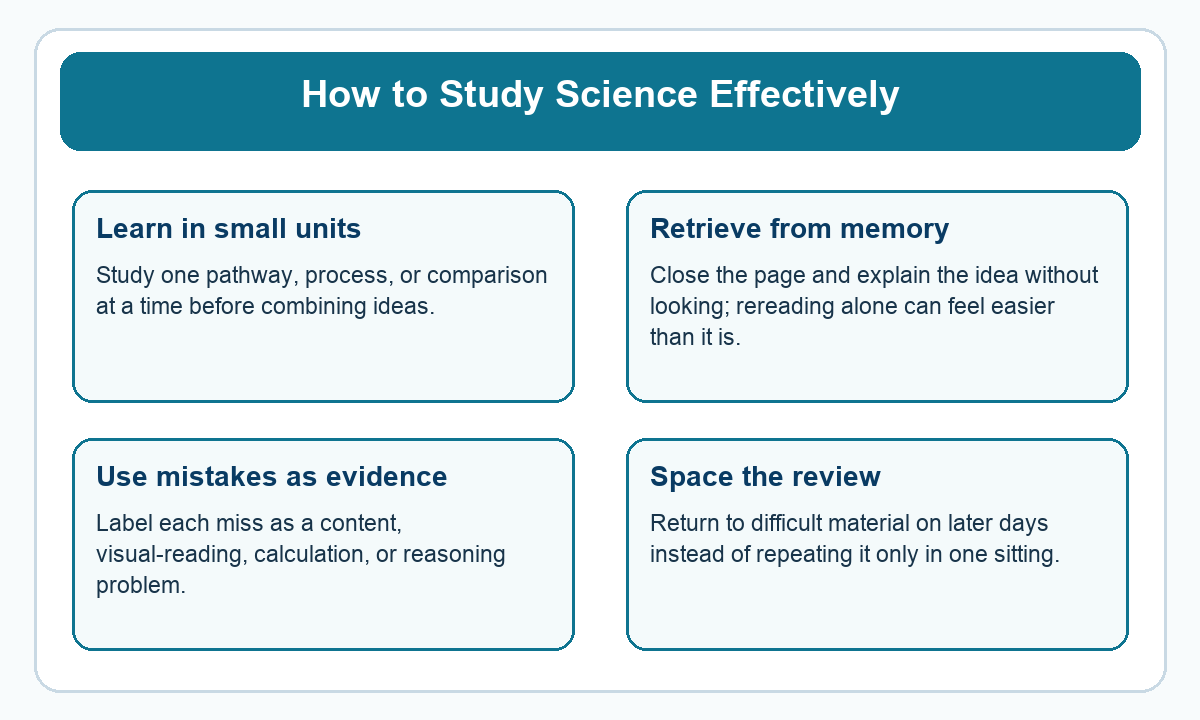
The diagram groups four study actions. After reading it, choose one process from your biology course and describe how you would use each action to learn that process.
Terms used in this lesson
| Idea | What it means |
|---|---|
| Learn in small units | Study one pathway, process, or comparison at a time before combining ideas. |
| Retrieve from memory | Close the page and explain the idea without looking; rereading alone can feel easier than it is. |
| Use mistakes as evidence | Label each miss as a content, visual-reading, calculation, or reasoning problem. |
| Space the review | Return to difficult material on later days instead of repeating it only in one sitting. |
Build a session around one process
Start with a question you can answer in a few sentences, such as how blood travels from the right ventricle to the lungs and back to the heart. Read that section. Then close it and draw the route, adding arrows to show direction and labels to distinguish vessels from chambers.
Check the drawing against the lesson. If you reversed the pulmonary artery and pulmonary veins, correct the direction and write why each vessel has its name: arteries carry blood away from the heart, and veins carry blood toward it. Oxygen content alone will not identify those vessels.
Choose practice that reveals what you understand
A definition card can help you learn the word capillary. A second card should ask how a capillary’s thin wall supports exchange with tissues. The first checks recall of a term. Explaining the second connects structure with function, which helps when a question presents an unfamiliar organ or diagram.
Use a blank page, a short written response, or a few practice questions to test yourself. Keep the answers covered until you have committed to a response. Looking immediately can make an explanation feel familiar without showing whether you could produce it.
Turn three wrong answers into a review plan
Suppose you miss three blood-flow questions. One asks about vessel direction, another uses a diagram viewed from the front, and the third asks where gas exchange occurs. Record the reason for each miss. Reversing artery and vein calls for a concept correction, whereas confusing the person’s right with the viewer’s right calls for diagram practice.
Return to the corrected route the next day and draw it again without looking. Later in the week, answer a new question that uses the same pathway. The exact interval can change with your schedule and how well you remember, but the next session should give you another opportunity to retrieve the material.
When rereading is useful
Reread the passage that explains a specific gap, then try the question again from memory. Highlighting a paragraph can mark where to return. It does not show that you can explain the paragraph. If your answer is incomplete, add the missing cause or step and test that part again during a later session.
Watch a short lesson
Connect retrieval practice and spaced review with the memory processes explained in this lesson.
Practice without looking at the answers
Write your responses before opening the answer panels.
-
You recognize a heart diagram but cannot redraw its main route. What should you do next?
Check the answer
Attempt the drawing from memory, compare it with the lesson, and correct the missing or reversed connections. Recognition alone has not demonstrated recall.
-
Why study pulmonary blood flow before adding the full body circuit?
Check the answer
A smaller pathway reduces the number of relationships you must handle at once. Once you can explain it, connect it to the body circuit.
-
You knew the concept but read the vertical axis incorrectly. What belongs in your error record?
Check the answer
Label this as a visual-reading error and record the missed unit or scale. Practice reading another axis instead of only rereading the biology definition.
-
What makes a useful second card after a card defining capillary?
Check the answer
Ask how a capillary’s thin wall supports exchange. That checks the relationship between a structure and its function.
-
How could you space review of a pathway learned today?
Check the answer
Recall it tomorrow and revisit it later in the week, adjusting the timing if you still miss steps. The sessions should include retrieval, another look at the page.
-
Why avoid memorizing the letters of three corrected answers?
Check the answer
Letters belong to those particular questions. Explaining the corrected blood-flow pathway prepares you to answer new questions with different wording and options.
Where does this fit in your science review?
The ATI TEAS Science Study Hub places this lesson inside the larger study skills review. Continue with these connected lessons:

Related to This Article
More math articles
- How to Find Similar Figures?
- FREE HSPT Math Practice Test
- Free Grade 6 English Worksheets for Vermont Students
- Using Number Lines to Compare and Order Rational Numbers
- How to Find Vertical Angles? (+FREE Worksheet!)
- Free Grade 6 English Worksheets for Oregon Students
- Free Grade 7 English Worksheets for Alabama Students
- Free Maine MTYA Grade 3 Math Worksheets: 49 Printable PDFs with Friendly Answer Keys
- Top 10 5th Grade Common Core Math Practice Questions
- How to Identify Linear vs. Nonlinear Functions? (+FREE Worksheet!)
















What people say about "How to Study Science Effectively"?
No one replied yet.