The Calvin Cycle Explained: Phases, ATP and G3P
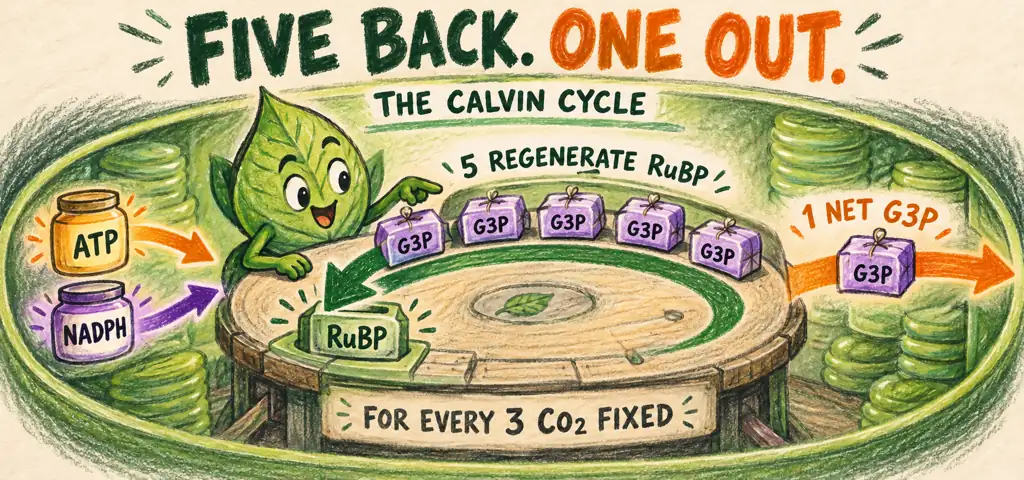
The Calvin cycle fixes carbon dioxide into organic molecules in the chloroplast stroma. ATP and NADPH support reduction and regeneration. Three fixed carbon-dioxide molecules yield one net G3P; six yield two net G3P equivalents at a standard cost of 18 ATP and 12 NADPH.
A growing plant can gain much more mass than its soil loses. Water contributes substantially to its fresh mass, while atmospheric carbon dioxide supplies the carbon built into its organic molecules. In photosynthetic cells, carbon enters the Calvin cycle through a reaction in the chloroplast stroma. The cycle must regenerate its carbon acceptor to keep incorporating carbon dioxide.
Watch the process
Photosynthesis
The light reactions supply ATP and NADPH to the stroma. ATP supports energy-requiring steps, while NADPH supplies reducing electrons. If the light reactions are disrupted, trace which Calvin-cycle reaction loses its input before predicting how an intermediate’s concentration changes.
Three Phases, One Loop
The Calvin cycle in the chloroplast stroma uses ATP and NADPH to incorporate carbon dioxide into organic molecules. Its three phases are carbon fixation, reduction and regeneration. Rubisco attaches carbon dioxide to RuBP, ribulose 1,5-bisphosphate; the unstable six-carbon product splits into two three-carbon 3-PGA molecules. Reduction uses ATP and NADPH to form G3P. Regeneration uses ATP and most of the G3P equivalents to rebuild the RuBP acceptor.
Keep the three intermediates separate by their roles. RuBP is the acceptor the cycle keeps rebuilding, 3-PGA is the acid made the instant carbon is fixed, and G3P is the sugar that appears only after ATP and NADPH have been spent. To predict a concentration change, identify which reaction produces the intermediate and which consumes it.
In the standard accounting, three carbon-fixation events produce six G3P molecules in the reduction phase. Five G3P equivalents regenerate three RuBP acceptors, leaving one net G3P. Fixing six carbon-dioxide molecules yields two net G3P equivalents, enough carbon for one glucose equivalent, at a cycle cost of 18 ATP and 12 NADPH. The cycle does not directly produce free glucose; later reactions build carbohydrates from its products.
The light reactions and carbon assimilation are coupled. Restricting ATP or NADPH supply limits the Calvin cycle. Restricting carbon assimilation can also limit the return of ADP and oxidized electron acceptors, affecting light reactions. Alternative electron sinks and cellular regulation make the actual response more complex than an immediate universal stop.
The Full Cost of One Glucose
Using three turns of the cycle to fix three \(\text{CO}_2\), work out how many turns, ATP, and NADPH are required to export enough G3P for one glucose, and show where each number comes from.
Step 1: count carbons entering per turn. One turn fixes one \(\text{CO}_2\), adding one carbon to the pool. Three turns add three carbons, which is exactly one G3P worth, since G3P has three carbons.
Step 2: count G3P production and regeneration. Fixing three carbon-dioxide molecules produces six three-carbon G3P molecules in the reduction phase. Five G3P equivalents provide the fifteen carbons needed to regenerate three five-carbon RuBP molecules. One three-carbon G3P equivalent remains as the net product.
Step 3: double the net carbon output. Two net G3P equivalents contain six carbons, enough for one glucose equivalent. This requires six carbon-fixation events. Subsequent carbohydrate synthesis is separate from the cycle’s net G3P accounting.
Step 4: total the inputs. Each turn spends 3 ATP, two in the reduction phase and one in regeneration, and 2 NADPH, both in the reduction phase. For six turns: \[6 \times 3 = 18\ \text{ATP}, \qquad 6 \times 2 = 12\ \text{NADPH} .\]
Step 5: check the ratio. The standard cycle accounting uses ATP and NADPH in a 3:2 ratio. Cyclic electron flow around photosystem I can contribute additional ATP without directly producing NADPH. How a chloroplast balances these requirements depends on electron flow and other metabolic demands.
Answer
Six carbon-fixation events, 18 ATP and 12 NADPH yield two net G3P equivalents in the standard model, enough carbon for one glucose equivalent. This accounting excludes subsequent carbohydrate synthesis and additional costs such as photorespiration.
Predicting the Effect of Withdrawing \(\text{CO}_2\)
A well-lit algal culture is fixing carbon at a steady rate. Carbon dioxide is abruptly removed from the medium while light continues. Consider the initial Calvin-cycle response and neglect photorespiration and alternative sources of 3-PGA in this model. Predict what happens to the concentrations of RuBP and 3-PGA in the stroma, and support the prediction.
Claim. RuBP accumulates and 3-PGA falls.
Evidence in the simplified model. Carbon fixation consumes RuBP and supplies 3-PGA. Removing carbon dioxide restricts this input. Existing intermediates can still pass through reduction and regeneration briefly while energy and substrates remain available.
Reasoning. Immediately after carbon-dioxide removal, reduced fixation lowers RuBP consumption and 3-PGA production. Continued use of the existing 3-PGA pool and regeneration of RuBP can therefore make RuBP rise and 3-PGA fall initially. This is a short-term model prediction, not an indefinite steady-state rule; enzyme regulation, pool depletion and rubisco oxygenation can change the actual response.
Conclusion
Under the stated short-term assumptions, RuBP is expected to rise and 3-PGA to fall because carbon fixation loses its carbon-dioxide substrate. Do not extrapolate that initial trend indefinitely.
Distinctions to keep clear
The older name “dark reactions” can misleadingly suggest that the Calvin cycle requires darkness. The Calvin cycle does not require darkness, does not prefer darkness, and is strongly limited at night in a typical photosynthetic leaf. It is called light-independent only in the narrow sense that photons do not strike its enzymes. In a typical leaf, darkness limits the supply of ATP and NADPH and changes the regulation of several Calvin-cycle enzymes. The response depends on available pools and cellular conditions.
Carbon fixation and carbon reduction are different chemical changes. Fixation is the attachment of inorganic \(\text{CO}_2\) to an organic acceptor, and the rubisco-catalyzed step does not directly consume ATP. The energy goes into the reduction phase, where ATP and NADPH convert an acid into a sugar. When a stem asks where the ATP and NADPH are spent, ATP is used in reduction and regeneration, while NADPH supplies reducing electrons in the reduction phase. Rubisco fixation itself does not directly consume either.
The cycle needs both its carbon dioxide substrate and its RuBP acceptor. RuBP is not a catalyst; it is consumed by fixation and rebuilt by regeneration. Cut off the regeneration phase, by starving the cycle of ATP, and fixation stops even with plenty of carbon dioxide available.
Review: The Calvin Cycle: Turning Gas into Sugar
The Calvin cycle spends the ATP and NADPH from the light reactions to attach carbon dioxide to an organic acceptor and reduce it to sugar.
Fixation supplies 3-PGA; reduction uses ATP and NADPH to produce G3P; regeneration rebuilds RuBP. Fixing six carbon-dioxide molecules yields two net G3P equivalents at a standard cycle cost of 18 ATP and 12 NADPH. This is carbon for a glucose equivalent, not direct glucose production.
In a typical photosynthetic leaf, sustained Calvin-cycle activity depends on light-supported ATP and NADPH supply and enzyme regulation. Light-independent does not mean that darkness is required.
Calvin cycle accounting
Practice question 1
The ATP and NADPH consumed by the Calvin cycle are used chiefly to
-
attach carbon dioxide to RuBP during the fixation step
-
reduce 3-PGA to G3P and regenerate the RuBP acceptor
-
split water so that electrons are available for fixation
-
transport carbon dioxide across the chloroplast envelope
Practice question 2
Three turns of the Calvin cycle produce six molecules of G3P, yet only one leaves the cycle. The other five are used to
-
reduce \(\text{NADP}^+\)
-
regenerate RuBP
-
form carbon dioxide
-
build the thylakoid membrane
Practice question 3
A chloroplast is illuminated normally but an inhibitor blocks ATP synthase in the thylakoid membrane. Which downstream change in the stroma is expected as ATP becomes limiting?
-
RuBP regeneration slows, so carbon fixation falls even though carbon dioxide is abundant
-
Rubisco stops fixing carbon dioxide first, because fixation is the step that spends ATP
-
3-PGA is converted directly to glucose without the reduction phase
-
Water splitting increases to compensate for the missing ATP
Practice answer key
1. B; 2. B; 3. A.
Practice answer explanations
-
Calvin cycle accounting, Question 1. Choice B is correct. Reduction uses ATP and NADPH; regeneration also uses ATP. Rubisco carboxylation does not directly consume either. Choice A places the main energy expenditure at fixation. Choice C describes water splitting in the light reactions. Choice D does not describe the cycle’s principal ATP and NADPH use.
-
Calvin cycle accounting, Question 2. Choice B is correct. Five of six G3P equivalents regenerate the three RuBP acceptors consumed in three carbon-fixation events. One G3P equivalent is the net output. A describes NADPH production rather than this carbon rearrangement; C reverses the net carbon input. D does not identify the direct use of those five G3P equivalents, although carbon from photosynthesis can later contribute to many cell components.
-
Calvin cycle accounting, Question 3. Choice A is correct. ATP shortage limits both reduction and RuBP regeneration. As regeneration slows, less acceptor is available for fixation even if carbon dioxide is abundant. B incorrectly says rubisco fixation directly spends ATP and assumes it must fail first. C skips required reactions, while D proposes compensation that water splitting alone cannot provide.
Continue your review at the AP Biology study hub.
Sources: OpenStax Calvin-cycle overview; cyclic electron flow research.

Related to This Article
More math articles
- How Right Triangles Demonstrate Similarity
- How to Decod Decimal Numbers: Dive into Place Values
- How Do You Prove Angles Are Congruent?
- Reversing Derivatives Made Easy: Power Rule of Integration
- How the Federal Bureaucracy Works
- The Best Grade 7 Math Book for Wyoming Students
- Polynomial Identity
- Inflation, Unemployment, and Expectations
- The Best Grade 5 Math Book for Montana Students
- If-Then Statements: Examples, Converse and Counterexamples








What people say about "The Calvin Cycle Explained: Phases, ATP and G3P"?
No one replied yet.