Judicial Review and the Role of the Courts
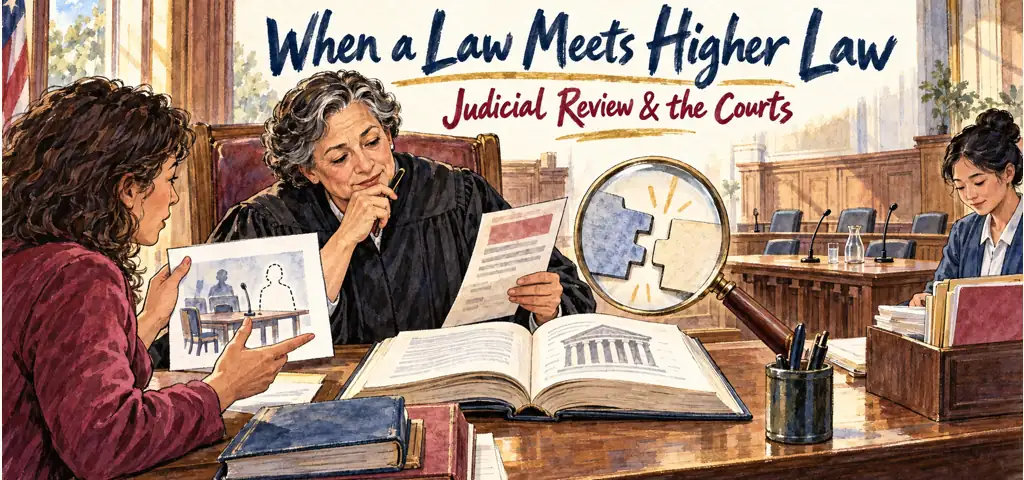
Congress enacts a popular law that conflicts with the Constitution. A court deciding a case cannot apply both commands if they point to opposite results. Judicial review is the authority of courts to determine the governing law in a proper case and to refuse effect to government action that violates higher law. It applies to legislative and executive action, and federal courts may also review state action when federal law controls.
Judicial review does not make courts a council that approves every policy before it takes effect. A litigant must present a case within the court’s jurisdiction and satisfy rules such as standing, ripeness, and mootness. The court addresses legal issues needed to resolve that dispute. Its judgment binds the parties, and its reasoning can create precedent for later courts. It does not authorize judges to answer abstract political questions on request.
A closer look at judicial review and the role of the courts
The authority operates throughout the judicial system, at the Supreme Court. A federal district judge can hold a federal action unlawful in a case within that court’s jurisdiction, subject to appellate review. State judges also must apply the U.S. Constitution and controlling federal law. The Supreme Court’s distinctive role is that its federal holdings bind lower federal and state courts, giving national effect to the rule announced in a proper case.
The mechanism follows three steps. Identify the government act. Identify the higher legal rule alleged to control it. Then ask whether a court with jurisdiction must resolve that conflict to decide the case. If a statute can be interpreted lawfully, courts often avoid an unnecessary constitutional ruling. If conflict cannot be reconciled, constitutional supremacy means the lower rule cannot govern the case.
Judicial Review and the Role of the Courts: what the rule leaves unsettled
Review can concern more than outright invalidation. A court may interpret a statute narrowly to avoid a constitutional problem, set aside an agency action that exceeds delegated authority, prevent enforcement against the plaintiff, or return a matter for lawful proceedings. The remedy depends on the violation, the parties, and the court’s authority. “The law is unconstitutional” is therefore a conclusion that must be connected to a claim and an appropriate judicial response.
Worked application. Congress authorizes an agency to impose a penalty without the hearing that the Constitution requires. A regulated party challenges the penalty in a court authorized to hear the claim. The court is not supervising the agency’s daily work. It is deciding whether the legally required process was denied. The remedy should fit that injury rather than become a general redesign of the program.
The beginner’s trap is to equate judicial review with judicial superiority in every policy disagreement. Courts decide legal conflicts. Legislatures choose among lawful policies, executives administer them, and voters hold elected officials accountable. A question points to judicial review when the decisive issue is compatibility with higher law, not when judges merely prefer a different policy.
Check your understanding of judicial review and the role of the courts
For Judicial review, follow the case from certiorari through briefing, conference, opinion assignment, precedent, implementation, and institutional constraint. Give one concrete example.
Check your reasoning
In Supreme Court practice, judicial review occurs through concrete cases rather than advisory opinions. Marbury v. Madison.
Video lesson: Judicial Review and the Role of the Courts
CrashCourse gives a focused explanation of this topic in Judicial Review: Crash Course Government and Politics #21.
If the player does not load, watch this lesson directly on YouTube.
Connect this lesson to the larger course
For a broader map connecting judicial review and the role of the courts to Congress, the presidency, the courts, and the bureaucracy, use the AP U.S. Government and Politics learning hub.

Related to This Article
More math articles
- The Best Grade 7 Math Book for South Carolina Students
- 4th Grade SC Ready Math Worksheets: FREE & Printable
- Long-Run Growth, Productivity, and Living Standards
- How to Multiply and Divide in Scientific Notation? (+FREE Worksheet!)
- Overview of the PSAT / NMSQT Mathematics Test
- Free Grade 5 English Worksheets for ACT Aspire Students
- How to Prepare for the ACT Math Test?
- Culture, Material Life, and Learned Meaning
- How to Write Best Fit Line Equations
- Top 10 Math Books for Grade 6 Students: Inspiring Masterminds











What people say about "Judicial Review and the Role of the Courts"?
No one replied yet.