3D Shapes for 5th Grade: Faces, Edges, and Vertices
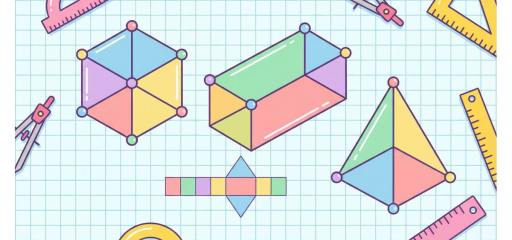
Three-dimensional (3D) shapes have length, width, and height. They have faces (flat surfaces), edges (line segments where two faces meet), and vertices (corners where edges meet). In Grade 5, students identify and classify 3D shapes such as cubes, rectangular prisms, pyramids, cylinders, cones, and spheres, and count their faces, edges, and vertices.
A rectangular prism has 6 faces (top, bottom, front, back, left, right), 12 edges, and 8 vertices. A cube is a special rectangular prism with all faces square. A pyramid has a polygon base and triangular faces that meet at a vertex (apex). A square pyramid has 1 square base + 4 triangular faces = 5 faces.
DETAILED EXPLANATION
Faces: Flat surfaces. Edges: Line segments where two faces meet. Vertices: Points where edges meet.
Rectangular prism: 6 faces, 12 edges, 8 vertices.
The Absolute Best Book to Ace Grade 5 Math
Cube: 6 faces (all squares), 12 edges, 8 vertices.
Square pyramid: 5 faces (1 square base + 4 triangles), 8 edges, 5 vertices.
Triangular prism: 5 faces (2 triangles + 3 rectangles), 9 edges, 6 vertices.
Euler’s formula (for polyhedra): Faces + Vertices − Edges = 2.
WORKED EXAMPLES WITH STEP BY STEP SOLUTIONS
Example 1
A rectangular prism has how many faces, edges, and vertices?
Solutions:
The Ultimate Middle School Math Bundle: Grades 6 to 8
Step 1: A rectangular prism has 6 faces: top, bottom, front, back, left, right.
Step 2: Edges: 4 edges on the top face, 4 on the bottom, and 4 vertical edges connecting them. Total: 12 edges.
Step 3: Vertices: 4 corners on top + 4 corners on bottom = 8 vertices.
Answer: 6 faces, 12 edges, 8 vertices
Example 2
A cube is a special rectangular prism. How many faces does it have?
Solutions:
Step 1: A cube is a rectangular prism with all faces square. Like any rectangular prism, it has 6 faces.
Step 2: All 6 faces are congruent squares.
Mastering Grade 5 Math
Answer: 6 faces
Example 3
A pyramid has a square base. How many faces does it have?
Solutions:
Step 1: A square pyramid has 1 square base and 4 triangular faces (one for each side of the base).
Step 2: Total faces: 1 + 4 = 5 faces.
Answer: 5 faces
Example 4
A triangular prism has how many faces, edges, and vertices?
Solutions:
Step 1: A triangular prism has 2 triangular bases and 3 rectangular lateral faces. Total: 5 faces.
Step 2: Edges: 3 on each base (6) + 3 connecting the bases (3) = 9 edges.
Step 3: Vertices: 3 on each base = 6 vertices.
Answer: 5 faces, 9 edges, 6 vertices

Related to This Article
More math articles
- The Best Algebra 1 Book for Nebraska Students
- 5th Grade New York State Assessments Math Worksheets: FREE & Printable
- Full-Length ISEE Middle Level Math Practice Test
- Collective Behavior and Routine Organization
- Presidential relations with Congress
- How to Measures of Dispersion?
- Multiplying Mixed Numbers Word Problems: Examples and Practice
- 10 Most Common 5th Grade MCAS Math Questions
- 7th Grade STAAR Math FREE Sample Practice Questions
- Degrees to Radians Converter (and Back)












What people say about "3D Shapes for 5th Grade: Faces, Edges, and Vertices"?
No one replied yet.