NCLEX-RN Recognize Cues vs Analyze Cues: Where Priority Starts (2027 Prep)
The short distinction
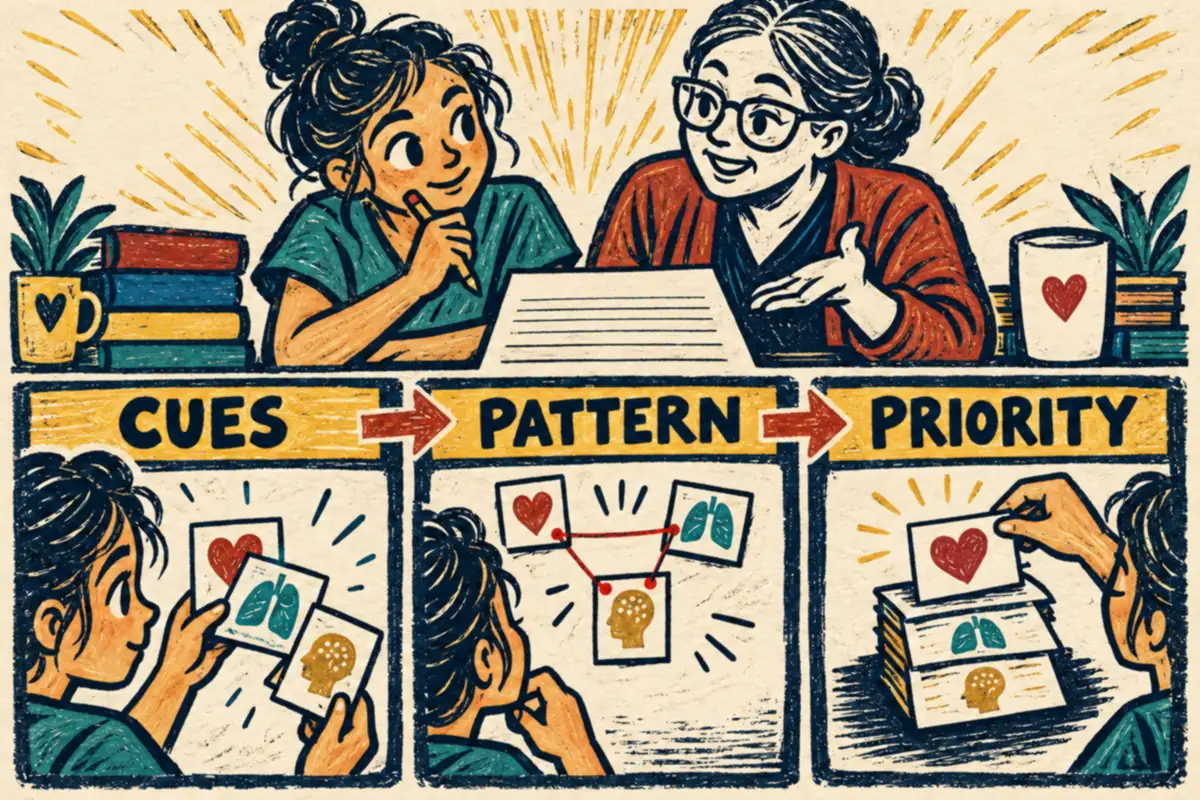
Start by selecting the details in the case that matter. That is cue recognition. During analysis, link those details to the presentation and explain what the pattern could fit. Analysis stops short of ranking it. Prioritizing hypotheses asks you to compare the possibilities the evidence supports, then rank them using urgency, likelihood, risk, difficulty, and time constraints.
A two-step explanation leaves one question unanswered. After you connect the clues, which supported concern should rank first, and why? A learner can spot a pattern correctly, then move it to the top without checking the prompt or comparing the other supported concerns. NCSBN describes judgment as iterative. Its current test plan names several criteria for prioritizing hypotheses. 2026 NCLEX-RN Test Plan (NCSBN) NCSBN Clinical Judgment Measurement Model
For this 2027 preparation edition, research checked October 13, 2026, against the 2026 NCLEX-RN Test Plan, effective April 2026. Check NCSBN again as your exam date approaches. 2026 NCLEX-RN Test Plan (NCSBN)
| Function | What you produce | A useful check |
|---|---|---|
| Recognize cues | Relevant information from the case | Can I point to the evidence as written? |
| Analyze cues | A connection between selected details and the presentation | Have I explained what the details may mean together? |
| Prioritize hypotheses | A reasoned ranking of possible concerns | Did I compare the options using the facts and stated criteria? |
Worked example: compare all four choices
The 2026 NCLEX-RN Test Plan includes a stand-alone question asking which client the nurse should assess first. The four choices describe diverticulitis with left lower-quadrant pain; COPD with hemoptysis; a client who became agitated eight hours after evacuation of a subdural hematoma; and a client whose affected leg is internally rotated eight hours after total knee replacement. NCSBN marks the third choice as the key. 2026 NCLEX-RN Test Plan sample item (NCSBN)
Before reading on, write down the details you noticed, what they may mean together, and why one option ranks first. Then check each of your notes against the item.
At Recognize Cues, keep each option's facts intact. The first pairs a diagnosis with a reported symptom. The second does the same. The third pairs a recent intracranial procedure with a new behavior change. The fourth pairs a recent joint replacement with an unusual position of the affected extremity. These are the printed details. No extra symptom or diagnosis belongs in your cue list.
At Analyze Cues, connect the details within each option. In choice 3, agitation follows a recent subdural hematoma evacuation. For study purposes, notice that this is a change in behavior after an intracranial procedure. That connection gives the cue more meaning than either detail alone, though the short item supplies no full assessment or trend.
At Prioritize Hypotheses, compare the options without treating the other three as harmless. Hemoptysis in choice 2 is a finding a candidate should take seriously, and the sample gives no amount or accompanying vital signs. Choices 1 and 4 also lack the extra context a complete clinical comparison would need. Choice 3 combines a recent intracranial procedure with a stated change in behavior, a pairing that supports prompt attention in this test question. NCSBN's answer key confirms choice 3. The brief sample does not explain why each alternative ranks lower, so keep your reasoning within those limits. 2026 NCLEX-RN Test Plan (NCSBN) 2026 NCLEX-RN Test Plan sample item (NCSBN)
NCSBN prints the key, not a detailed rationale. This is an independent test-prep explanation of the options, not an official rationale or advice for real client care. For longer practice, use the official sample pack. Official NCLEX preparation and sample materials
Read the prompt before the screen layout
Before reading the answer choices, pause at the verb in the prompt. Is it asking you to identify information, connect information, or rank a possible concern? A recognition response names chart details. An analysis response explains a connection among them. For prioritization, compare the supported concerns and explain your ranking.
The wording may leave the step unnamed. Read the full question and the case context. NCSBN materials define the clinical judgment functions, but they do not establish a guaranteed one-to-one mapping between each function and a particular screen layout or item format. Follow the thinking the prompt requests. Item layout alone cannot tell you what to conclude. Official NCLEX preparation and sample materials
Three common slips, and a repair for each
If you diagnose while selecting cues, go back and separate what the record says from what you think it may mean. Label them separately in your scratch work. Evidence first. Interpretation later.
Analysis needs the link between findings. Ask what changes when those pieces are considered together, and whether any detail supports or weakens a possible explanation. An NCSBN-authored methods paper describes cue analysis as organizing and linking related information, then developing hypotheses and appraisals. It describes evaluating and ranking those possibilities as a later function. The current 2026 test plan remains the source for today's exam definitions. Building a Method for Writing Clinical Judgment Items for Entry-Level Nursing Exams (NCSBN authors; Journal of Applied Testing Technology) 2026 NCLEX-RN Test Plan (NCSBN)
If you jump to an action while ranking hypotheses, stop at the task the question asks. Generating solutions and taking action are separate functions in the model. Finish the requested reasoning before moving on. That pause keeps a plausible intervention from hiding an assumption the case never supported.
A compact study routine
When reviewing a practice case, make three columns. Label them "Evidence," "Possible connection," and "Priority with reason." Keep the first column factual, then let the case details earn each conclusion. Use tentative language in the second. In the third, compare rather than simply repeat the most dramatic detail.
After checking the rationale, mark the exact boundary where your thinking moved too early or stopped too soon. If you selected the right evidence but missed the interpretation, more memorization may not solve the problem. Practice connecting trends and context. If your analysis was reasonable but your ranking was weak, compare the options using the criteria named in the official plan. 2026 NCLEX-RN Test Plan (NCSBN)
Then revisit a different case later instead of copying the same answer pattern. Practice the mental move across changing cases. The official NCLEX-RN study hub is a useful next stop for broader NCLEX-RN preparation and related study resources.
This independent article supports NCLEX test preparation by analyzing an official sample item. It is not clinical advice and is not affiliated with or endorsed by NCSBN.

Related to This Article
More math articles
- Classifying Quadrilaterals for 4th Grade
- Long Division using 1 Number
- The Best Grade 5 Math Book for Alaska Students
- Oklahoma OSTP Grade 6 Math Free Worksheets: 72 Free PDF Worksheets Aligned to OAS Math Standards
- 10 Most Common 5th Grade MCAS Math Questions
- Maintenance, Alarms, Feed Lines, Drains, and Outlets
- The Best Grade 8 ELA Practice Tests for Nevada Students
- 7th Grade PACE Math Worksheets: FREE & Printable
- Kindergarten Math Guide for Parents: What Your Child Should Know by June 2026
- 4th Grade NHSAS Math Worksheets: FREE & Printable








What people say about "NCLEX-RN Recognize Cues vs Analyze Cues: Where Priority Starts (2027 Prep) - Effortless Math"?
No one replied yet.