NCLEX SATA Partial Credit: How Plus/Minus Scoring Works (2027 Prep)
The short answer
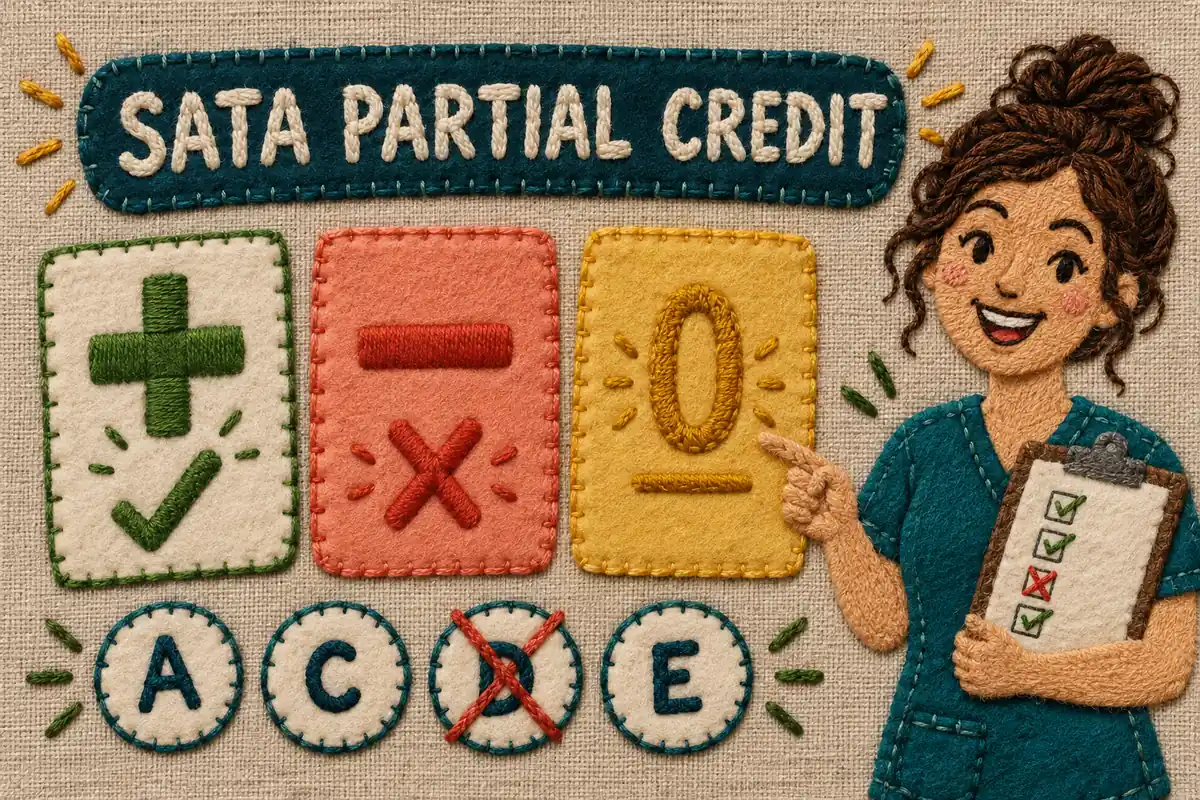
NCSBN's current NCSBN on SATA scoring says traditional select-all-that-apply (SATA) items use plus/minus scoring. Correct selections add points, incorrect ones subtract, and an item cannot score below zero. A partly correct response can still earn credit. An unsupported extra choice can erase some of it.
Old all-or-nothing advice? Set it aside. The July 2026 NCSBN on SATA scoring update says traditional SATA items previously earned either all-correct or all-incorrect scores. Older prep pages can miss the change.
Start with the rule, then check the response instruction
The 2026 Test Plan names three partial-credit methods: plus/minus, zero/one, and rationale scoring 2026 NCLEX-RN Test Plan. Start by checking how many options the prompt permits. Rationale items score a cause-and-reason pair together. Use the table, then follow the SATA example NCSBN scoring FAQ.
| Scoring method | What the item asks | Worked score |
|---|---|---|
| Plus/minus | Select an unspecified number | Key A, C, E; response A, C, D: 2 correct – 1 incorrect = 1 point |
| Zero/one | Select a specified number | Two correct targets; response has 1 correct and 1 incorrect: 1 point |
| Rationale | Answer a linked pair | One pair has a correct cause and incorrect reason: 0 points |
A worked plus/minus example
Use this made-up, six-option SATA key: A, C, and E are correct. This is a teaching example, not an NCLEX item.
Select A and C only, and you earn 2 out of 3 points. Add D and your two correct picks minus one incorrect pick leave 1 point. Select A, B, C, D, and E, and the three correct picks minus two wrong ones also leave 1. More boxes did not help.
If subtraction passes the zero floor, record zero. A negative never carries into the next item, according to the NCSBN scoring FAQ.
How the other two methods change the math
Imagine a fictional item that says, "Choose two," and has two correct targets. A response with one correct and one incorrect target earns one point under zero/one scoring NCSBN scoring FAQ. The missed target adds nothing, yet it does not remove the point already earned.
Now picture two linked blanks, one for a cause and one for its reason. If the cause is right and the reason is wrong, the pair earns no point. Both parts have to fit NCSBN scoring FAQ.
Do not turn a practice percentage into a pass prediction
Your bank percentage reflects that practice set. It helps show what to review. It does not predict an NCLEX pass. As you answer, the NCLEX adaptive system updates an ability estimate against the passing standard, so a percentage from a separate practice bank cannot show your likely result on that exam 2026 NCLEX-RN Test Plan.
Your practice bank may use its own scoring labels. Keep that result in your study log, then check current NCSBN material for the exam rule.
A quick check before you answer
Read the instructions before choosing. "Select all that apply" leaves the number open, and the NCSBN scoring FAQ explains how traditional SATA earns points. "Choose two" sets a response count and fits zero/one. Linked fields may use rationale scoring. Screen appearance alone does not tell you the rule.
Then test each choice against the item. On plus/minus questions, a doubtful extra selection can cost a point. With zero/one, a wrong target earns nothing but does not erase a correct one. Keep the distinction nearby as you review.
For official NCLEX preparation links and a broader study sequence, visit the NCLEX-RN study hub.
Independent NCLEX-RN test-preparation article. Scoring statements are based on current NCSBN materials checked October 13, 2026. Examples are original teaching scenarios, not live NCLEX items. Confirm official guidance again before your exam.

Related to This Article
More math articles
- ISEE Upper Level Math Practice Test Questions
- 10 Most Common 4th Grade PSSA Math Questions
- How to Solve Permutations and Combinations? (+FREE Worksheet!)
- The Ultimate 6th Grade DCAS Course (+FREE Worksheets)
- Transitions Between Sections
- FREE 3rd Grade Common Core Math Practice Test
- Assimilation, Carlisle, and the Dawes Severalty Act
- 10 Most Common 6th Grade MEAP Math Questions
- The Best Grade 3 Math Book for Ohio Students
- Political Ideology and Social Policy















What people say about "NCLEX SATA Partial Credit: How Plus/Minus Scoring Works (2027 Prep) - Effortless Math"?
No one replied yet.