Ecclesia, Church, Denomination, Sect, and New Religious Movement
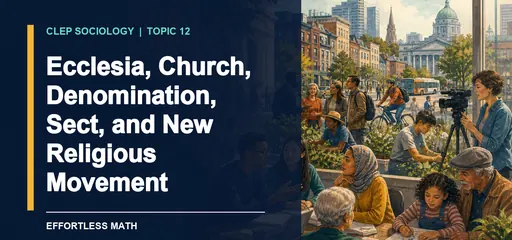
Chapter 12 of the CLEP Sociology study guide on Effortless Math covers Ecclesia, Church, Denomination, Sect, and New Religious Movement: the key terms, the core ideas, and worked examples showing how this topic is tested on the exam.

CLEP Sociology – Chapter 12
Ecclesia, Church, Denomination, Sect, and New Religious Movement
CLEP Introductory Sociology · Chapter 12
Religious organization types are ideal types. Real organizations can combine features or change over time. Size is not enough. State connection, claim to broad membership, voluntary participation, exclusivity, professional organization, and tension with the wider society provide stronger evidence.
An ecclesia is closely tied to the state and claims broad membership within the society. Citizenship and religious membership may overlap, and the organization may influence public law or ceremony. A large denomination without state connection is not an ecclesia merely because many people belong.
A church is a large, established, relatively inclusive religious body that accommodates the wider society and may claim broad legitimacy. In this sociological typology, the term is not a building and does not apply only to one religious tradition.
A denomination is an established organization that accepts religious pluralism, meaning a field in which multiple faith organizations are treated as legitimate, and operates alongside those groups. Membership is typically voluntary. This use differs from cultural pluralism among ethnic groups and political pluralism among interest groups. A denomination can be large, old, wealthy, and professionally organized without claiming the whole society.
A sect is usually more exclusive and in greater tension with the surrounding society. It may break from an established body, demand strict conduct, and emphasize a return to what members see as pure practice. A small congregation is not automatically a sect. Tension and exclusivity carry the classification.
A new religious movement, or NRM, is a relatively new faith organization or spiritual movement in a society. New describes social location and history, not truth, danger, or moral worth. The popular word “cult” often carries vague and stigmatizing assumptions, so a precise sociological category is preferable.
A strict breakaway group from an old tradition may be a sect rather than an NRM because its lineage is established even if the organization is new. An unfamiliar belief does not establish either category. Researchers examine origins, claims, membership demands, leadership, and social tension.
Organizations can move along the continuum. A sect can grow, reduce tension, train professional leaders, build offices, and become a denomination. A charismatic founder’s organization can create budgets, succession rules, and formal roles. Weber called that process the routinization of charisma.
Church and denomination can be close. A historically dominant organization that performs civic ceremonies and expects to represent the respectable community resembles the church ideal type. An established organization that openly accepts a field of other faiths and recruits voluntary members resembles a denomination. Formal state connection and a near-universal claim point more strongly to ecclesia.
Classification should describe organization without passing judgment on beliefs. It should also preserve context. A group can have tension with one government and acceptance in another. The question concerns a relationship at a stated time and place.
These categories are ideal types, so actual organizations can sit between them or change over time. A sect may grow, train professional clergy, lower entry demands, and become a denomination. A denomination may gain close state ties in one country while remaining one voluntary option in another. Classification therefore depends on the organization’s current relation to government, membership, other groups, and the surrounding society.
Size is a weak shortcut. A small congregation can be a denomination if it accepts religious pluralism and maintains ordinary ties with society. A large movement can retain sect-like exclusivity and high tension. New religious movement is also a historical label. It tells us that a tradition is relatively new in the setting, not that its beliefs are false, dangerous, or socially tense. Researchers should examine recruitment, leadership, membership demands, state recognition, and relations with outsiders. A sensational news story about one group cannot define the entire category.
When a CLEP stem names an official state faith with broad expected membership, ecclesia is the best fit. An established body accommodated to society suggests church. One accepted option among several suggests denomination. Strict membership and high tension suggest sect. Relative newness suggests NRM. The deciding relationship matters more than age, head count, or a reader’s familiarity with the beliefs.
Quick review: Ecclesia is tied to the state and claims broad membership. Church is established, broad, and accommodating. Denomination accepts a plural field. Sect has greater exclusivity and social tension. NRM describes relative newness, not truth or danger.
Watch the chapter connection
Religion: Crash Course Sociology #39 places ecclesia, churches, denominations, sects, and newer movements inside the broader sociology of religion. As you watch, compare each organization by its ties to the state, its membership boundary, and its relationship with the wider society.
Use this lesson for CLEP practice
Write one original example, one close nonexample, and one observation that would help you choose between them. This turns vocabulary recognition into the kind of applied reasoning the exam expects.

Related to This Article
More math articles
- TSI Math FREE Sample Practice Questions
- Percent Change Calculator (Increase, Decrease & Percent Error)
- The Ultimate ASTB Math Course (+FREE Worksheets & Tests)
- Campaign contributions
- Cramer’s Rule Calculator (2×2 and 3×3 Systems, Free)
- The Ultimate ISASP Algebra 1 Course (+FREE Worksheets)
- FTCE General Knowledge Math Formulas
- Homeostasis, Skeleton, and Muscles
- How to Multiply Rational Expressions? (+FREE Worksheet!)
- Tenements, Streetcar Suburbs, and Political Machines

















What people say about "Ecclesia, Church, Denomination, Sect | CLEP Sociology"?
No one replied yet.