CPA REG Simulations: Build a Tax Research Source Trail (2027 Prep)
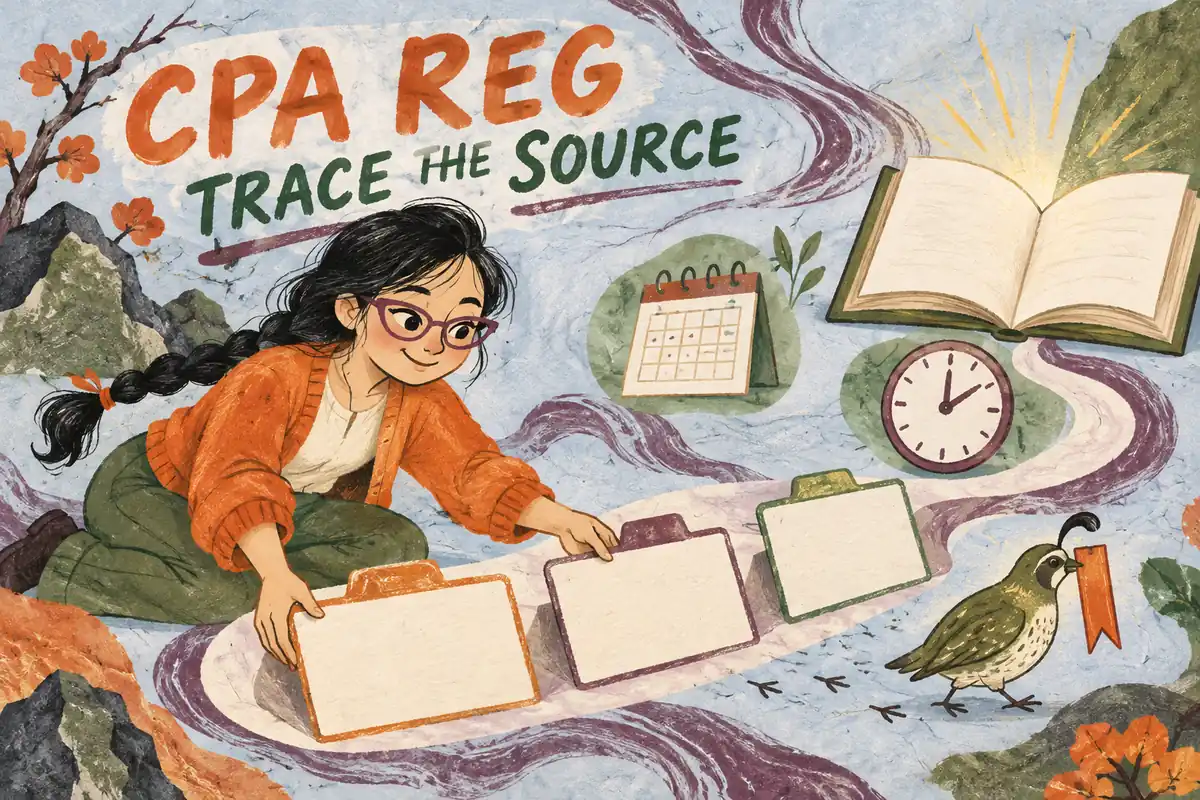
A useful tax-research trail connects a fact and tax year to an exact passage, identifies what kind of source supplied it and explains why that passage supports the claim. Save the reasoning beside the link.
For REG study, keep a separate field for the law eligible on your intended exam date. This guide follows four real public guidance pages and an invented calendar example, with a worked source-purpose log (CSV) you can check against each page. It teaches a research habit without reproducing a simulation or claiming to verify a future exam interface or task.
Start with the issue and the missing facts
Consider an original fictional note for Meadow Bicycle Repair: a payment occurred in 2026, but its purpose, recipient, amount and contractual terms are missing. A business name and a year cannot tell us what that payment bought.
The first entry in the trail should preserve those missing facts before anyone labels the payment deductible. It might need classification as an expense, an asset or something else, and that classification needs both evidence and applicable law. The example deliberately stops before a tax result.
Keep the tax year. It will help determine which version of a provision belongs in the later analysis, even while the transaction itself remains unresolved.
Use the source map to locate law, then record its role
The IRS guide to tax code, regulations and official guidance points to the Code in Title 26 of the United States Code, Treasury regulations in Title 26 of the Code of Federal Regulations and other official IRS guidance. Our log records that page as a route to sources, rather than a substantive deduction rule.
Check the displayed version. The IRS warns that online Code text may include changes effective after the year under review, or may lag a recent enactment. A current access date settles neither problem. Record the version information and applicability dates before using the text for an earlier transaction.
The log pairs each supported use with a limit, so locating the IRS source map leaves Meadow's tax treatment open.
Distinguish source families without a universal numbered ladder
Use the IRS primer on guidance types to identify the document you found. It distinguishes a revenue ruling, which applies the Service's interpretation to facts, from a revenue procedure addressing a procedure that affects rights or duties. Read the exact passage before asking it to carry a different kind of claim.
Source type matters.
The IRS explanation of guidance and FAQ reliance explains that published Bulletin rulings and procedures can serve as precedents, while lacking the force and effect of Treasury regulations. Later law and material factual differences can affect their application. Counting supportive links therefore cannot replace examining what each source says and whether its facts fit.
Court decisions also belong in research, with attention to the court, issue, procedural setting and jurisdiction. The categories here organize reading. They do not create a universal ladder that puts every ruling above every judicial decision or resolve a conflict between authorities.
Separate a helpful explanation from precedential support
An IRS FAQ can explain an issue or point you toward further reading, but the reliance page distinguishes non-Bulletin FAQs from precedent and says law controls liability when a FAQ is inaccurate. It also describes conditional penalty considerations for reasonable, good-faith reliance and certain Fact Sheet FAQs.
State the purpose. Understanding an explanation, supporting a tax treatment and evaluating possible penalty relief are different inquiries. Our source map establishes no return position or penalty relief for Meadow.
The primer's private-letter-ruling discussion supplies another boundary: a different taxpayer cannot use a PLR as precedent. We have read no actual PLR and make no claim that written determinations lack every possible relevance under separate authority or penalty standards.
| Source page | Supported use | Limit preserved |
|---|---|---|
| IRS source map | Locate Code, regulations and official guidance | Check version and tax-year applicability |
| IRS guidance primer | Identify guidance type and PLR precedent limit | No actual PLR or substantive tax result verified |
| IRS reliance explanation | Distinguish precedent from conditional reliance considerations | No taxpayer penalty relief determined |
| AICPA content policy | Check the applicable testing-timing category | No real amendment or future task alignment verified |
Give the tax year and the exam date separate columns
The AICPA exam-content and new-pronouncement policy ties eligibility for Code and federal taxation regulation changes to the calendar quarter beginning six months after the later effective or enactment date. That governs examination timing, rather than when a law applies to an actual taxpayer.
Take entirely invented inputs: an amendment enacted January 20, 2026, effective July 1, 2026. July 1 is later. Six calendar months after that date is January 1, 2027, already the first day of a quarter, so the bounded example points to the quarter beginning then. The original timing comparison (CSV) records the selection and calculation separately.
No real amendment is identified. Its transition rules, substantive effects and place in a tested task remain unverified.
The AICPA page gives different policies for other change categories, so applying the federal-tax calculation to accounting pronouncements, state-law developments or uniform acts would lose distinctions the page makes.
Write the trail so someone can check it
The blank tax-research trail (CSV) has fields for issue, supplied fact, tax year, citation, passage, source type, version, applicability and proposed inference. Verify before marking completion. Its separate exam-date and eligibility fields prevent a source citation from silently answering the wrong timing question.
Our worked log connects four public guidance pages to limited method claims, and a later reader can revisit each link to see what was used. If later evidence changes the analysis, record the conflict and reason for revision alongside the earlier conclusion.
The official page lists preparation editions effective in 2026 and 2027, but detailed future REG task alignment remains unverified. Use current authorized materials for your attempt. This trail helps organize evidence for study and does not complete a taxpayer analysis.
2027 preparation edition. Public informational HTML checked October 12, 2026. Meadow and the January 20/July 1 amendment dates are invented teaching material, not an actual taxpayer or statute. The January 1, 2027 result is a bounded calendar example under the cited AICPA federal-tax policy. No deduction, filing position, penalty relief, actual ruling, substantive amendment or future REG task alignment verified. No linked PDF, assessment or worksheet inspected.

Related to This Article
More math articles
- The Best Grade 6 ELA Practice Tests for Montana Students
- How to Represent Systems of Linear Equations Using Matrices?
- A Deep Dive into the Integral Test
- Full-Length 8th Grade Common Core Math Practice Test-Answers and Explanations
- Campaign contributions
- Wrenches, Sockets, and Pliers: Making the Right Match
- Twenty-Fourth Amendment
- Top 10 Tips to Overcome ASTB Math Anxiety
- How to Solve Simple Interest Problems? (+FREE Worksheet!)
- Why So Many Students Struggle with Math Anxiety and How to Deal with It
















What people say about "CPA REG Simulations: Build a Tax Research Source Trail (2027 Prep) - Effortless Math"?
No one replied yet.