CPA AUD Blueprint: Audit Your Study Plan (2027 Prep)

Start a CPA AUD study-plan audit by recording your intended testing date and the source that supports each proposed change to your notes. Keep the old version. A preparation-year label on a course page cannot tell you which blueprint, pronouncement policy or software announcement its lessons actually reflect.
The official exam-content page now lists blueprint editions effective January 1, 2026 and January 1, 2027, alongside a summary of changes for the latter edition. Check the effective label. We have not inspected those linked PDFs, so this article teaches a verification workflow without claiming a detailed comparison of their AUD tasks.
Our worked resource audit (CSV) demonstrates how to separate a public source label from an unverified lesson mapping, and the fictional eligibility calendar (CSV) explains a date calculation using entirely invented pronouncements. Both are original teaching records. Use the blank study-source record (CSV) to keep your resource version and the supporting passage together.
Identify the claim before changing a lesson
Suppose your course folder contains a risk-assessment lesson saved last spring and a bookmarked page headed with the coming preparation year. Record the actual file version.
Before replacing the lesson, identify the specific claim you need to check, such as whether its governing standard remains appropriate for your intended testing date. A heading alone cannot answer that question. Read the dated explanation. When the text discusses an earlier edition or expressly uses an earlier specification as its baseline, carry that limitation into your study record instead of treating the newer year in the heading as verification.
Your first entry can remain unresolved while you request a dated update note from the resource provider. Name the missing support. That gives you something concrete to investigate without discarding sound explanations merely because their filename looks old.
Keep the blueprint label separate from your mapping
For a planned February 2027 attempt, the official listing identifies the blueprint edition effective January 1, 2027 as the edition to check. Record that label.
It establishes which listed edition concerns that date, but the label does not establish what a particular AUD lesson covers or whether an individual task changed. The worked audit therefore has a source row for the official listing and a separate row for the old lesson's proposed mapping. Leave the mapping unverified. Our source record contains no invented task reference, page number or completed comparison, and it leaves your actual findings and review date blank.
Once you have appropriate current instruction and its supporting source, attach the actual passage to the lesson decision. Preserve the provider's version. A statement such as "lesson checked" offers no way to revisit the decision if the provider later corrects its explanation.
Calculate eligibility using calendar quarters
New accounting and auditing pronouncements have a separate testing-eligibility policy on the official exam-content page. Calculate both branches.
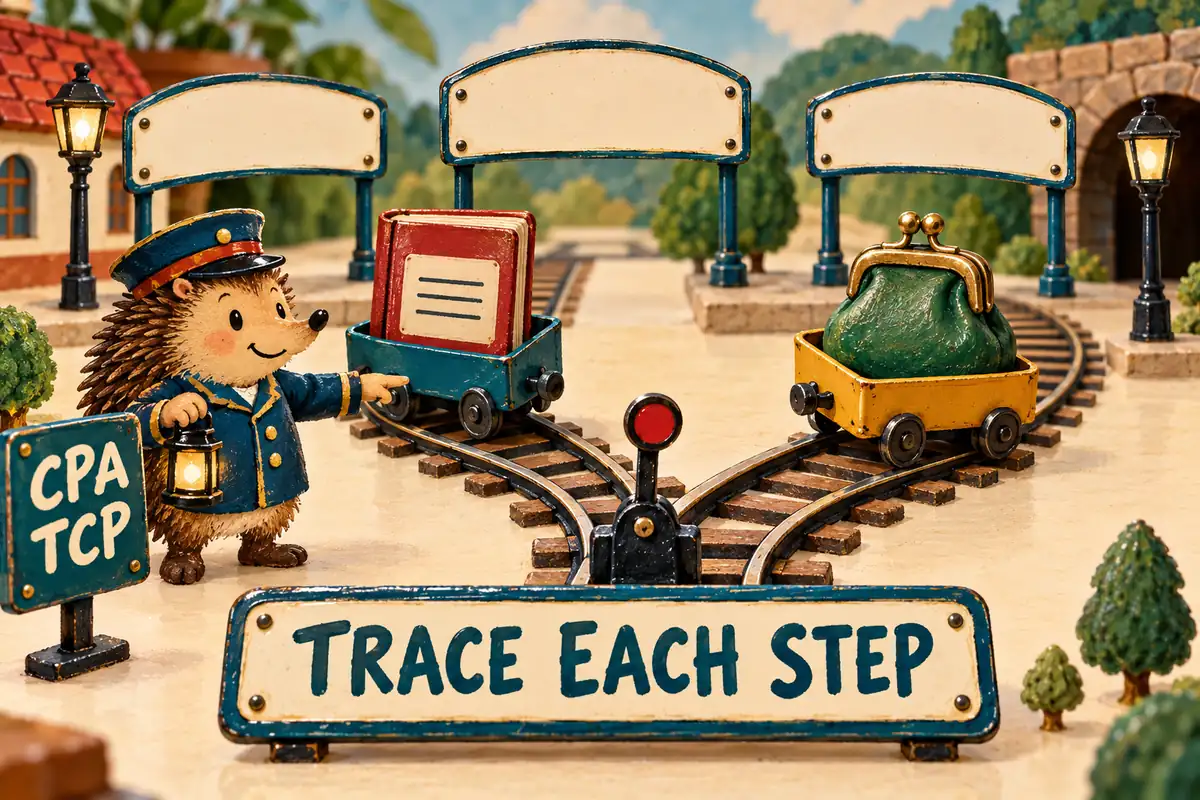
The policy uses the later of the first calendar quarter beginning after the earliest mandatory effective date, regardless of entity type, and the first calendar quarter beginning six months after issuance. The six-month anniversary is not automatically the eligible testing day. Locate the quarter boundary. These invented dates illustrate that calculation only, and they identify no real pronouncement, establish no AUD task coverage and offer no conclusion about a particular standard's inclusion.
For fictional Pronouncement A, issuance is May 20, 2026 and its earliest mandatory effective date is July 15, 2026. The mandatory-date branch reaches October 1. Six months after issuance is November 20, with the next calendar quarter beginning January 1, 2027, so the later branch produces January 1, 2027.
Our CSV retains each intermediate date. Read across the row. If you mistakenly write November 20 as the eligibility date, the quarter-start column shows exactly which step your calculation skipped.
Check the branch that controls the later date
Fictional Pronouncement B is issued January 10, 2026 and has an earliest mandatory effective date of February 15, 2027. Start with those supplied facts. Its six-month anniversary is July 10, 2026, followed by the October 1 quarter start, while the mandatory-date branch reaches April 1, 2027.
The later branch is April 1, 2027. Keep both branches visible. A plan that automatically adds six months to every issuance date would miss the controlling mandatory-date branch in this example, even after correctly finding October 1 for the other branch.
Real source dates still need verification. Do not substitute a company's voluntary adoption date for the earliest mandatory effective date in this policy, or assume that performing this calendar calculation identifies the precise task wording in a blueprint you have not checked.
Both fictional rows are marked scope unverified, with actual source passages, results and review dates empty. Preserve those distinctions in your own record. The arithmetic illustrates the policy's timing structure and does not certify a real standard's testability.
| Invented record | Quarter after mandatory date | Later eligible date |
|---|---|---|
| Pronouncement A | October 1, 2026 | January 1, 2027 |
| Pronouncement B | April 1, 2027 | April 1, 2027 |
Add the interface transition as a separate planning note
AICPA's official interface-transition announcement describes a move to a new delivery platform beginning in July 2027. Its dates are targets. The current announcement identifies a testing pause targeted for July 1 through July 11 and a resumption targeted for July 12, with score-release adjustments for twelve months following launch.
For a planned summer attempt, record that announcement separately and check its current status before booking. Keep the target wording. A planned software pause cannot establish that an AUD content topic changed, and January's blueprint label does not guarantee July's testing availability or your score-release date.
The article also says that more information is forthcoming. Leave unknown details open. Our audit gives the transition its own source row, while your actual appointment, applicable delivery arrangements and score-release date remain matters to confirm through current official information.
Turn an unresolved row into a useful study action
When you return to the spring risk-assessment lesson, read its actual update note and ask for the source behind any proposed replacement. Record the passage beside the decision.
If you still cannot support the mapping, retain the uncertainty and seek clarification through your authorized course rather than guessing which content to remove. Keep a separate note for a software announcement and a separate calculation for a new pronouncement's timing. They answer different questions. Your next study session can then address the unsupported lesson claim without treating every dated announcement as a reason to rewrite the entire plan.
The completed record should identify what you checked, which resource version you used and what remains unresolved. Add your actual review date. Revisit the official listing and relevant announcements near your intended attempt, since this preparation edition cannot verify future revisions or replace a current AUD source comparison.
2027 preparation edition. Public informational HTML checked October 12, 2026. No linked blueprint PDF, worksheet, sample or assessment content inspected. No detailed AUD task crosswalk or real pronouncement eligibility certified. All example dates and resource records are original illustrations. Source mappings, actual findings and professional approval remain unverified. July transition dates are current targets, subject to official updates. Qualified CPA review, matching AUD hub and current-source/live checks required before publication.

Related to This Article
More math articles
- Weight Measurement for 4th Grade
- How to Find Magnitude of Vectors?
- The Best Grade 3 Math Book for New Hampshire Students
- Free Grade 3 English Worksheets for Mississippi Students
- 3rd Grade NYSE Math Practice Test Questions
- Best Cybersecurity Policy Degrees to Consider
- Reusable vs. Disposable Items and Waste Handling
- How to Prepare for the SSAT Middle-Level Math Test?
- Top 10 Tips You MUST Know to Retake the CBEST Math
- Free Grade 3 English Worksheets for Delaware Students

















What people say about "CPA AUD Blueprint: Audit Your Study Plan (2027 Prep) - Effortless Math"?
No one replied yet.