NREMT AEMT Study Plan: Use the Current Domains and Your Error Log (2027 Prep)
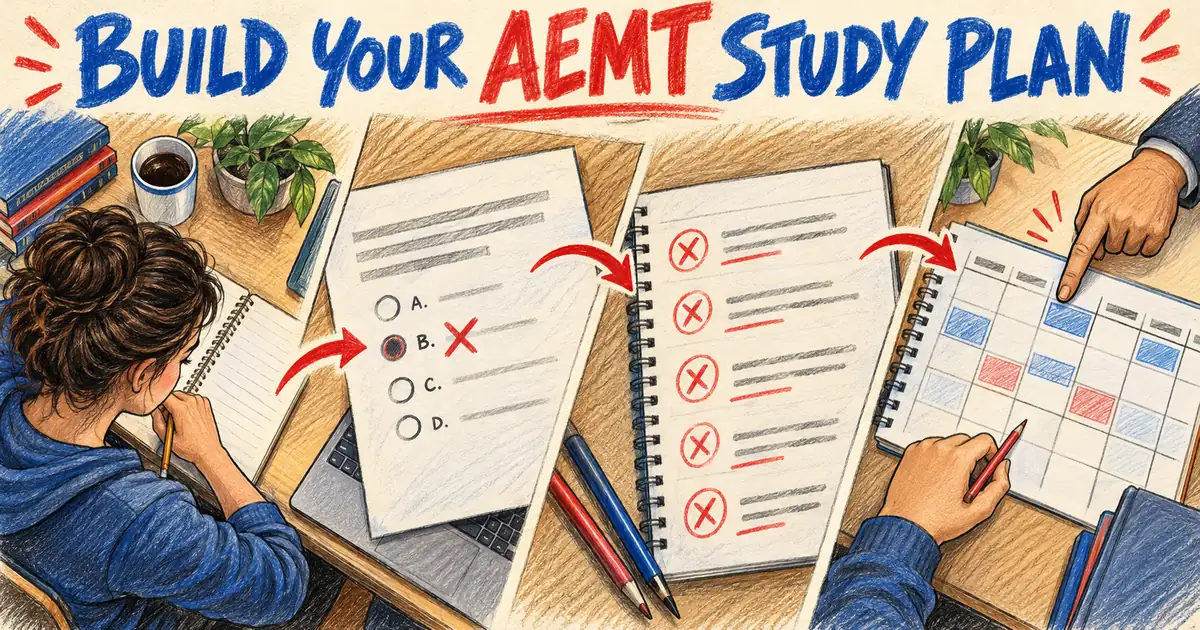
Start with the current test plan. Let missed questions guide your next session. Use all six domains. A practice score cannot predict your official result. Current format: 135 items in three hours. Some pages still call it adaptive. Check the source date first.
Use the four-week map below as a flexible example. If your exam is sooner, combine sessions. If you have more time, repeat the review cycle. Baseline first. Repair one gap. Retrieve it later. Mix topics next.
The current AEMT exam at a glance
135 items, 3 hours
The plan confirms 135 items in three hours.
35 pilot items
Thirty-five items are unscored pilots. The exam does not mark them. Answer every item.
Linear navigation
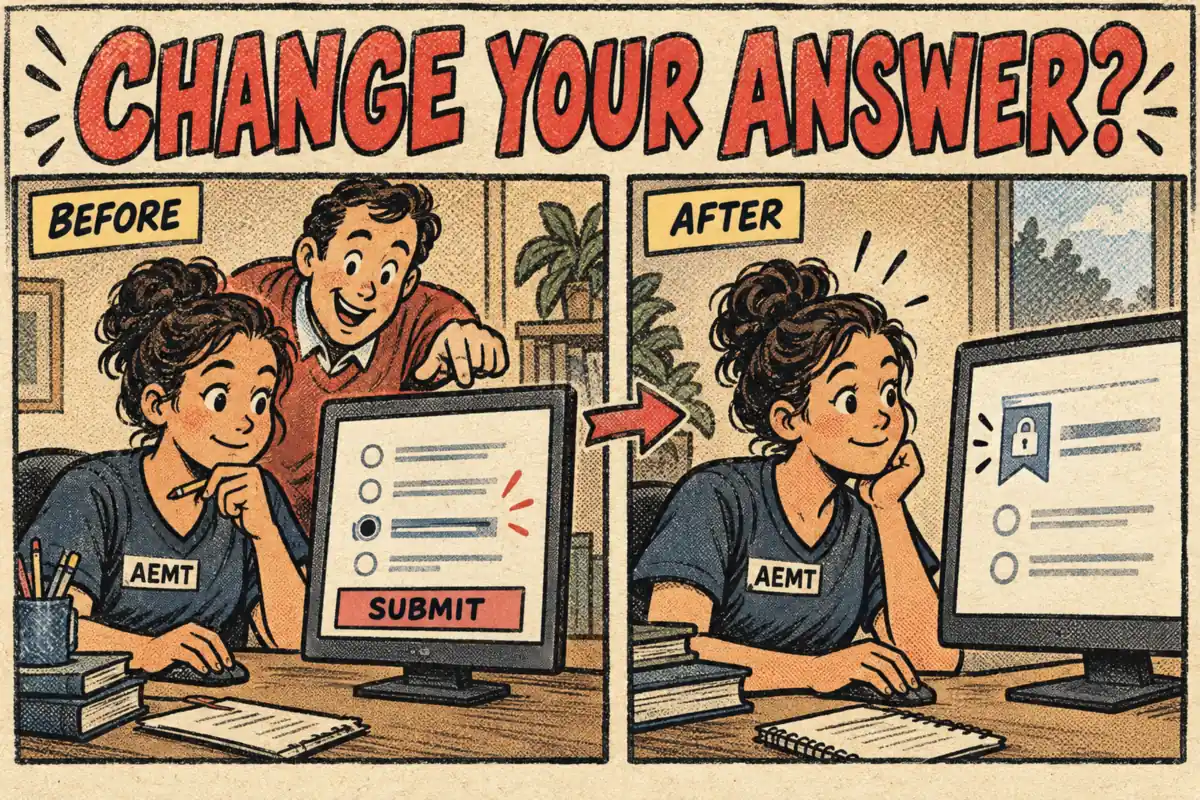
You may change the current response before advancing. After submission, you cannot return to that item. A blank at time expiry is incorrect.
Several item formats
Expect multiple choice, multiple response, Build List, Drag-and-Drop, Options Box, graphical items, and scenario-based items. Scoring is all-or-nothing.
Pass/fail standard
The handbook describes a pass/fail decision based on entry-level competence, with the same standard for all candidates. A practice-app percentage is not the official result.
Those details come from the National Registry AEMT Test Plan, which is linked from the Registry’s AEMT and Paramedic examination page. The AEMT Candidate Handbook repeats the 135-item format. Recheck NREMT pages before test day. Exam details can change.
Check your eligibility and appointment dates
If you are setting a test date, check the Authorization to Test (ATT) in your National Registry account first. The Candidate Handbook says the ATT is posted after the application, payment, and program-director eligibility verification are complete. Processing is typically one to two business days, though it can take longer. The ATT is valid for up to 90 days, so use its actual deadline when you plan your final review.
You schedule through your Registry account and continue to Pearson. Keep the appointment confirmation email. The handbook says an exam is not successfully scheduled until that confirmation arrives. On test day, the examination tutorial has a ten-minute limit before the three-hour exam begins. Read the current AEMT Candidate Handbook for the latest appointment and check-in steps.
Know the six AEMT domains
The official plan assigns approximate ranges to six domains. Use the ranges to keep your study map honest. They are not a promise about the exact mix on your individual form, and the ranges do not add up to a study-hour formula by themselves.
Airway, Respiration & Ventilation
9-13%
Organize review around assessment, pathophysiology, and management. Pediatric items appear throughout the exam.
Cardiology & Resuscitation
11-15%
Revisit all three in your current AEMT materials. Name the missed cue or reasoning step.
Trauma
7-11%
Sort errors into assessment, pathophysiology, or management. Stay with current course materials and scope.
Medical, Obstetrics & Gynecology
25-29%
This is the largest cognitive content domain. Split the outline into small units. Revisit missed ideas later.
EMS Operations
6-10%
The plan includes vehicles and equipment, leadership and professionalism, communication and documentation, medical/legal standards, and environment of care.
Clinical Judgment
31-35%
Practice the information cycle: recognize cues, analyze them, define a hypothesis, generate solutions, take action, and evaluate. Communication and leadership are sampled here too.
Clinical Judgment has its own weight. Use its cycle to examine cases in other domains. Track the content domain and reasoning error separately. Pediatric items are spread across the domains.
Build a four-week plan from your available study time
Pick a repeatable session length that fits your week. The schedule uses flexible study blocks. A block can be a short focused session on a work night or a longer weekend review. Do not treat the calendar as a readiness guarantee.
Week 1: Find the pattern
Take one mixed AEMT diagnostic set. Log the domain, format, and why each answer felt uncertain. Review Airway/Respiration/Ventilation and Cardiology/Resuscitation, then schedule one short return to each later in the week.
Week 2: Work the largest content area
Divide Medical/Obstetrics/Gynecology into course-sized topics. Close your notes. Explain the idea from memory. Reopen the source to correct gaps. Thread pediatric examples through those topics instead of saving them for one day.
Week 3: Mix content with judgment
Review Trauma and EMS Operations, then work new mixed cases. For each missed case, mark the first reasoning step that went off course: cue recognition, cue analysis, hypothesis, possible solutions, action, or evaluation. Return to earlier weak topics for a second retrieval attempt.
Week 4: Recheck and taper
Use timed mixed practice that fits the time you have. If your materials include a complete simulation, you may use one to rehearse concentration for a long session, but a practice result does not certify readiness. Spend the remaining blocks on unresolved error-log entries, current course sources, item instructions, and a calm test-day routine.
Move the weeks to fit your exam date. Keep every domain in rotation. Repeat work on recurring gaps. The official ranges help you see why a plan made only from your strongest topics leaves blind spots.
Use an error log that tells you what to do next
A raw percentage says how a set went. A useful log says what to review. Log every wrong or uncertain response. Download the editable AEMT error-log template as a spreadsheet:
- Date and source: Record when you practiced and which course text, class material, or question bank supplied the item.
- Content domain: Choose a cognitive domain or Clinical Judgment. Add a pediatric tag when it fits.
- Item format: Note multiple choice, multiple response, Build List, Drag-and-Drop, Options Box, graphical, or scenario-based, when you can identify it.
- Miss type: Mark a content gap, missed cue, reasoning step, scope or sequence concern, instruction-reading error, or rushed choice.
- Evidence: Name the missed prompt detail. Keep it brief.
- Correction and source: State the correction. Name your current source.
- Return date: Revisit the concept after a gap. Try to retrieve it before rereading the explanation.
Example: a learner chooses too early and misses a detail in the prompt. The log records the relevant domain, labels the miss as cue recognition, names the overlooked detail, and sets a later retry. Practice spotting it in a new case. Copying the answer will not fix that habit.
Repeat misses earn another block. When you retrieve the idea correctly on a later day and can explain why, keep it in occasional mixed review. One strong set cannot set the passing mark. Only the Registry’s approved standard determines your result.
Make each study session do two jobs
Use this five-step study loop:
- Retrieve: Close the notes. Recall the topic aloud.
- Check: Compare your explanation with your current course source. Repair one gap at a time.
- Apply: Use a fresh question. Follow its instructions.
- Log: Classify errors by domain and miss type. Then write one clear next action.
- Return: Revisit older log entries in a later session. Retrieval practice has support in health-professions education research, though studies differ and it does not guarantee an exam outcome.
Let evidence set your next block. Fact miss? Read, close, retrieve later. If you knew the fact but missed the question’s key cue, practice slowing down enough to locate the cue. Format miss? Rehearse its directions. These are different problems and deserve different repairs.
What to avoid when you plan
- Check the plan before using an adaptive-exam strategy. The current AEMT Test Plan says fixed-length linear CBT. Change it before advancing. Submission locks the item.
- Domain ranges are not a passing formula. They describe approximate exam distribution. They reveal no personal correct-answer target.
- Do not spend every block on the largest domains. The smaller ranges still count. Keep Trauma and EMS Operations in your rotation.
- Practice scores do not authorize clinical care. Real care follows training, protocols, and scope.
- Choose current AEMT resources, not EMT-only review. Check the level and plan date.
Browse the NREMT AEMT preparation hub for level-specific practice. Follow your instructor and current course materials for clinical content, and use the National Registry sources above for exam format and official domain guidance.
Sources and scope
This guide covers the exam. It does not replace clinical protocols or official NREMT materials. The domain names, ranges, item counts, timing, pilot-item count, formats, and linear navigation description come from the AEMT Test Plan and the AEMT Candidate Handbook. A 2024 systematic review by Trumble et al. found benefits from retrieval practice in many health-professions studies. Study designs and outcomes differed, so treat that as support for a study method, not a promise of an AEMT score. Treat this calendar as a sample. Adapt it to your course and exam date.
Independent study resource. Effortless Math is not affiliated with or endorsed by NREMT.

Related to This Article
More math articles
- Line Segments: Definition, Measurement, Midpoints & Practice
- Track surplus before judging a pricing system
- Lenses and Optical Instruments
- Top 10 Tips to Overcome PSAT Math Anxiety
- How to Solve Point-Slope Form of Equations?
- The Grocery Store Challenge: How to Use Unit Rates to Solve Word Problems
- Materials Chemistry: Compare Structure and Properties
- What Kind of Math Is on the TABE Test?
- 5th Grade PACE Math Worksheets: FREE & Printable
- How to Interpret Histogram? (+FREE Worksheet!)





















What people say about "NREMT AEMT Study Plan: Use the Current Domains and Your Error Log (2027 Prep) - Effortless Math"?
No one replied yet.