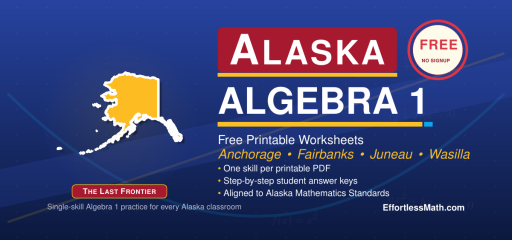
Alaska Algebra 1 Free Worksheets: Standards-Aligned Algebra 1 Practice PDFs, No Signup
There is a quiet moment near the start of Algebra 1 when a student realizes that the rules of arithmetic still apply, but the questions have changed. You’re no longer asked “what is 12 minus 5?” You’re asked “what value of x makes 12 minus x equal to 5?” The answer is the same, but the thinking is reversed. Algebra is arithmetic run backward. Once a student feels that flip, once they trust that solving an equation is just undoing what was done to the variable, the whole course starts to make sense.
Alaska teenagers come to Algebra 1 from very different places. A student in Anchorage may be in a large urban classroom with a structured pacing guide. A student in Fairbanks might be working through a course online during the long winter months. A student in Juneau could be balancing math homework with a part-time job, and a student in Wasilla might be on a school schedule that shifts with the season. The math is the same in every one of those settings. What changes is the time and space available to practice it, and that’s exactly what these worksheets are designed to fit into.
Seventy-two free PDFs, one skill per page, made to be printed and worked on a kitchen counter or a desk or a clipboard in the back of a truck. Each one is short, focused, and self-contained.
Pre-Algebra for Beginners 2026 The Ultimate Step by Step Guide to Preparing for the Pre-Algebra Test
What’s on this page
The Alaska Algebra 1 standards cover the same scope you’d see in any Common Core-aligned course: expressions and properties, linear equations from one step all the way up to variables on both sides and literal equations, inequalities and absolute value, functions and sequences, slope and lines, systems of equations and inequalities, polynomials and special products, factoring trinomials, three different methods for solving quadratics, plus statistics, probability, and exponential models. It’s a year of real ground to cover. These worksheets split that ground into 72 manageable pieces.
Each PDF starts with a one-page Quick Review: the skill explained clearly, a single worked example carried through every step, and a callout on the most common slip-up. Then 12 practice problems building from easy to hard, then a student-facing answer key written in plain, friendly language, the kind of explanation that lets a student catch their own mistake instead of being told what went wrong. There’s no account to make and nothing to sign up for.
Foundations of Algebra
Foundations come first, writing and evaluating expressions, honoring the order of operations, and stretching the ideas into everyday money math. For Alaska students, fluency here shows up directly on the Alaska Algebra 1 course.
- Variables, Expressions, and Properties
- Order of Operations and Evaluating Expressions
- Simplifying Algebraic Expressions
- Introduction to Equations and Solutions
- Personal Financial Literacy
Solving Linear Equations
Solving linear equations takes center stage, progressing from quick solves to multi-step reasoning and formula rearrangement. Getting comfortable here pays off all the way through the Alaska Algebra 1 course.
- Solving One-Step Equations
- Solving Two-Step Equations
- Solving Multi-Step Equations
- Equations with Variables on Both Sides
- Literal Equations and Formulas
Inequalities and Absolute Value
Inequalities behave like equations but answer with a range, and absolute value adds the idea of distance from zero. Time spent here is time saved when the Alaska Algebra 1 course rolls around.
- Solving One-Step Inequalities
- Solving Multi-Step Inequalities
- Compound Inequalities
- Absolute Value Equations
Relations, Functions, and Sequences
Students formalize relations and functions, read domain and range, and meet arithmetic and geometric sequences. Across Alaska, this is one of the skills that rewards regular reps.
- Relations and Functions
- Function Notation and Evaluating Functions
- Domain and Range
- Graphing Functions and Transformations
- Arithmetic Sequences as Linear Functions
- Geometric Sequences
- Comparing Functions
- Piecewise Functions
- Combining Functions
- Inverse Functions
Linear Functions and Their Graphs
Students graph and write linear functions, connect slope to rate of change, and explore direct and inverse variation. It is worth the extra reps for Alaska learners aiming for a strong score on the Alaska Algebra 1 course.
- Slope and Rate of Change
- Slope-Intercept Form
- Point-Slope Form
- Standard Form of a Linear Equation
- Writing Linear Equations from Graphs and Tables
- Parallel and Perpendicular Lines
- Inverse Variation
- Understanding Graphs as Solution Sets
Systems of Equations and Inequalities
Systems of equations, and inequalities, anchor this unit, with three solution methods and applied problems. Anchorage families can use these pages to lock the skill in before it’s tested.
- Solving Systems by Graphing
- Solving Systems by Substitution
- Solving Systems by Elimination
- Applications of Systems of Equations
- Systems of Linear Inequalities
- Solving Linear-Quadratic Systems
Exponents, Polynomials, and Real Numbers
Exponent laws and polynomial work drive the unit, with special products and the real-number system rounding it out. In Anchorage classrooms it tends to separate confident students from hesitant ones.
- Properties of Exponents
- Adding and Subtracting Polynomials
- Multiplying Polynomials
- Special Products of Polynomials
- Rational and Irrational Numbers
Factoring
Factoring runs multiplication in reverse, pulling out common factors, factoring trinomials, and spotting special patterns. Steady practice now makes the Alaska Algebra 1 course feel far more manageable later.
- Greatest Common Factor and GCF Factoring
- Factoring Trinomials: \(x^2 + bx + c\)
- Factoring Trinomials: \(ax^2 + bx + c\)
- Factoring Special Products
Quadratic Functions and Equations
Students explore quadratic functions and solve them several ways, with the discriminant predicting the number of solutions. Master it early and the rest of the Alaska course leans on it with ease.
- Graphing Quadratic Functions
- Characteristics of Quadratic Functions
- Solving Quadratics by Factoring
- Solving Quadratics by Completing the Square
- Solving Quadratics by Square Roots
- The Discriminant
- The Quadratic Formula
- Quadratic Applications and Modeling
Statistics and Probability
The chapter turns to data and chance, measures of center and spread, graphical displays, and counting and probability. It’s a frequent early hurdle for learners in Anchorage and across the state.
- Measures of Center and Spread
- Scatter Plots and Correlation
- Lines of Best Fit and Predictions
- Counting Principles
- Probability
- Two-Way Frequency Tables
Exponential Functions and Modeling
Exponential functions round out the course, modeling rapid growth or decay and contrasting model types. These worksheets give Alaska students focused, low-pressure practice.
- Graphing Exponential Functions
- Comparing Linear, Quadratic, and Exponential Models
- Exponential Growth
- Interpreting Functions and Parameters
More Topics
- Absolute Value Inequalities
- Direct Variation
- Displaying Data with Box Plots
- Displaying Data with Histograms
- Exponential Decay
- Graphing Cube Root Functions
- Graphing Square Root Functions
How to use these worksheets at home
The biggest mistake parents and students make with Algebra 1 is treating each skill as a separate island. The course is built on chains. Translating a verbal expression feeds into evaluating expressions, which feeds into solving one-step equations, which feeds into two-step, which feeds into multi-step. The graph of a line is the visual version of slope-intercept form, which is the visual version of a function. So when your student picks a worksheet, pick the next one with intention. After “Solving Two-Step Equations,” try “Solving Multi-Step Equations” the same week. After “Slope and Rate of Change,” do “Slope-Intercept Form.” After “Factoring Trinomials,” go straight into “Solving Quadratics by Factoring.” Each pair is one idea stretched a little further.
Keep sessions short. A focused twenty minutes once or twice a week beats a tired hour on a Sunday night. Print the PDF in advance, set the answer key somewhere your student can reach when they’re stuck, and let them work alone for the first pass. Then go over the problems that didn’t come out right, not by re-explaining the whole skill, but by reading the answer-key walkthrough together. Most fifteen-year-olds would rather not have a parent narrate every step. They will, however, accept a parent who sits next to them, says nothing, and points out where the work went off the rails.
There’s also a long-game piece. Alaska classrooms often pause around test windows or fold into pre-college planning, and Algebra 1 is the foundation for everything that comes after, geometry, Algebra 2, precalculus, and any high school science course that uses formulas. Whatever sticks now saves time later. Even a single worksheet a week, kept up across the year, leaves a student in a different place by spring.
A note about Algebra 1 in Alaska
Alaska does not run a single statewide Algebra 1 end-of-course exam the way some states do, so the most important thing for an Alaska student is the course itself, the unit assessments, the semester finals, and whatever the local district uses to confirm Algebra 1 proficiency. The Alaska Algebra 1 standards are Common Core-aligned, which means they map almost one-for-one onto the topics in this worksheet set. If your student’s classroom is currently on functions, the function PDFs here will match. If they’re on quadratics, same story.
That alignment makes a focused, skill-by-skill approach unusually useful in Alaska. Because there isn’t one big test to teach to, the year is really a slow accumulation of standards mastered. Each worksheet is a small piece of evidence, for the student, the parent, and the teacher, that one specific idea has been understood. Stack enough of those, and the course takes care of itself.
A short closing
A school year is long, and a math course is long inside it. The trick is to make tonight’s practice small enough that it actually happens. Bookmark this page, print one PDF before bed, and let your Alaska ninth grader start there. From Anchorage to the edge of the Interior, the work that builds Algebra 1 looks the same: one skill, one sitting, one explanation read until it makes sense.
New to Algebra? Start with the basics


Related to This Article
More math articles
- Types of Angles (Acute, Right, Obtuse) for 4th Grade
- Campaign contributions
- 5th Grade ACT Aspire Math Practice Test Questions
- Grade 7 Math Flashcards (Free Online: Formulas, Terms & Concepts)
- Oscar’s Grind: Why a ‘Smart’ Progression Still Loses
- Institutions can reduce transaction costs
- Grade 4 Discussion and Simple Research Skills: Stronger Speaking, Listening, Notes, and Sources
- Comparing and Ordering Fractions for 4th Grade
- DAT Quantitative Reasoning Math Practice Test Questions
- Top 10 7th Grade Common Core Math Practice Questions











What people say about "Alaska Algebra 1: Free Worksheets"?
No one replied yet.